


"I never wanted to leave the country... I was forced to leave under a certain set of circumstances, and I only learnt the details much later." This is what former Bangladesh Prime Minister Sheikh Hasina told Kolkata-based news outlet The Wall in an interview uploaded in September 2026.
During the conversation, the ousted PM made several revelations about her departure from Dhaka. Among them was that she had wanted to take refuge in her hometown of Tungipara, in Gopalganj district, rather than flee to India."When the helicopter crossed the border, I was told we were coming here, to India.
Why should I have to stay in power by leaving bodies behind? In that situation, I said I did not need to stay; I would leave.
Where would I go? I said I would go to our village home in Tungipara.
It was only once I was on the aircraft that I realised I had come here, to India."This testimony assumes fresh significance nearly two years after Hasina was ousted from power and two months after The Wall interview was published. Hasina's promised return to Bangladesh increasingly appears to be a question of when rather than if.
Tensions are mounting across the country, and nowhere is this more evident than in Gopalganj where her ancestral home is located.In 2024, External Affairs Minister of India, S Jaisankar, had told the Parliament that Hasina made a request to come to India "at very short notice" prior to her arrival. Hasina's claims in the interview are most likely to establish the narrative that she didn't want to flee her country.
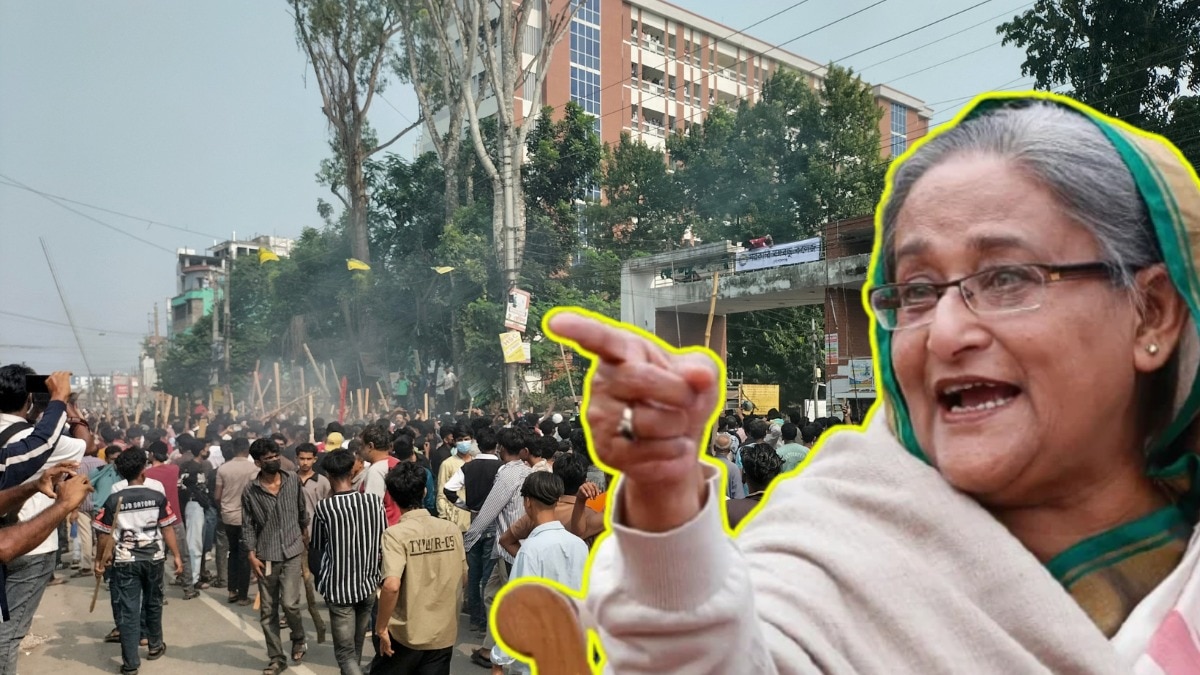
But why we are reminded of her interview is because of the reference to a place in Gopalganj. Over the weekend, hundreds of people, allegedly Awami League members repeatedly clashed with police personnel, took out processions armed with sticks, clubs, boat oars, and other sharp weapons, and set fire to homes and properties linked to the ruling Bangladesh Nationalist Party (BNP) in Gopalganj, Hasina's home district.The situation has reportedly featured in multiple high-level discussions in Dhaka, with the government led by Prime Minister Tarique Rahman said to be considering the use of force to contain the unrest, while also putting thousands of police personnel across the country under the scanner for alleged Awami League links.VIOLENCE IN GOPALGANJ ADDS TO TARIQUE RAHMAN'S WOES Sheikh Hasina was forced to seek safety in India in August 2024, after what started as a student-led movement against government job quotas snowballed into a general uprising against her Awami League government.Hasina has promised multiple times since August this year that she would return to Bangladesh by December, with her lawyers approaching Dhaka for a new passport and identification documents to facilitate her return.The unrest in Gopalganj comes at a critical juncture for Bangladesh's Tarique Rahman-led BNP government.
Since taking office following the February elections, the administration has found itself firefighting one crisis after another. Bangladesh has been grappling with an energy supply crunch, a growing measles outbreak, a struggling economy and nationwide protests by workers in its ready-made garment (RMG) industry.Authorities in Dhaka have taken stringent measures to curb Gopalganj unrest.
More than 1,000 police personnel and several platoons of the Border Guard Bangladesh (BGB), comprising around 150 personnel, have been mobilised in Gopalganj with armoured personnel carriers.According to local news reports, there is an heightened vigilance along the Jessore border to prevent the infiltration of Awami League leaders and activists, while the government has withdrawn the district's Deputy Commissioner and transferred its Superintendent of Police and the OCs of three police stations following the unrest.BNP LEADERS, PROPERTIES TARGETED IN GOPALGANJGopalgan district, where the town of Tungipara, Sheikh Hasina's hometown, has long been an Awami League bastion. Even during the rule of the Muhammad Yunus-led interim administration, when the party was forced to go underground pan-nation, the Awami League maintained a very visible presence in the district.For instance, in September 2024, a BNP-led motorcade was attacked by alleged Awami League activists in the district, leaving one person dead and around 50 injured.
Nearly a year later, in July 2025, Awami League and Chhatra League supporters attacked a rally organised by the National Citizen Party (NCP), triggering clashes that left four people dead and dozens injured.The district also benefited heavily during Hasina's tenure from 2009 to 2024.A 2019 study by the Bangladesh Institute of Planners (BIP), a national professional and non-governmental apex organisation, examined geographically allocated development expenditure between FY 2012–13 and FY 2016–17. It found that Gopalganj received 5.36% of the total allocation, making it the third-highest recipient among Bangladesh's 64 districts, after Dhaka and Chattogram.Now in 2026, with party matriarch Hasina stating that she would return to Bangladesh one way or the other in December, the alleged Awami League members have once again resurfaced in Gopalganj, this time with a vengeance.The violence in Gopalganj unfolded over the weekend, beginning with attacks on BNP-linked offices and properties in Tungipara on Saturday (November 14) evening.
According to Dhaka-based, The Daily Star newspaper, the BNP office at Nilfa Bazar was vandalised and set on fire, along with several nearby shops belonging to BNP supporters. The Jubo Dal office at Patgati bus stand was also ransacked.The situation escalated on Sunday (November 15), when hundreds of people converged on Gopalganj town from different parts of the district.
According to eyewitnesses cited by The Daily Star and BBC Bangla, many carried wooden poles, sharp weapons and oars, locally known as logi-boitha, as they marched through the town chanting slogans in support of Sheikh Hasina.The protesters breached police barricades, damaged a police armoured personnel carrier and a police box, vandalised the July Memorial and removed signboards at government institutions, replacing them with names associated with the Awami League. They also set tyres and other materials on fire at several locations, disrupting traffic.The violence subsequently spread to Tungipara, where BNP leaders alleged that Awami League activists and members of affiliated organisations attacked homes, offices and businesses belonging to their party colleagues.
Dhaka Tribune reported that the Jubo Dal office at Patgati Bazar was torched, while the homes of BNP municipal president Imdad Molla and other party leaders were vandalised and set on fire.DHAKA SENDS BGB TO GOPALGANJ, TRANSFERS SENIOR POLICE OFFICERSIn response to the escalating unrest in Gopalganj, Dhaka has stepped out security deployments, with the Daily Star reporting that around 1,350 police personnel and six platoons of the Border Guard Bangladesh (BGB), comprising approximately 150 personnel have been mobilised. The Business Standard separately reported that 10 BGB platoons with APC's have been deployed to the district.The Daily Star reported on Sunday that the BGB had stepped up vigilance along different points of the Jessore border to prevent illegal infiltration of Awami League leaders and activists.According to a Prothom Alo report on Monday, the government has withdrawn Gopalganj's Deputy Commissioner, Mohammad Arif-uz-Zaman, and transferred Superintendent of Police Mohammad Habibullah following the weekend's unrest.
The Business Standard reported that the officers-in-charge (OCs) of three police stations in the district have also been transferred.The newspaper, citing government sources, reported that two high-level meetings on the law-and-order situation were held over the preceding two days. The meetings reviewed the situation and discussed alleged lapses and lack of cooperation among some local administration and police officials, and weighed the use of force to disperse the demonstrators.Home Minister Salahuddin Ahmed told Prothom Alo that security forces were handling the situation patiently but would take action under the law if protesters crossed the line.
He added that the government would respond firmly if the Awami League created further disorder.Separately, BBC Bangla and Daily Times of Bangladesh reported on Monday that 22,000 police personnel, mostly constables and sub-inspectors were under the scanner for alleged links to the Awami League. This comes after a Chattogram-based police officer was slapped with a sedition case for maintaining contact with Awami League members.VIOLENCE IN DHAKA, GAZIPUR, SHARIATPUR TOOProthom Alo reported Information and Broadcasting Minister Andaliv Rahman Partha as saying on Monday that the Awami League's protests, arson and vandalism are nothing but the party's bankruptcy, and that it proves that they have no existence in Bangladesh except Gopalganj.The Daily Sun, meanwhile, reported BNP Acting Secretary General Ruhul Kabir Rizvi as saying on Monday that the people of Bangladesh would not allow the Awami League to return to power through enforced disappearances, killings and bloodshed.For Tarique Rahman's BNP-led administration, the unrest in Gopalganj could not have come at a worse time.
The country is already being buffeted by a persistent energy shortage, high prices, and a rising measles outbreak that has killed more than a thousand, mostly children. To make matters worse, its Ready-Made Garments sector, a vital part of the economy, has been almost paralysed, thanks to ongoing countrywide worker demonstrations demanding higher wages.But what happened over the weekend in Gopalganj is not unprecedented.
Last week, Dhaka, Gazipur, Shariatpur and other districts also experienced similar outbreaks of violence, mostly in the form of bomb blasts, clashes with police and arson attempts.The unrest across Bangladesh, particularly in Gopalganj, comes as Sheikh Hasina prepares for her promised return to the country. Her hometown and a longtime Awami League citadel, Gopalganj, is one of the few places where the banned party has managed to retain a visible presence, even as its activities have largely gone underground elsewhere.
For the Tarique Rahman administration, it's another addition to the long list of crises it has been firefighting this year.- Ends