


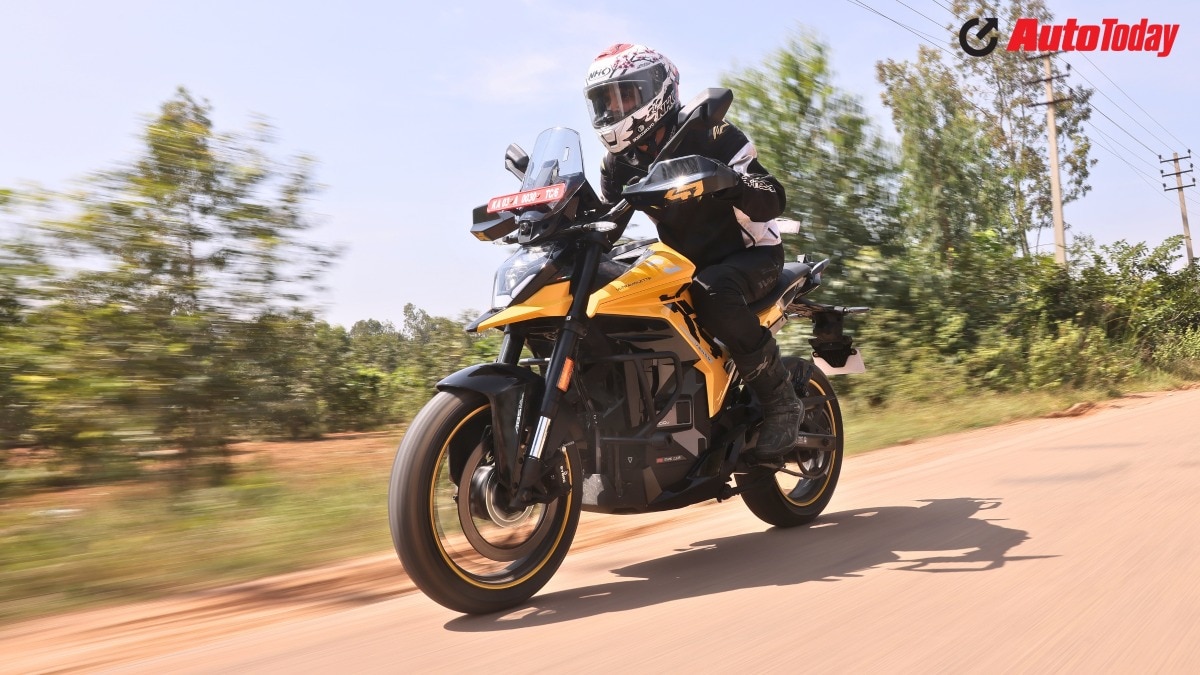
There’s something about electric motorcycles that makes manufacturers want to throw everything at them. More performance, more electronics, more features, and increasingly, more things to explore on a touchscreen.
The Ultraviolette X-47 Venom follows a similar philosophy, although its rather aggressive name suggests that riding it should be a lot more interesting than scrolling through its menus. Having spent time with it at the Velocity International Circuit near Bengaluru and on the surrounding roads, I reckon that’s where the motorcycle makes its strongest case.
The Ultraviolette X-47 Venom cuts an aggressive stance at the front, with sharp styling that gives it a bold road presence. For starters, the Venom isn’t short on performance.
Built on Ultraviolette’s VX-100 platform, it produces up to 40bhp and 90Nm of motor torque, with a claimed 550Nm delivered at the rear wheel. The latter is a wheel-torque figure rather than something directly comparable with the engine torque quoted for petrol motorcycles.
Ultraviolette claims it’ll reach 100kmph from a standstill in 5.9 seconds, with a top speed of 155kmph. Impressive numbers, certainly, but the more interesting bit is how effortlessly it delivers that performance.
The Venom tips the scales at 180kg with the 7.5kWh battery pack, while the larger 11kWh unit increases its weight to 195kg. There are three riding modes — Glide, Combat and Ballistic — and the last one is where the Venom really comes alive.
The throttle response is sharp, almost sudden, with plenty of shove available the moment you ask for it. It’s entertaining on the straights, but what caught my attention on track wasn’t necessarily how quickly it accelerated.
It was how easily it changed direction. Compared to the previous version, Ultraviolette has reduced the weight by 17kg and 13kg for the respective battery variants.
The Venom weighs 180kg with the 7.5kWh battery and 195kg with the larger 11kWh pack. Ultraviolette has managed to shave off 17kg and 13kg respectively compared to the previous version, and whatever they’ve done seems to have worked.
Flicking the motorcycle through consecutive corners felt surprisingly effortless, and once moving, the weight rarely made itself apparent. It was genuinely nimble, something I appreciated more with every lap.
The brakes, however, weren’t quite as impressive. Stopping performance felt adequate, but the ABS had a habit of intervening rather frequently under hard braking.
It’s not something that ruined the experience, although it did make me wish for a little more confidence when pushing harder. The Venom’s strong torque delivery was impressive, especially when accelerating to overtake.
Back on public roads, the Venom’s abundant torque was just as enjoyable, particularly when overtaking. There’s very little waiting involved; twist the throttle and the motorcycle responds almost immediately.
The suspension was generally pleasant too, especially at the rear, although it wasn’t particularly fond of sharper bumps. Hit one while firmly seated and the rear could deliver a noticeable kick through the saddle.
Lifting yourself slightly helped, but it’s a characteristic that could become tiresome on consistently broken roads. Regenerative braking proved to be one of the more practical features during the ride.
Interestingly, one of the more useful features turned out to be regenerative braking. With 10 adjustable levels, the system provides noticeable deceleration when you roll off the throttle, reducing how often you need to reach for the brakes.
Ultraviolette also says regen now works at battery charge levels as high as 99 per cent, compared to 90 per cent previously. It’s a good example of technology making a tangible difference to the riding experience.
The Venom is loaded with technology, including a 7-inch TFT, front and rear cameras, cruise control and a 77GHz rear radar, depending on the variant. And technology is something the Venom has plenty of.
Depending on the variant, there’s a 7-inch TFT display, front and rear cameras, cruise control and a 77GHz rear radar that can monitor traffic up to a claimed 200 metres behind the motorcycle. The radar supports features such as blind-spot alerts, lane-change assistance and rear-collision warnings.
It’s quite an extensive package for something with two wheels.Now, I genuinely enjoy a motorcycle with clever features, particularly when they make riding safer or more convenient. But electric motorcycles seem to be developing an almost insatiable appetite for technology.
Every new model brings another menu, another setting or another feature to configure. It’s fascinating, but I do sometimes wonder where it ends.
If you’re spending more time navigating menus than actually riding, haven’t we slightly missed the point?That’s not to say the Venom’s interface is unnecessarily complicated. Our relatively short ride wasn’t enough to assess its long-term usability, and some of its electronics, particularly the regenerative braking, proved genuinely useful.
It’s simply an interesting direction the industry is taking. Thankfully, the Venom has enough character on the move that its feature list doesn’t become the main attraction.
The two battery variants deliver claimed IDC ranges of 227km and 343km, respectively. As for practicality, the two battery options offer claimed IDC ranges of 227km and 343km, while charging provisions include a 1.6kW onboard charger and compatibility with DC fast charging at up to 12kW.
We didn’t conduct a dedicated range test, so how closely those figures translate to everyday riding remains to be seen.Verdict Despite its steep pricing and suspension and ABS niggles, the Venom impresses with thrilling acceleration, effective regeneration and excellent handling. With prices ranging from Rs 2.65 lakh to Rs 4.12 lakh (ex-showroom, Bengaluru), the Venom isn’t exactly inexpensive, especially in its higher configurations.
And while the occasional rear suspension kick and frequent ABS intervention leave room for improvement, there’s plenty to like here. The strong acceleration is entertaining, the regenerative braking works well, and the handling is genuinely impressive.What stayed with me after the ride wasn’t the enormous wheel-torque figure or the long list of electronics.
It was how willingly the Venom tipped into corners and how enjoyable it felt simply being ridden. For a motorcycle packed with so much technology, that’s a rather reassuring thing to come away with.Subscribe to Auto Today Magazine - Ends