


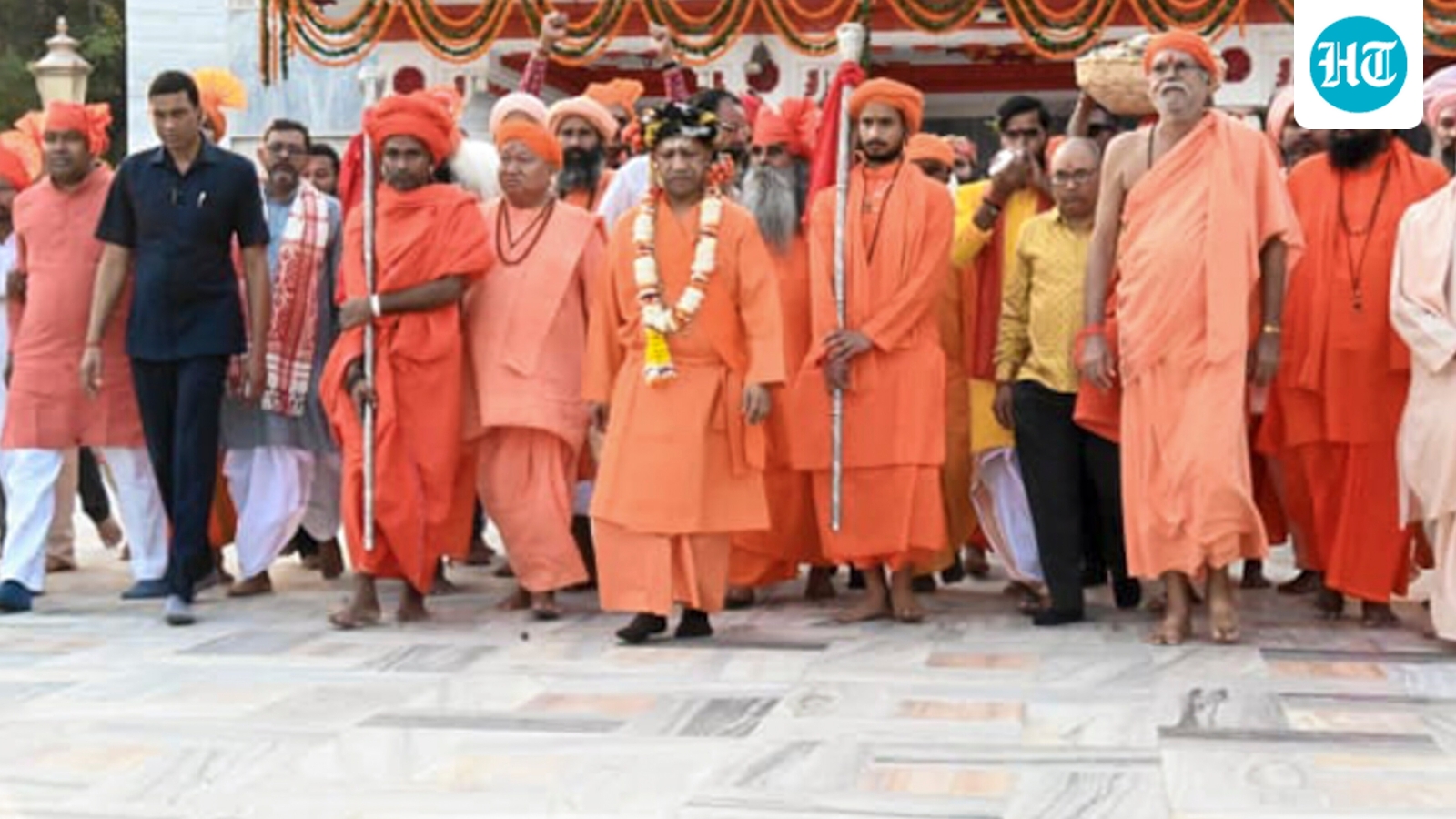
Following the Rajya Sabha elections in October 2026, Uttar Pradesh chief minister Yogi Adityanath reiterated his contentious “80 vs 20” slogan, which carries two interpretations.In this image received on Oct. 20, 2026, Uttar Pradesh Chief Minister Yogi Adityanath led the traditional Vijayadashami procession from Gorakhnath Temple during Vijaydashmi festival. (Handout via PTI Photo) (PTI/Handout Photo)Publicly, it is defined as 80% support for the National Democratic Alliance (NDA) and 20% for the INDIA bloc.
Politically, however, it is widely viewed as defining Uttar Pradesh’s (UP) demographic profile comprising roughly 80% Hindus and 20% Muslims.Thus, when Yogi raises the slogan “batoge toh katoge” (if you divide, you are ruined) it acquires a communal hue. Prime Minister Narendra Modi recast the phrase as “Saath rahoge, safe rahoge” (stay united, stay safe), emphasising the importance of Hindu unity under the Hindutva banner.Interestingly, the BJP, which had initially tried to win over the Muslim community, has apparently given up hope of gaining their support in the forthcoming UP assembly elections.
In the 2017 assembly polls, the NDA managed to secure less than one per cent support from Muslim women who appreciated the government's move against Triple Talaq.Despite the existence of the Muslim Morcha, whose national president Basit Ali hails from poll- bound UP, the BJP has no Muslim MLA, MP or minister in the state. The oft-repeated rationale is that the community must support the BJP to earn political representation.Nonetheless, Ali is attempting to convince the party leadership to field one Muslim candidate in the upcoming elections, as a symbolic gesture to blunt the public narrative about the BJP’s anti-Muslim politics.It’s clear that the BJP’s electoral calculus relies on securing a 45% victory margin primarily from an 80% non-Muslim vote base.
Its allies, like the Apna Dal (Sonelal), Rashtriya Lok Dal, the SBSP of Om Prakash Rajbhar and the Nishad Party of Sanjay Nishad, may manage negligible support from the community. As such, the party leadership makes no apparent effort to win their support.Paradoxically, the Samajwadi Party (SP), leading the opposition camp, is also navigating a similar strategy by relying heavily on its time-tested formula of PDA (Pichra, Dalit and Alpasankhyak).
The party fielded Pawan Pandey from the Ayodhya Sadar assembly constituency, announcing his candidature early. It also fielded Sanjayan Tripathi from the Gorakhpur graduate constituency for the October 23 legislative council election, which is the CM's stronghold.The SP chief Akhilesh Yadav has broadened the PDA acronym to include “aadhi abadi” (women) and "peedit" (the poor).
However, the party is convinced that the upper caste Brahmins, Vaishyas and Rajputs would not desert the BJP in their favour. As in the 2024 general elections, the party’s success will come from the PDA.This leaves the SP also with 80% of the Dalit, Backward and Muslim voters as the remaining 20% comprises the Brahmin, Rajput and Vaishya voters.
Nonetheless, the party’s ally, the Congress, can become the second choice of the Brahmins in constituencies where they don’t vote for the BJP.Ironically, it was Bahujan Samaj Party (BSP) founder- president Kanshi Ram, who had first raised the slogan of “85% vs15%.” However, his style of politics was vitriolic against the upper castes. He even formed a Bahujan Samaj alliance by entering into a pact with the SP in 1993 and declared Mulayam Singh Yadav, a member of the Bahujan Samaj, as the chief ministerial candidate.This move completely rattled the BJP, which ensured Mulayam and Mayawati parted ways before completing two years of their five-year term.
The BJP propelled Mayawati to power by extending external support. They did not patch-up ever again as mistrust between them remained unrepairable.
The 2019 alliance between SP and BSP for the Lok Sabha polls failed to mend their relationship and they parted soon after the results.Significantly, Kanshi Ram’s slogan of “85 vs 15” was dropped by Mayawati as she realised the need to build a social alliance of Dalits, Brahmins and Muslims to win a majority in the state assembly.Given this background, can the BJP-led NDA and the SP-led INDIA bloc with their focus on “80 vs 20” clinch victory?The BJP is out to woo Dalits and OBCs to reconstruct the Hindu vote bank, while the SP is also making tactical moves in ticket distribution.In the new team of BJP, president Pankaj Chaudhury (Kurmi), four of the six regional presidents and 29 of the 64 office bearers are from the OBC community, especially non-Yadavs and sub-castes like Kushwaha, Kori, Chaurasia, Lonia, Teli, Nishad, Bind, Maurya, Rajbhar, Vishwakarma, Jaiswal and Saini. Six posts went to the Scheduled Caste community -- four to Pasis who have been more obliging towards the BJP in elections than the Valmikis and Jatavs, who got one post each.Past recordAfter 14 years of a coalition jinx, the BSP formed an independent government by polling 30.43% votes, winning 206 seats in the 2007 UP assembly polls.
The SP, with 25.43% votes and 97 seats, remained the runner-up.In 2012, it was the SP’s turn to rule. It won 224 seats polling 29.15% votes while the BSP remained the runner-up with 80 seats and 25.91% votes.Thereafter, not only the voter turnout increased, the election also became bipolar as the two main players, the BJP and the SP, found poll partners.
In 2017, the NDA won 325 seats and polled 39.47% votes. The BJP alone won 312 seats.
The SP-Congress alliance finished at 54 seats and 28.07% votes.The gap narrowed in 2022 as the opposition parties decided on a solo fight with the NDA. The BJP+ polled 43.82% votes, winning 255+ seats while the SP won 111 seats with 32.06% votes.
The Congress tally fell to its lowest figure of 2 seats and 2.05% votes.The INDIA bloc turned the tables on the NDA in the 2024 general elections by winning 43 of the 80 Lok Sabha seats in Uttar Pradesh. The SP performance was at its best.In 2027, both the NDA and INDIA bloc will have to crack over 50% of the 80% votes they are chasing to rule the state.