


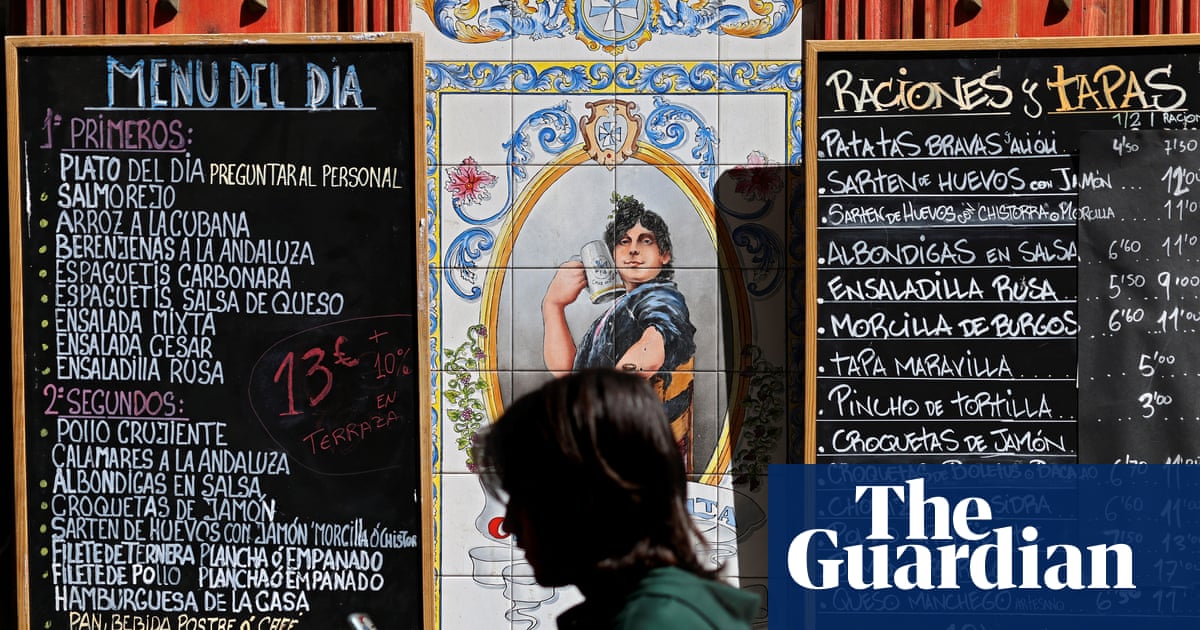
A little before lunchtime each working day across Spain, evidence of one of the lingering, if less notorious, legacies of the Franco dictatorship is carefully traced in chalk, marker pen and printer ink.Beckoning to hungry workers from blackboards, whiteboards and pieces of paper hastily taped to windows, the competitively priced menú del día, or daily set-price lunch, has been part of everyday Spanish life for more than half a century. But while 4m menús are still served each weekday, Spain is slowly losing its appetite for the familiar ritual.Back in 2009, the country’s best-known chef, Ferran Adrià, went so far as to pronounce it dead – a victim of changing eating habits, economic downturns and bistro-style restaurants trying to charge €20-€30 (£17-£25) for what should be a simple starter, a hearty main and a choice of pudding or coffee … with bread and a drink thrown in.Seventeen years later, however, the diagnosis seem a little premature.
A new book by the Spanish food journalist Lakshmi Aguirre charts the history and evolution of the menú and argues that while the tradition is indeed in hot water, it hasn’t quite had its chips.Her book – Menú del Día: Everyday Scenes of a First Course, a Second Course and Pudding – begins with the unpalatable fact that it all began with a tourist menu dreamed up in the mid-1960s up by the Spanish dictator Francisco Franco’s information and tourism minister, Manuel Fraga.The regime was keen in the aftermath of the “years of hunger” that followed the Spanish civil war to show foreign visitors that food was plentiful, good and affordable. So it was that establishments serving food should offer “a starter of soup, a main course chosen from at least three options and based on egg, fish or meat and accompanied by a side dish, and a pudding based on fruit, something sweet, or cheese”.A selection of daily menus on chalkboards in Madrid.
They typically consist of a simple starter, a hearty main and a choice of pudding or coffee with bread and a drink thrown in.The price was set at between 50 and 250 pesetas and, to stop unscrupulous restaurant owners watering down the drinks, the law stipulated that the accompanying quarter-litre of vino had to be “reds and whites from Spain that are pure, clean, pleasant on the palate and with an alcohol content of not less than 12%”.In the early 1970s, the menú del día was rebaptised to make it look less like an attempt to woo – and sometimes gouge – tourists, but also to give ordinary Spaniards the idea that they, too, could indulge.It is now so ubiquitous that many in Spain have no idea of its genesis. “When I was working on the book and people asked me about the menú del día, I’d mention Manuel Fraga and lots of them would throw their hands up in shock,” Aguirre said. “Some people know, but the vast majority don’t. It says a lot about us Spaniards; we forget very quickly.”Researching the book, which includes personal reminiscences and a hefty selection of recipes, led Aguirre to consider the place of the menú in the popular consciousness.“It’s part of our history, yet it’s changed over the years, reflecting the evolution of Spanish society,” she said. “It originated from something as terrible as a dictatorship, and today it has become a deeply ingrained custom.
We feel a sense of nostalgia as we realise it’s fading away.”Aguirre says restaurants serving a menú del día should be a centre of community gravity ‘where families with limited financial means can afford to eat out’. Photograph: Jeffrey Isaac Greenberg/AlamyThe threats to the set lunch, whose average price today is €14.70, are many.
Increasingly time-poor, many Spaniards now opt for a quick lunch, eating food from home at work or popping to a supermarket for a ready meal to microwave in a soulless canteen. Rising energy and food prices are making it harder for small, family-run restaurants to offer a rotating daily selection of starters and mains.All of which explains the rise of the “dish of the day”, which offers restaurants a cheaper alternative to the traditional choice of three or four mains, and the increasing diversity of some menús, which now feature Latin American staples as a reflection of Spain’s changing demographics.“The menú del día purists reject such options, but it has always been a reflection of the society that consumes it – and that’s exactly how it should be,” Aguirre said. “Spain today isn’t the same as it was in the 1980s, it is far more diverse and pluralistic, and as a result diners have changed as well.
The menú del día exists for those who need it, for people who may come from many different backgrounds.”skip past newsletter promotionafter newsletter promotionA daily menu at a restaurant in Palma, Mallorca. The food writer Lakshmi Aguirre says chalkboards should ideally be written by ‘someone who’s never heard of lettering’.
Photograph: Ian Shaw/AlamyAguirre’s menú of choice would be a simple but well-cooked vegetable stew followed by hake in green sauce or baby squid in ink, and then leche frita (fried custard) or rice pudding.But, as she points out in her book, the surroundings are almost as important as the cooking. Her benchmarks for a good menú del día spot include simple dishes, a regularly changing menu, chips that aren’t frozen, a chorus of regulars and “a chalkboard free of any trace of words such as avocado, burrata, tartare, truffle or sourdough bread”.That chalkboard should, by preference, be written “by someone who’s never heard of lettering”, and bonus points are awarded if the child of the owners is doing their homework on a table down the end.As it hobbles slowly towards what may be its demise, the menú del día has become something that transcends a filling and reasonably priced midday meal.“What’s being lost is a meeting point,” Aguirre said. “A centre of community gravity where families with limited financial means can afford to eat out, and where those who live alone can find some company during a meal, which remains a deeply social activity.“It’s a place where joys, sorrows and problems can be shared, or where you can simply enjoy a bit of breathing space, as well as a place for those who live far away or who don’t have the time to go home for lunch.”The true privilege of the menú, she added, lay “not just in being able to pay for a meal, but also in having the time to enjoy it”.