


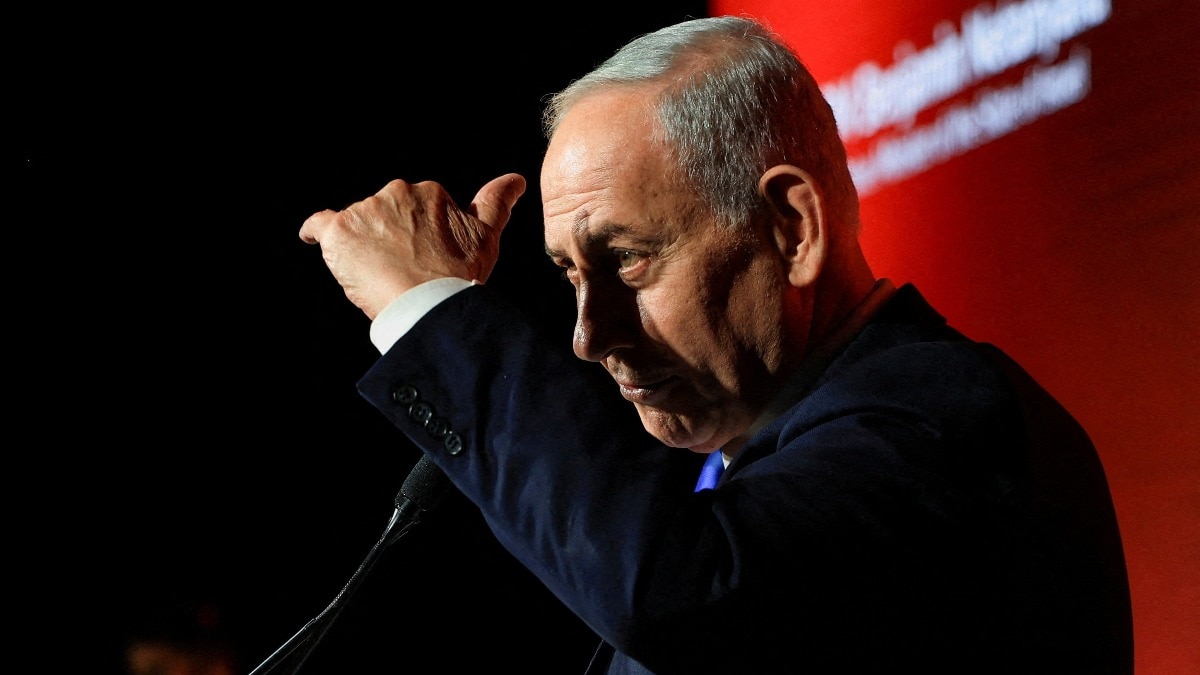
Israelis will vote in a parliamentary election on October 27, the first since the Hamas-led attack of October 7, 2023. The verdict will decide whether Benjamin Netanyahu survives the security failure and three years of war that followed.The Knesset was dissolved on July 17, clearing the way for the election.
It will be Israel’s sixth parliamentary vote since 2019, but the first in 38 years to arrive at the natural end of a full Knesset term.Israel’s longest-serving prime minister wants voters to remember the damage inflicted on Hamas, the weakening of Hezbollah and the strikes against Iran. His opponents want them to remember the security breakdown that allowed the October 7 attack and Netanyahu’s refusal to accept responsibility.But Israelis will not directly choose between Netanyahu and his main challenger, former military chief Gadi Eisenkot.
They will vote for parties, and the next prime minister will be the leader who can bring together at least 61 lawmakers in the 120-member Knesset. The final polls show Netanyahu’s opponents winning more seats than his allies.
But they remain divided over ideology, leadership and whether to work with Arab parties. They may defeat Netanyahu at the ballot box and still fail to remove him from office.WHAT IS AT STAKE FOR NETANYAHU?Netanyahu has governed Israel for more than 18 years across three separate tenures.
He is seeking a seventh term, and Israel has no limit on how long a prime minister can remain in office. For Netanyahu, this election is about more than another term.
It will shape how Israelis judge his handling of one of the worst security crises in the country’s history.He has tried to shift attention from the October 7 failure to Israel’s military response. Netanyahu presents himself as the leader who resisted international pressure, weakened Israel’s enemies and restored the deterrence shattered by the Hamas attack.His opponents say military gains cannot erase the original failure.
They accuse him of avoiding responsibility, blocking an official state inquiry and failing to secure an earlier agreement to free the hostages.For many voters, October 7 remains the starting point. An Israel Democracy Institute survey found that 68 per cent of Jewish Israelis considered the attack a central factor in deciding which party to support.
Among Arab Israelis, crime within their communities was a more pressing concern.The result will also determine how much power Netanyahu’s far-right and ultra-Orthodox allies retain. Their influence could shape military conscription, the judiciary, settlements in the occupied West Bank and Israel’s next steps in Gaza.THE CORRUPTION CASES THAT NEVER WENT AWAYNetanyahu enters the election while standing trial on charges of bribery, fraud and breach of trust.
The proceedings began in 2020. He denies all wrongdoing and says the cases are part of a politically motivated campaign to remove him.The allegations arise from three corruption cases.
Case 1000 concerns gifts, including cigars and champagne, that Netanyahu and his wife allegedly received from wealthy businessmen. Prosecutors say Netanyahu provided political assistance in return.Case 2000 centres on alleged discussions with newspaper publisher Arnon Mozes.
Netanyahu is accused of discussing measures that could weaken a rival newspaper in exchange for favourable coverage.Case 4000 is the most serious. Prosecutors allege that Netanyahu granted regulatory benefits worth about 1.8 billion shekels to telecommunications company Bezeq in return for favourable coverage on the Walla news website.
It is the only case in which he faces a bribery charge.Netanyahu completed his testimony in June after appearing at 98 hearings over 18 months. The trial is continuing, and no verdict is expected before the election.Israeli law allows Netanyahu to remain prime minister while the case continues.
He would have to leave office only after a conviction and the exhaustion of his appeals.The allegations once dominated the political argument around him, but war has pushed them down the list of voter concerns. They also hang over his government’s effort to reshape the judiciary.Netanyahu’s supporters say the changes would curb the power of unelected judges.
His opponents see an attempt to weaken the institutions that can hold him accountable.WHO IS TRYING TO REPLACE HIM?Netanyahu’s main challenger is Gadi Eisenkot, a former chief of the Israeli military and leader of the new centrist Yashar party. Eisenkot joined the emergency government created after October 7 but later left following disagreements over the direction of the Gaza war.His campaign rests on security experience as well as accountability.
He has promised to establish a state commission to investigate the failures behind the Hamas attack.The war has touched Eisenkot personally. His son and two nephews were killed while serving in Gaza.
Their deaths have added weight to his argument that the burden of defending Israel must be shared more equally.Former prime ministers Naftali Bennett and Yair Lapid are running together under the Beyachad, or Together, alliance. Bennett comes from Israel’s religious right but presents himself as a less divisive alternative to Netanyahu.
Lapid remains one of the most recognisable figures in the centrist opposition.Avigdor Liberman’s Yisrael Beyteinu is hard-line on security but firmly secular on domestic policy. Liberman has said he will not join another Netanyahu government.Yair Golan’s Democrats occupy the centre-left.
They are more open than other Jewish parties in opposition to working with Arab parties, though Israel’s political centre has moved to the right since October 7.Netanyahu’s allies include the ultra-Orthodox Shas and United Torah Judaism parties. He also relies on Itamar Ben-Gvir’s Otzma Yehudit and Bezalel Smotrich’s Religious Zionist Party on the far right.Ben-Gvir and Smotrich support expanding Jewish settlements and tightening Israeli control over the occupied West Bank.
If Netanyahu returns, their seat count will determine how much influence they can demand.Two new right-leaning groups could also affect the result. Ofer Winter’s Amcha Yisrael and the Reservists-Economy alliance led by Yoaz Hendel and Yaron Zelekha have been polling close to the electoral threshold.Either could alter the coalition arithmetic by entering Parliament.
If they fall short, their votes will not be represented in the Knesset.WHAT DO THE FINAL POLLS SAY?The final opinion polls place Eisenkot’s Yashar ahead of Netanyahu’s Likud, although the margins remain narrow.Yashar is projected to win between 22 and 23 seats across the last surveys conducted by Israel’s three main television networks. Likud is forecast to take between 19 and 21.
Bennett and Lapid’s Beyachad alliance is placed third with 14 or 15 seats.The largest party does not automatically form the government. What matters is the combined strength of the parties willing to sit together.One final projection gave the primary opposition parties 56 seats, Netanyahu’s religious-nationalist bloc 50 and the Arab parties 14.
Another placed the primary opposition parties on 52 and Netanyahu’s alliance on 50, with 14 seats going to Arab parties and four to the Reservists-Economy alliance.The surveys point to difficult negotiations in which a small party, or even a few individual lawmakers, could decide who becomes prime minister. Parties polling close to the 3.25 per cent electoral threshold add to the uncertainty.If one of those parties falls below the threshold, its votes will not count towards the allocation of Knesset seats.
A small shift in support could therefore cost an entire bloc several seats.WHY ISRAEL ALMOST ALWAYS GETS A COALITIONIsrael’s political system leaves room for many parties because the entire country votes as one constituency. People choose a party list, not an individual representative from their area.
Seats are then allocated broadly in proportion to each party’s share of the national vote.A party needs at least 3.25 per cent of valid votes to enter the Knesset. The relatively low threshold allows parties representing specific religious, ethnic and ideological constituencies to survive.The result is a Parliament divided among the secular right, religious nationalists, ultra-Orthodox parties, centrists, the left and parties representing Palestinian citizens of Israel.
Personal rivalries frequently produce new parties and alliances.No party has ever won the 61 seats needed to govern alone. Every Israeli government has therefore depended on a coalition.This gives smaller parties power beyond their numbers.
A party with six or seven seats can decide who becomes prime minister. In return, it can demand Cabinet positions, government funding or commitments on policies important to its supporters.Once the results are confirmed, Israel’s president will consult the elected parties.
The president will then ask the lawmaker considered most likely to assemble a majority to try to form a government. That person need not lead the largest party.Israel held five elections between 2019 and 2022 because repeated attempts to build stable coalitions failed.
The October 27 vote could return the country to the same cycle.Netanyahu’s opponents face an additional problem. The camp stretches from Bennett and Liberman on the nationalist right to Golan’s centre-left Democrats and potentially the Arab parties.They differ over Palestinian policy, settlements, the role of religion in the state and who should lead the next government.
Those divisions explain why an opposition lead in the polls may not produce an opposition government.COULD ARAB PARTIES DECIDE THE RESULT?Palestinian citizens of Israel make up about one-fifth of the population. Their parties are projected to win around 14 or 15 seats, potentially enough to decide who governs.Their influence will depend on turnout and whether the primary opposition parties are prepared to work with them.
Mansour Abbas, the leader of Ra’am, has already crossed that political line once. His party joined the broad coalition that removed Netanyahu from power in 2021.Eisenkot has not completely ruled out cooperation.
But he has said any Arab party seeking to work with him must recognise Hamas as a terrorist organisation that Israel must defeat.Other opposition leaders fear that openly relying on Arab parties would drive right-wing voters back towards Netanyahu. Netanyahu has made that possibility part of his campaign, warning that his opponents would need Arab support to govern.Turnout could increase the parties’ leverage.
Arab participation has hovered around 50 per cent over the past decade, but researchers and pollsters believe it could reach between 63 per cent and 65 per cent this year. Anger over violent crime and dissatisfaction with the government are among the factors driving the expected rise.More Arab seats would make it harder for either of the main blocs to reach a majority on its own.
Yet those seats would matter only if other parties were willing to work with them.WHAT MATTERS TO ISRAELI VOTERS?The wars dominate this election, but Israelis are not voting on security alone. Accountability for October 7 remains a central issue.
The opposition has promised an official inquiry, while Netanyahu wants the election to focus on Israel’s subsequent military gains.Military service is another major point of tension. Most Jewish men and women face compulsory service, while ultra-Orthodox men studying in religious seminaries have historically received exemptions.That arrangement has become harder to defend after three years of war and repeated deployments of reservists.
Around 13,000 ultra-Orthodox men reach military age each year, but fewer than 10 per cent enlist.Netanyahu depends on ultra-Orthodox parties that want the exemptions protected. Eisenkot and much of the opposition want military or national service to be shared more widely.The judiciary remains another dividing line.
Netanyahu’s government has already passed a law giving politicians greater influence over judicial appointments, but it will take effect only after the next Knesset is sworn in. The opposition has promised to repeal it.Relations with the United States and Israel’s growing international isolation also matter.
Half the people questioned in one Israel Democracy Institute survey said ties with Washington would influence their vote. The issue carried particular weight among opposition supporters.Priorities differ across communities.
For Palestinian citizens of Israel, violent crime is a leading concern. Many secular Jewish voters are focused on conscription and the judiciary, while Netanyahu’s core supporters place greater weight on security and resisting foreign pressure.ECONOMY THAT LOOKS STRONGER FROM OUTSIDEIsrael’s economy has survived three years of war better than many expected.
Its people have not necessarily felt the same relief.A Kan News poll found that the economy was the leading concern for 34 per cent of voters, narrowly ahead of security at 32 per cent. Yet the parties have spent relatively little time explaining how they would make life cheaper or pay for the wars.The Tel Aviv stock market has risen about 130 per cent since October 2023, while the shekel has strengthened by around 25 per cent.
Technology, artificial intelligence and rising demand for Israeli defence and cybersecurity products have helped keep the economy moving.Inflation stood at 1.6 per cent in September, within the Bank of Israel’s target range. The central bank kept its main interest rate unchanged at 3.25 per cent shortly before the election.These figures suggest resilience, but the bill for that resilience is rising.
Defence spending has almost doubled to around 8 per cent of gross domestic product. Public debt is nearing 70 per cent of GDP, about 10 percentage points higher than in 2022, while the budget deficit has risen from below 2 per cent to around 4.5 per cent.The Bank of Israel has estimated that the wars cost the economy more than $55 billion by last year.
That included the equivalent of 8.6 per cent in cumulative lost economic growth.Foreign investors also remain cautious. The share of global funds holding Israeli equities has fallen sharply since 2023, even as the domestic market has rallied.For families, the more immediate problem is the cost of housing, food and everyday goods.
A stronger shekel and rising shares mean little to someone struggling with rent, grocery bills or lost income during months of reserve duty.Reservist deployments have disrupted jobs and small businesses. Higher defence spending could eventually lead to tax increases or cuts in civilian programmes.The economic question is therefore tied to the political one.
Voters are not simply asking who has the better financial plan. They are asking which leader can reduce years of uncertainty without exposing Israel to greater danger.GAZA SHAPES THE VOTE, BUT NOT AS EXPECTEDGaza is present throughout the election, but the debate over it is narrower than an outside observer might expect.The humanitarian devastation in the territory and the conduct of Israel’s military campaign have received relatively little attention in the domestic debate.
The main argument is over who can defeat Hamas and manage Gaza afterwards, not whether Israel’s wartime approach should fundamentally change.Netanyahu says Israel will not withdraw its forces or allow reconstruction to begin until Hamas is disarmed. Eisenkot has promised that Hamas will no longer rule Gaza within 18 months, either through the framework backed by US President Donald Trump or through further military action.Bennett also supports retaining Israeli positions inside Gaza until Hamas gives up its weapons.
He says reconstruction should begin only after disarmament.The leading candidates therefore agree that Hamas must be removed from power. They differ over how to achieve it, how long Israel should remain inside Gaza and whether military gains can be converted into a political settlement.Netanyahu presents continued force as the safest option.
His challengers say he has kept Israel at war without producing a workable plan for what comes next.Nor does the election offer Palestinians a clear route to statehood. Netanyahu, Eisenkot and Bennett all oppose a Palestinian state in the foreseeable future.Eisenkot does oppose Israeli annexation of the West Bank.
He argues that permanent control over millions of Palestinians would eventually threaten Israel’s future as a Jewish state.A change of government could alter Israel’s tactics, its dealings with Western allies and its response to settler violence. It is less likely to bring a fundamental change in its approach to Palestinian statehood.IRAN GIVES NETANYAHU HIS STRONGEST ARGUMENTIsrael has fought two direct wars with Iran, one in June 2025 and another in 2026, alongside the United States.
The confrontations gave Netanyahu a military record he could present as a strategic success after the failure of October 7.Iran has been at the centre of his political identity for years. Netanyahu presents the strikes and the weakening of Tehran’s regional allies as proof that Israel recovered from the Hamas attack and changed the balance of power.But the wars also extended reservist service, increased defence spending and left Israelis facing the possibility of another round of fighting.Netanyahu does not have a monopoly on being hard-line towards Iran.
Bennett has called for using every available means to bring down the Iranian government before it acquires a nuclear weapon.Eisenkot says Iran must be prevented from retaining its enriched uranium, developing a nuclear explosive capability and funding Hezbollah.The differences are mainly about method. Eisenkot says Israel must turn military gains into diplomatic arrangements and repair relations with Western allies.
Netanyahu says continued pressure and the freedom to strike are what keep the country safe.Netanyahu received a late boost when Trump urged Israelis to “vote for Bibi”. The US President praised him as a wartime leader and said Washington and Israel must finish what they started against Iran.The endorsement reinforces Netanyahu’s claim that his relationship with Trump is an asset.
It also brings a foreign leader directly into a campaign shaped by Iran, Gaza and Israel’s reliance on US support.WHAT HAPPENS AFTER THE VOTE?The clearest result would be a Netanyahu victory in which Likud and its established allies cross 61 seats. The polls suggest that is possible, but unlikely without a stronger-than-expected performance by smaller right-wing parties.An Eisenkot-led government could bring together Yashar, Beyachad, Yisrael Beyteinu and the Democrats.
Current projections suggest they would still need another faction or support from Arab lawmakers.A broad unity government involving Likud and opposition parties is another possibility. It would become easier if Likud replaced Netanyahu, as several opposition leaders oppose serving under him but have not ruled out joining a government led by his party.A Netanyahu-Eisenkot arrangement would require difficult compromises over the premiership, an October 7 inquiry, military conscription and judicial changes.
A minority opposition government supported from outside by Arab parties would be vulnerable to defections and disputes over Gaza.If nobody can assemble a majority, Netanyahu will remain caretaker prime minister and Israel could return to the polls. It is an outcome the country knows well after the repeated elections between 2019 and 2022.Tuesday’s vote will measure Netanyahu’s hold over Israel.
The deals that follow will decide whether he stays.- Ends