


Donald Trump's approval rating rose marginally as Democrats maintained their congressional polling lead. The findings highlight economic concerns and political headwinds confronting Republicans before the midterms.US President Donald Trump's approval saw a tiny boost after last week's record low. (Reuters photo)US President Donald Trump's approval rating has increased by one percentage point to 32 per cent from last week's record low, according to a new Reuters/Ipsos poll.
The slight uptick comes a week before the November 3 midterm elections, with Democrats continuing to lead Republicans in the race for control of Congress.The tiny boost follows a string of surveys showing deepening dissatisfaction with his presidency, with the continuing war with Iran and rising living costs weighing on public sentiment.The latest poll found that registered voters favoured Democrats over Republicans by 47 per cent to 36 per cent when asked which party they would support for Congress.The 11-point gap was one percentage point narrower than in a Reuters/Ipsos poll that closed on October 19. When undecided voters were asked which way they were leaning, the Democratic lead narrowed to nine points, with 50 per cent backing Democrats and 41 per cent Republicans.
The findings offer little comfort to Republicans, who are fighting to retain their majorities in the House of Representatives and the Senate.Losing control of either chamber could make it harder for Trump to advance his agenda during the final two years of his second term.APPROVAL RISES, BUT VOTER MOOD A CHALLENGE The Reuters/Ipsos findings come after other polls recorded historic lows for Trump’s approval ratings.A Washington Post-ABC News-Ipsos poll published last week put his approval among American adults at 33 per cent, with 66 per cent disapproving of his performance. More than half of respondents, 52 per cent, said they strongly disapproved of him.A separate Fox News poll put his approval at 36 per cent and disapproval at 64 per cent, marking the lowest reading recorded by the network across his two terms.These findings underscored the political headwinds facing Republicans as the midterm campaign entered its final stretch.Economic concerns remain a central factor in the congressional contest.
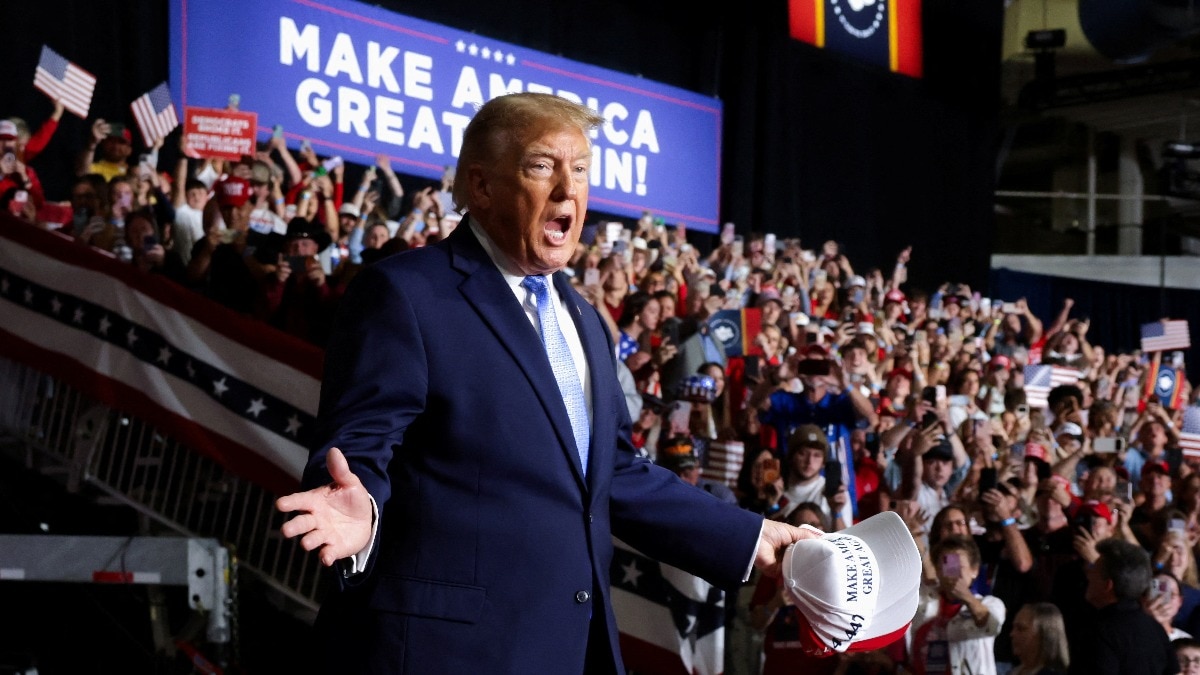
In the latest Reuters/Ipsos poll, 73 per cent of voters said the cost of living was heading in the wrong direction.Democrats also held an edge on the economy, with 37 per cent saying the party had a better approach to the issue, compared with 33 per cent who chose Republicans.The poll suggested Democrats were also more enthusiastic about voting.While 46 per cent of Democratic voters said they were very enthusiastic about the midterms, the figure stood at 30 per cent among Republicans.Even among respondents considered most likely to vote, Democrats led Republicans by nine percentage points, at 53 per cent to 44 per cent.Political analysts generally see Democrats as having a strong chance of winning the House, while facing a more difficult path to securing the Senate.The national generic ballot offers a snapshot of voter sentiment, but does not capture the state-by-state and district-level contests that will determine control of Congress.TRUMP BETS ON HIMSELF TO RESCUE REPUBLICANSTrump has made himself central to the Republican midterm campaign, travelling across the country for rallies in an effort to mobilise his core supporters.An AFP report described his strategy as one built around his own political appeal, despite his poor approval ratings.At a Republican Party midterms' convention in Dallas in September, Trump urged supporters to treat him as though he were on the ballot.He has also used campaign appearances to attack Democrats and promised a $5,000 payment to every adult American if Republicans retain control of Congress, though questions have been raised about the proposal's legality and funding.Peter Loge, director of George Washington University's School of Media and Public Affairs, told AFP that Trump's presence on the campaign trail could hurt Republicans, citing both the historical tendency of the president's party to lose ground in midterms and Trump's unpopularity.While his rallies could energise loyal supporters, Loge cautioned that this might not be enough to change the electoral outcome.- Ends(With Reuters and AFP inputs)