


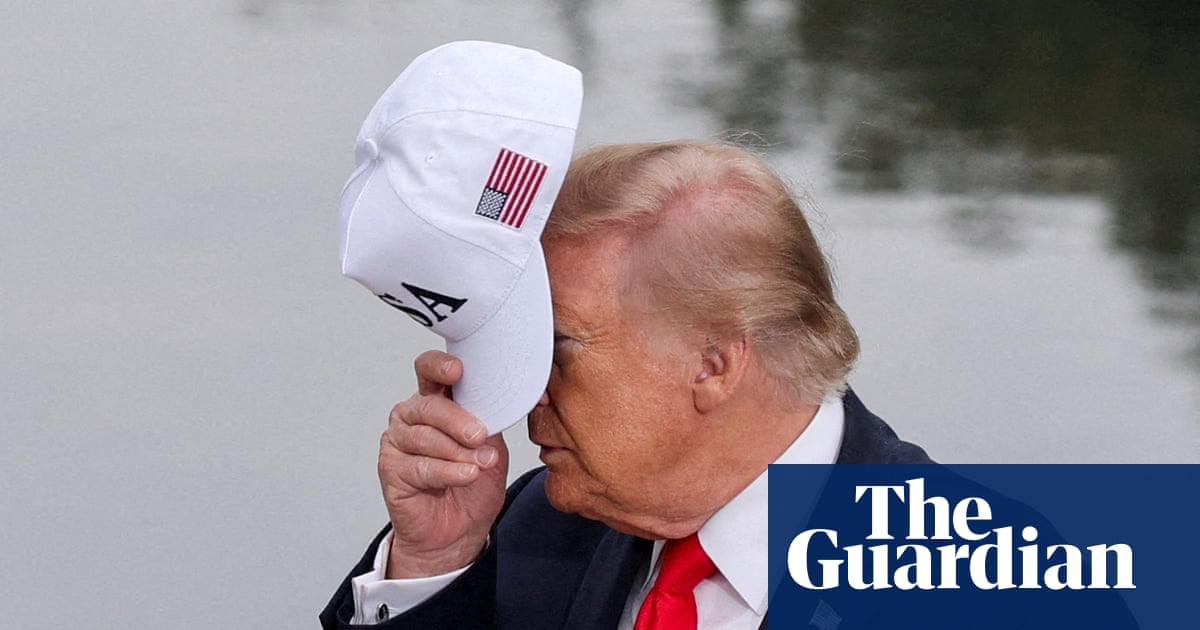
“Is Maga dead?” asked Margaret, a Guardian reader in Switzerland, in a live Q&A with our correspondents after the seismic US midterm elections. If Margaret’s query expressed a hope that the Democrats’ blue wave could transform Europe’s fortunes after two years of Maga-induced trauma, she was probably not alone.The resounding defeat for Donald Trump’s Republicans and the installation of a Democratic-controlled US Congress has been met with understandable relief in European capitals.
In the short term however, the worst for Europe is not over. Trump didn’t need congressional approval, after all, to unleash a trade war on his supposed European allies, threaten to invade Greenland, try to stitch up Ukraine or go to war with Iran, an act that has inflated fuel and food prices disastrously.Hemmed in now on domestic policy, the US president may, many European leaders fear, use his extensive foreign policy powers to become even more confrontational on the world stage.
Europe, warned Nathalie Tocci, is exactly where Trump will lash out. “Trump and Maga have always seen Europe as the mirror image of their domestic foes: a bunch of presumptuous, woke, emasculated liberals. Now that those foes have made a comeback at home, Trump’s rancour towards Europe is likely to grow.”The lashing out could come in the form of new tariff chaos.
As the humiliated Maga figurehead (one Washington expert likened the movement now to “a cornered ferret”), Trump could veto aid for Ukraine and thwart Kyiv’s access to defence technology. Paul Taylor sketched a fearful scenario in which he could even attempt a carve-up of eastern Europe in the so-called “big, beautiful deal” for Ukraine that he says he is working on with Russia.
The omens for Europe were poor as US-mediated talks opened in Abu Dhabi, with delegates from Germany, France, the UK and the EU, literally sidelined.Nor can Europe rely on the new intake of congressional Democrats to challenge Trump on its behalf, Blanche Leridon of the Institut Montaigne thinktank in Paris, tells me. “We have to be clear-sighted that the Democrats’ priority in Congress won’t be to re-establish a more harmonious relationship with Europe. Their foreign policy is, at this point, difficult to decipher.
There isn’t a single, consistent position between the more progressive and centrist factions when it comes to either Europe or Ukraine specifically.”We can’t even assume that nationalist populist parties, encouraged by Trump to destroy the EU from the inside, will suffer by their association with him. True, in central and eastern Europe, where the Maga spirit was heavily promoted by Viktor Orbán, some incumbents may have to perform a pivot.
Poland’s conservative president Karol Nawrocki, who is backed by the opposition Eurosceptic Law and Justice party and has vaunted his proximity to Trump, is now facing awkward questions. And in Czechia, which has one of the most pro-Maga governments in Europe, populist PM Andrej Babiš and his far-right coalition partners, the Motorists party, have faced a wave of grassroots protests lately.In Italy meanwhile, the far-right prime minister Giorgia Meloni played up tensions with Trump months ago, a strategic move to allay the concerns of voters, the majority of whom despise him.But in countries where populists have not yet been in government and are polling at record levels, Trump’s humiliation may not matter to voters, even if their grievances – such as stagnant pay, inflation and lack of affordable housing – are often driven by global forces.“It would be wrong to conclude that national-populist and reactionary forces are in retreat everywhere in the west,” Leridon says. “The Democrats won in the US because people were fed up with Trump, in Serbia, [Aleksandar] Vučić was overthrown after 14 years, but in countries where populist political forces are not in power, but on the verge of gaining it, the calculation is different.”In France, Marine Le Pen is still leading in the polls, six months ahead of a presidential election being fought on cost-of-living issues.
Her far-right National Rally party identified Trump as a liability some time ago. “Le Pen and [Jordan] Bardella understood perfectly the radioactive effect the US president could have on them as politicians claiming to defend French national interests. Above all, they recoiled from the corrosive impact of Trump’s policies on purchasing power in France, whether via trade tariffs or the war in Iran,” Leridon says.In Germany, Alice Weidel, a co-leader of the far-right Alternative für Deutschland, had also distanced the party from Trump in response to tariffs and Greenland.
Weidel now blames Trump’s defeat on broken promises about going to war with Iran.A critical test for Europe’s political direction is looming in Spain. Socialist prime minister Pedro Sánchez, who called a snap election for 29 November, welcomed Trump’s defeat as a straw in the wind for the revival of progressive forces.
But amid public outcry over housing and wages (the cause of Wednesday’s general strike), the momentum is with the opposition rightwing Popular Party (PP) – which could coalesce with the far-right Vox. If this happens, it will be the first time a far-right party enters government in Spain since the end of the Franco dictatorship in 1975.
Santiago Abascal, the Vox leader, dismissed any suggestion of an ideological connection with Trump’s Republicans. “We are in Spain, not in Michigan,” he said after the midterms.skip past newsletter promotionafter newsletter promotionA yearning for generational changeThe youth movement in Serbia toppled a government. Photograph: Uros Arsic/ReutersAnd yet, longer term, the broader, more hopeful lesson from across the Atlantic could be that after years of global backsliding liberal democracy is not dead. “If Europe can celebrate an essential point, it is that American democracy is alive and was the big winner of these elections,” Leridon says.Could this even, as Alexander Hurst asked, be a “democratic spring” – one that began in Budapest in April with Orbán’s defeat?
Julian Borger unpacked how a sequence of four pivotal elections this year, in Hungary, Serbia, Brazil and now the US, has shown the power of grassroots activism to produce surprises and could, perhaps, begin the reversal of a worldwide drift towards authoritarianism.The US vote could even shake Europe’s ailing mainstream parties out of their fatalistic mimicking of far-right policies and into action. Gen Z voters fuelled the US blue wave, which showed a yearning for generational change.
At a time when youth-led protest movements have rocked Europe, progressive parties may be able to channel protest energy into serious political change. They can’t say they haven’t been warned, loudly, to heed calls for democratic renewal, education, decent housing, equality and limits on the power of the big tech billionaires.
Or that failure to do so could allow grassroots anger to be co-opted into the same kind of anti-system nihilism that fuelled Maga.To receive the complete version of This Is Europe in your inbox every Wednesday, please subscribe here.