


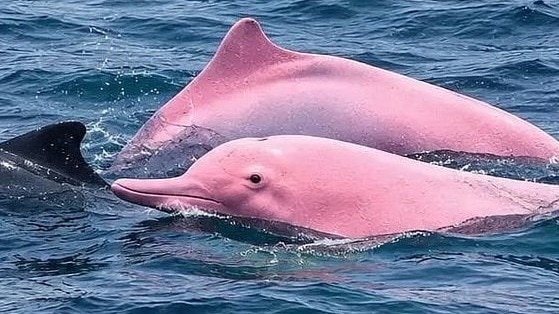
New Delhi: Beachgoers and residents in Muscat, Oman, were treated to an unexpected spectacle when a pink-looking dolphin was observed swimming close to the shore alongside several darker companions. Video footage of the marine encounter quickly spread across social media platforms, sparking widespread curiosity regarding the animal's species and the biological reasons behind its striking coloration.
The recorded footage captured the marine mammals surfacing in the coastal waters of Oman. However, marine experts caution that the animal's distinct appearance alone is insufficient to confirm its exact species, leaving its classification uncertain.
While pink dolphins are frequently associated with the Amazon River dolphin, a distinct freshwater species native to South America, they are not the only cetaceans capable of displaying this shade. Certain Indo-Pacific humpback dolphins, inhabiting coastal regions across parts of Asia, can develop pale or pinkish skin tones as they mature.
Adult populations of humpback dolphins around China and Hong Kong are particularly recognized for this characteristic. Interestingly, this coloration is not typically caused by a pink skin pigment. Instead, as the skin lightens with age, blood vessels situated close to the surface become visible, producing a pinkish flush.
Enhanced blood flow near the skin assists these marine mammals in releasing excess body heat, and heightened physical activity can make the rosy hue even more pronounced. Nevertheless, researchers have not yet verified whether this physiological process accounts for the appearance of the dolphin filmed off the coast of Oman.
Other possibilities discussed in reports include Risso's dolphin, scientifically known as Grampus griseus, a species whose outer appearance shifts significantly over time as it accumulates pale scars. Observers have also considered humpback dolphins, given that some regional populations display pinkish tones.
Despite these theories, neither identification has been officially confirmed. The International Whaling Commission points out that Indian Ocean humpback dolphins, which inhabit the broader region, typically maintain a lead-grey color throughout their lives, highlighting why experts advise against identifying marine animals based solely on color.