


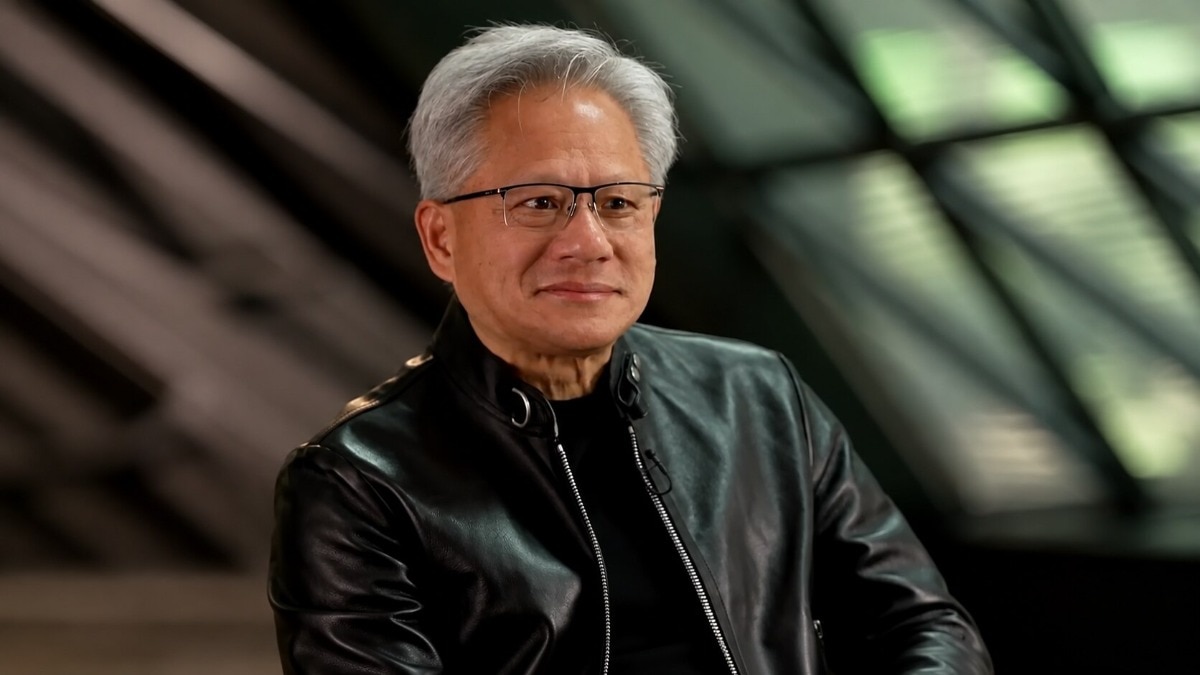
Jensen Huang co-founded Nvidia in 1993 with Chris Malachowsky and Curtis Priem. The company, headquartered in Santa Clara, California, initially developed processors used in video games before expanding into computing technologies that would later become essential to artificial intelligence.AI boom and ChatGPT launch boosted Nvidia's value and Huang's wealth.
Nvidia CEO Jensen Huang has a net worth of $155 billion, making him the world's 10th-richest person, according to the Bloomberg Billionaires Index. Much of his fortune comes from his stake in the chipmaker he co-founded more than three decades ago, a company that has become central to the global artificial intelligence boom.The Bloomberg Billionaires Index puts Huang's wealth at $155 billion, with a gain of $3.99 billion, or 2.6%, in the latest update shown on November 9.
His wealth has, however, seen significant fluctuations alongside Nvidia's market performance. In May 2026, his net worth had climbed to as much as $195 billion.Huang's fortune is closely linked to Nvidia's shares.
According to the Bloomberg index, he owns about 3.4% of the company, including shares held in his own name and through family trusts, based on a September 2026 filing. The index estimates that $151.5 billion of his wealth is held in public assets, largely Nvidia stock, while cash assets account for around $3.48 billion.HOW JENSEN HUANG BUILT HIS FORTUNEHuang co-founded Nvidia in 1993 with Chris Malachowsky and Curtis Priem.
The company, headquartered in Santa Clara, California, initially developed processors used in video games before expanding into computing technologies that would later become essential to artificial intelligence. Born in Taipei, Taiwan, in 1963, Huang moved to the US as a child.
He studied electrical engineering at Oregon State University, graduating in 1984, and went on to earn a master's degree in the same subject from Stanford University in 1992.Before starting Nvidia, Huang worked in the technology industry. He was 29 when he founded the company with his two friends after a meal at Denny's, according to the company's history.
Nvidia went public in 1999, the same year it introduced the graphics processing unit, or GPU. The technology was initially associated with video games, but its use gradually expanded into other areas of computing.A major turning point came in 2006, when Nvidia introduced its CUDA architecture.
This allowed its GPUs to be used for a wider range of mathematical and scientific computing tasks, taking the company's products beyond gaming.HOW THE AI BOOM MADE HIM A BILLIONAIREHuang's decision to invest heavily in AI computing platforms helped position Nvidia for the rapid growth of artificial intelligence.By the end of 2016, Nvidia had delivered its first supercomputer to OpenAI. The launch of ChatGPT in 2022 was followed by a sharp expansion in the AI industry, increasing demand for the powerful chips needed to train and run AI systems.Nvidia emerged as a key supplier to companies developing AI models and infrastructure.
This drove strong growth in its business and share price, significantly increasing the value of Huang's stake.In 2024, Nvidia's market value crossed $3 trillion, while Huang's personal wealth rose above $100 billion.His fortune continued to climb, reaching as much as $195 billion in May 2026, before moving lower. The latest Bloomberg Billionaires Index figure puts it at $155 billion.FROM CHIPMAKER TO AI POWERHOUSEHuang has led Nvidia as its president and chief executive since the company was founded in 1993.
What began as a business focused on graphics processors for gaming has become one of the most important companies in the global AI industry.The company's chips are used by technology firms and research organisations to develop and run artificial intelligence systems. As demand for computing power has increased, Nvidia's position in the AI supply chain has helped drive its valuation and Huang's personal wealth.His fortune remains heavily dependent on the company's stock market performance.
Any major movement in Nvidia shares can therefore have a significant impact on his net worth.For Huang, the rise of artificial intelligence has transformed not just Nvidia's business but also his position among the world's wealthiest individuals.- Ends