


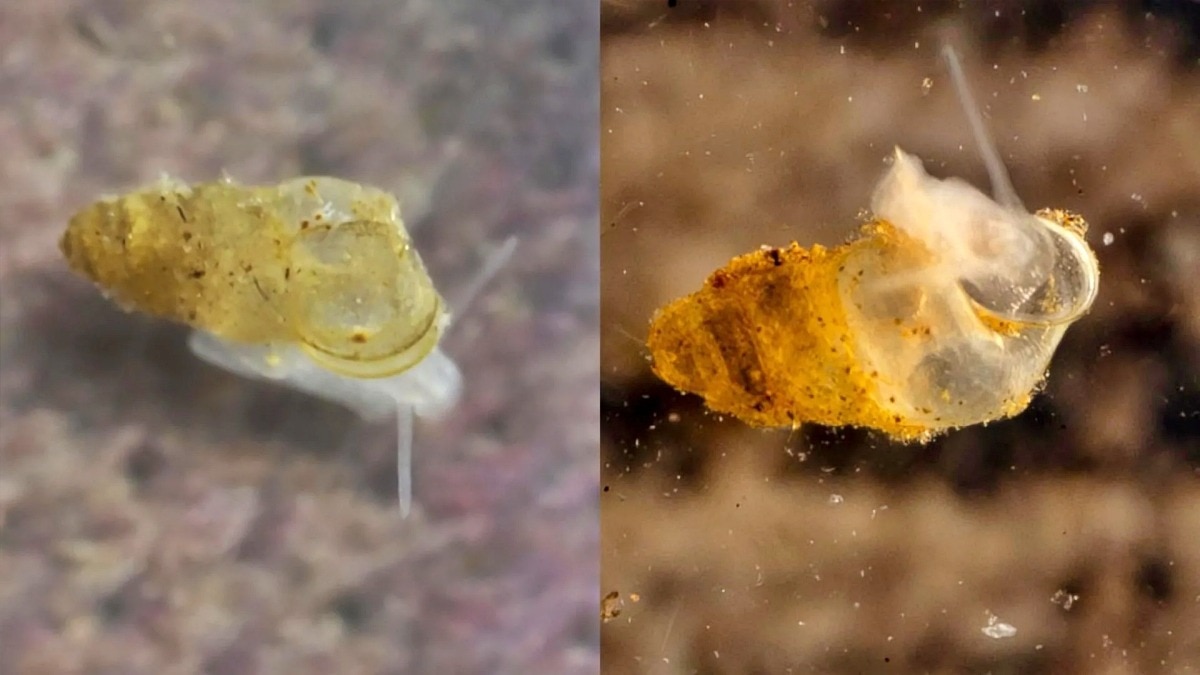
New Delhi: A tiny, nearly transparent creature lacking eyes and adapted for life in total darkness has been discovered inside a mountain cave in China, providing researchers with a rare look into underground freshwater ecosystems.
Named Erhaia dijiang, the newly identified freshwater snail has evolved distinct characteristics to survive in an environment devoid of sunlight. Its fragile, unpigmented body, cone-shaped translucent shell, and elongated, slender tentacles give it a ghostly look.
The findings, published in the journal Subterranean Biology, represent a significant milestone for research into China's subterranean biodiversity. Prior to this discovery, freshwater cave snails had not been recorded in the country, underscoring the limited knowledge surrounding aquatic life beneath the surface.
Researchers chose the name in honor of Di Jiang, a faceless mythical entity from the ancient text Classic of Mountains and Seas. This mythological reference mirrors the snail's distinct morphology, specifically its total absence of eyes.
Laboratory tests demonstrated the species' strong adaptation to subterranean conditions. When subjected to light, the snails consistently moved away into dark crevices beneath rocks, indicating extreme sensitivity to illumination.
Investigators located Erhaia dijiang at an altitude of 2,062 meters, establishing it as the highest-elevation cave snail documented within the family Erhaiidae.
The small mollusks live in shallow subterranean streams measuring less than a meter in depth, residing among underwater gravel and fragmented stone. Water temperatures stay near 20 degrees Celsius, providing a steady habitat.
Even though seasonal heavy rains elevate current speeds and sometimes flush individual snails past the cave mouth, researchers have not observed them in adjacent streams. Their documented range is confined to within two meters of the cave entrance.
Studies indicate that the snails consume diatoms, which are microscopic algae found on stone surfaces. When kept in a laboratory setting, the specimens also accepted fish food supplied by the team.
The finding has sparked worries regarding the long-term survival of the species. In the course of the initial field assessment in August 2025, the research team recovered only three living adult snails alongside a single empty shell, with no young specimens detected.
Scientists characterized the conservation outlook for the species as pessimistic, pointing to its very small population and highly localized range. Because subterranean species rely heavily on specific conditions, local environmental disruptions could endanger them.
Researchers are advocating for broader surveys across Chinese cave networks to uncover other hidden species and implement protective measures before these delicate underground habitats suffer permanent harm. The discovery emphasizes that many of the planet's most unique organisms may still reside undetected in the dark.