


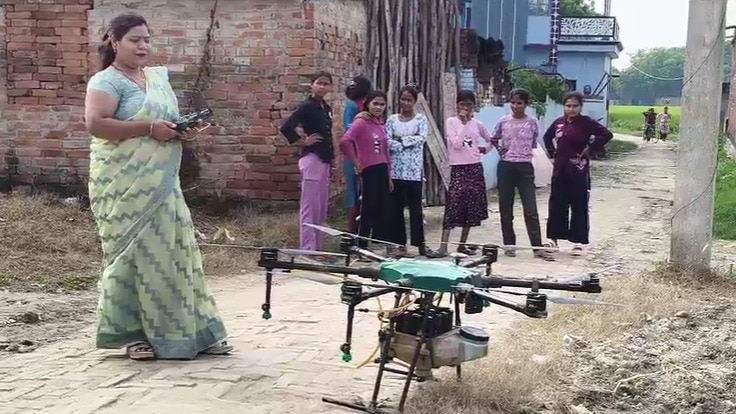
Neetu Singh won farmers' trust by offering free drone spraying across 20 to 25 acres. The venture now earns her up to Rs 2,000 daily and employs two assistants.Neetu Singh, who lives in Unch village in the Kashi Vidyapeeth block of Varanasi, is known as ‘Namo Drone Didi’.Varanasi,Oct 23, 2026 15:48 ISTWhen Neetu Singh first began using a drone to spray fertilisers and pesticides on farms, farmers were not convinced the technology would work.
She had to persuade them to trust a machine they had little experience with, even as people around her doubted whether the venture would succeed.Rather than wait for farmers to come around, Singh offered to spray crops free of charge across 20 to 25 acres. When the crops grew well, farmers began calling her back.
What started in her village has since expanded across several districts of Uttar Pradesh, with requests for her services now coming from Bihar as well.Today, Singh, who lives in Unch village in the Kashi Vidyapeeth block of Varanasi, is known as ‘Namo Drone Didi’. Prime Minister Narendra Modi has praised her work, and she says she has met him twice.
Her journey has also transformed her own finances: she now earns up to Rs 2,000 a day from drone operations and employs two assistants.Singh was born in Mirzapur and grew up and studied in Mumbai. After marriage, she moved to her village and became involved with a self-help group.
In January 2024, she learnt about the Sakhi Drone scheme and decided to apply. She subsequently underwent training in Phulpur, Prayagraj, where she learnt to operate the drone, drive the vehicle and handle the technical aspects of the work.In May 2024, the government provided her with a drone, a three-wheeled electric vehicle and a generator.
The equipment was estimated to be worth around Rs 15 lakh, giving her the tools to start a business using agricultural technology. But receiving the equipment was only the first step.
Singh still had to convince farmers that drone-based spraying could be useful for their fields.When she started, the technology was unfamiliar to many farmers. Singh said she faced scepticism from people in the village and discouragement from those around her.
She continued approaching farmers and explaining how the drone could help with spraying fertilisers and crop-protection chemicals.She initially carried out the work free of charge on around 20 to 25 acres. After farmers saw good crop growth in those fields, they began asking her to return.Demand gradually spread from her village to the Arajiline and Sevapuri blocks of Varanasi.
Her work later reached Jaunpur, Azamgarh, Mirzapur, Sonbhadra and Chandauli. She now also receives requests from Bihar.The demand can sometimes exceed her capacity.
Singh said she has occasionally had to cancel visits to some farmers because requests arrive from different places at the same time.Singh said drone spraying has reduced the time and physical effort required for farm work. Previously, farmers often had to hire labourers or send family members into the fields to apply fertilisers and pesticides.
The process could be time-consuming and labour-intensive.With her drone, she can spray urea over an acre in around 15 minutes and typically covers 10 to 15 acres in a day.The drone is equipped with a mapping system that helps it spray designated sections of a field. According to Singh, this reduces the likelihood of repeatedly spraying the same patch and makes the process more systematic.For farmers, the service offers a way to complete spraying more quickly, while Singh has built a livelihood around operating the technology.Singh said her financial circumstances were very different before she became a drone operator.
She recalled depending on others even for small expenses of Rs 20 to Rs 25. She now earns around Rs 2,000 a day from her work, depending on the assignments she receives.Her business also provides employment to two assistants, whom she pays between Rs 600 and Rs 700 a day.Singh’s husband works as a mason and earns around Rs 500 a day.
He sometimes accompanies her on work assignments, she said, and on those days their combined earnings can reach Rs 2,000 to Rs 3,000.The additional income has helped the family meet expenses for their children and parents. What began as an opportunity through a government scheme has become a source of income for the household and work for others.Singh said she has met Prime Minister Modi twice.
The first meeting took place during a public meeting in Barki, Varanasi, where he referred to her as ‘Namo Drone Didi’. Before that, she was known as a ‘Sakhi Drone’ operator.After she had completed spraying work across around 2,000 acres, she said, she was given an opportunity to meet the Prime Minister in Delhi.During their interaction, Modi asked how the work was progressing and whether farmers had started calling her for assignments.
Singh told him that demand was growing and that she needed another drone. According to her, he told her to inform him if she needed one.For Singh, the recognition has accompanied a practical change in her life: a new skill, a growing customer base and an income she says she once could not have imagined.Her experience illustrates how access to training, equipment and a livelihood opportunity can help rural women take up work in fields traditionally dominated by men.
In Singh’s case, winning farmers’ trust one field at a time has turned an unfamiliar technology into a business that supports her family and employs others.- EndsInputs from Surendra Kumar Gupta