


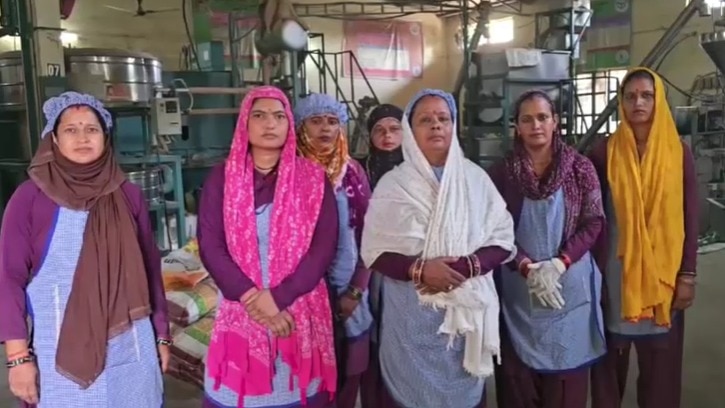
Twenty women in Jhansi now produce supplementary nutrition for anganwadis through a government-supported plant. Their earnings have strengthened household finances, children's education and their standing within families.Jhansi,Oct 23, 2026 16:11 ISTWhen women in Bhojla village in Uttar Pradesh’s Jhansi district decided to join self-help groups and set up a plant, not everyone in their families supported the move.
Some faced resistance at home, while their financial circumstances often left them struggling to provide the education they wanted for their children.Today, women say their circumstances have changed. The plant they set up with government support prepares supplementary nutrition supplied to anganwadis, providing them with a regular source of income.
They say they can now contribute to household expenses, send their children to private schools and, most importantly, command greater respect within their families.At the Saksham Prerna Small Industries unit in Bhojla gram panchayat, 20 women work in the production of food items supplied to anganwadis. Their journey began with self-help groups, savings and a collective decision to invest in a business of their own.From self-help groups to a nutrition plantDraupadi, who heads the Shiv Mandir self-help group, said the women were first introduced to the initiative by a team that visited their area and informed them about government schemes. “Initially, 10 women joined our group.
Later, the group developed into a village organisation, followed by a cluster-level federation,” she said.The village organisation is called Nari Shakti Prerna Sangathan, while the cluster-level federation is Lakshya Prerna Samiti, Bhojla. The women were subsequently informed that a Take-Home Ration (THR) plant was to be set up.
Each woman was required to contribute Rs 30,000 through her self-help group towards establishing the facility. The women pooled the money, and the plant was installed.Draupadi said the work had brought a significant change to their lives.
Regular wages have helped them manage household expenses and provide better schooling for their children.Before joining the self-help group, she earned a living through sewing and agricultural work. Even meeting basic household needs could be difficult, she said, and the family could not afford to send the children to better schools.“After joining the group, our lives changed considerably,” she said, adding that women who had once faced opposition from family members were now treated with respect.She also thanked the state government for providing the women with an opportunity to work and earn.From government schools to private educationSaroj, a resident of Behta village and president of the Jai Maa Ratan Wali self-help group, said the plant prepares several food products for children at anganwadis, including besan barfi, besan halwa and porridge made with moong dal.The women gradually built their savings through the self-help group before setting up the plant with government assistance.Saroj said the change in their earnings had affected how they could plan for their children’s future.“Earlier, our children studied in government schools.
Now we are able to send them to private schools. The biggest thing is that we are standing on our own feet,” she said.For the women, the income from the plant has meant more than an additional contribution to the household budget.
It has given them greater financial independence and the ability to make decisions about their families’ needs.‘We were discouraged from joining the groups’Vinita, another woman employed at the plant, said each self-help group typically has 10 members and that 17 groups are active in the area. Women associated with these groups are involved in different activities, she said.She recalled that some women were initially discouraged from joining self-help groups.
But those who persisted have gradually become financially independent.“Earlier, we could not go out freely. After joining the group and starting to earn, our lives changed.
We never imagined that we would become independent,” she said.Vinita added that earning an income had enabled women to contribute to their husbands’ earnings and household expenses. She said family members who had once opposed their participation in the groups now treated them with respect.The women’s experience in Bhojla shows how collective savings, government support and access to paid work can create new economic opportunities in rural communities.
For the women working at the nutrition plant, the most visible changes are in their ability to support their children’s education, contribute to household incomes and gain a greater say in family life.- Ends