


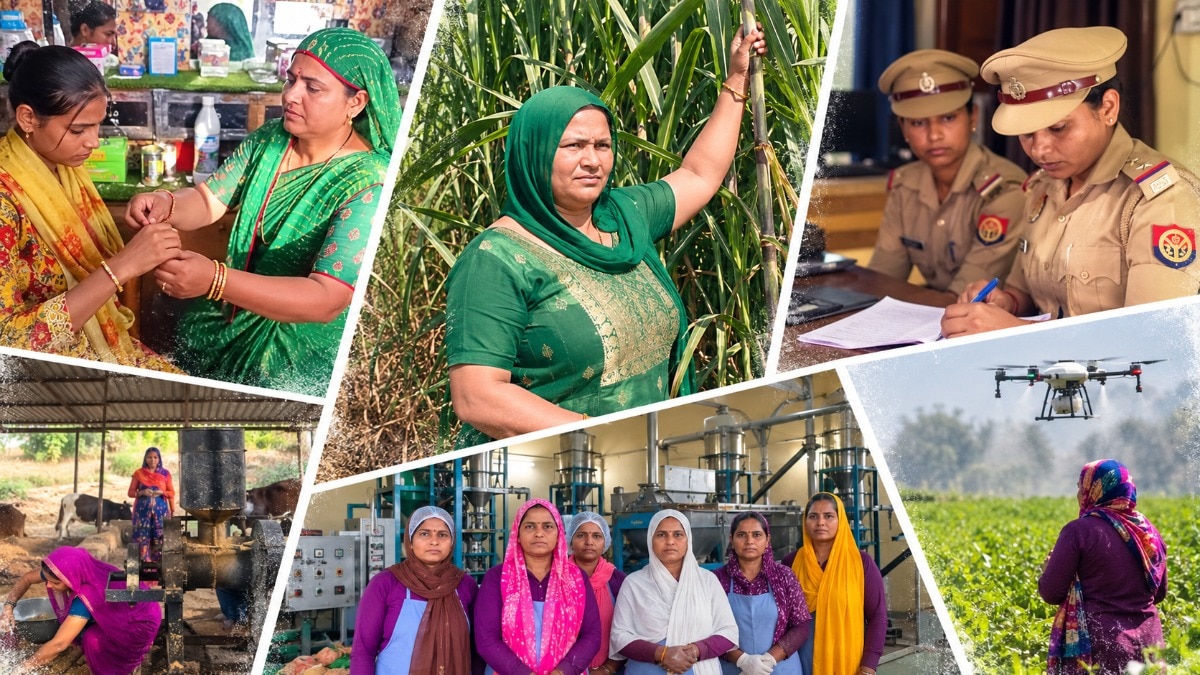
From operating agricultural drones and running businesses to managing farms, pursuing higher education and seeking help against harassment, women across Uttar Pradesh are finding new ways to shape their lives. Their stories from Varanasi, Barabanki, Lucknow, Muzaffarnagar, Hathras and Bareilly show how access to skills, financial support and safety mechanisms can open up opportunities.When Neetu Singh first took an agricultural drone to the fields in Varanasi, farmers were not convinced that the technology would work.
Some questioned whether a woman from their village could make a business out of operating a drone. Instead of giving up, she offered to spray crops free of charge across 20 to 25 acres.
When farmers saw the results, they began calling her back.Today, Singh travels across several districts to provide drone-spraying services. Known as 'Namo Drone Didi', she earns up to Rs 2,000 a day and employs two assistants.In Barabanki, Sakina Bano took a loan through a self-help group to buy an e-rickshaw after her husband left her and their three daughters.
She now operates a small transport business with two e-rickshaws and a car attached to a ride-hailing platform. In Muzaffarnagar, Neelam Malik took charge of 13 bighas of agricultural land after her husband's death and used the income from sugarcane farming to educate her two sons.Their journeys are different, but they point towards a larger shift.
Across Uttar Pradesh, women are taking up work traditionally dominated by men, building businesses, using government-supported opportunities and making financial decisions for their families. At the same time, initiatives focused on education and safety are attempting to address other barriers that women face.FROM A VILLAGE HOMEMAKER TO A DRONE OPERATOR Neetu Singh, who lives in Unch village in the Kashi Vidyapeeth block of Varanasi, was born in Mirzapur and grew up and studied in Mumbai.
After marriage, she moved to her village and became involved with a self-help group.In January 2024, she learnt about the Sakhi Drone scheme and decided to apply. She underwent training in Phulpur, Prayagraj, where she learnt to operate the drone, drive the vehicle and handle the technical aspects of the work.In May 2024, the government provided her with a drone, a three-wheeled electric vehicle and a generator.
The equipment was estimated to be worth around Rs 15 lakh.But receiving the equipment was only the beginning. Singh still had to convince farmers to trust drone-based spraying of fertilisers and pesticides.She initially offered the service free of charge across 20 to 25 acres.
Once farmers saw that the crops were growing well, they began approaching her for paid assignments.Demand gradually expanded beyond her village to the Arajiline and Sevapuri blocks of Varanasi. Her work later reached Jaunpur, Azamgarh, Mirzapur, Sonbhadra and Chandauli.
She now also receives requests from Bihar.Singh says she can spray urea over an acre in around 15 minutes and typically covers 10 to 15 acres in a day. The drone's mapping system helps it spray designated sections of a field, reducing the chances of repeatedly covering the same patch.She says drone spraying saves farmers time and physical effort, as they no longer need to depend entirely on labourers or send family members into the fields to apply fertilisers and pesticides.The business has also changed her financial circumstances.
Singh recalls a time when she depended on others even for small expenses of Rs 20 to Rs 25. She now earns up to Rs 2,000 a day, depending on the assignments she receives.
Her two assistants are paid between Rs 600 and Rs 700 a day.Her husband works as a mason and earns around Rs 500 a day. He sometimes accompanies her on assignments, and on those days, their combined earnings can reach Rs 2,000 to Rs 3,000.Singh has also received recognition for her work.
Prime Minister Narendra Modi has referred to her as 'Namo Drone Didi', and she says she has met him twice. During one interaction, after she had completed spraying work across around 2,000 acres, she told him that demand was growing and that she needed another drone.
According to her, he asked her to inform him if she needed one.For Singh, the recognition has come alongside a more tangible change: a technical skill, a growing customer base and a business that provides employment to others.SELF-HELP GROUPS HELP WOMEN BUILD BUSINESSES IN BARABANKIFor some women, the first step towards financial independence has come through access to credit and collective savings.In Barabanki, three women have used loans through self-help groups to establish businesses in transport, agricultural machinery and food processing.Sakina Bano, a resident of Noorpur village in the Banki block, joined the Khwaja Self-Help Group in 2021 after her husband left her and their three daughters. Although her brothers offered support, she wanted to build an independent source of income.She took her first loan through the group and purchased an e-rickshaw.
As the business began generating income, she repaid the loan and borrowed again to purchase a second e-rickshaw.She later took a loan of Rs 4 lakh through the group. With additional financial support from her brothers and her own contribution, she bought a car and attached it to the Ola ride-hailing platform.Sakina estimates that her three vehicles now generate a combined monthly income of Rs 25,000 to Rs 30,000.
The earnings help her manage household expenses and pay for her daughters' education.In Daudpur village, also in the Banki block, Moni Vishwakarma used a self-help group loan to invest in agricultural machinery.Her husband worked as a labourer and welder, but his earnings were not always sufficient to meet the family's expenses. Moni formed the Maa Lakshmi Mahila Self-Help Group and borrowed around Rs 1.5 lakh to purchase a crop-harvesting machine.Her husband now operates the machine in agricultural fields.
According to Moni, the work generates between Rs 30,000 and Rs 35,000 per harvesting season, providing the family with an additional source of income.She says the self-help group has given her a new identity in society and that she also encourages other women to explore livelihood opportunities.Another resident of Daudpur, Nisha Yadav, borrowed Rs 50,000 through the Shiv Swayam Mahila Self-Help Group to establish a flour and spice grinding mill.The mill caters to residents of the village and nearby areas who bring wheat and other grains, as well as spices such as chilli, turmeric and coriander, for grinding.Nisha operates the machinery herself and says the business generates monthly savings of around Rs 15,000 to Rs 20,000. The income helps her contribute to household expenses and pay her children's school fees on time.According to Sunil Kumar Kaushal, deputy commissioner for self-employment in Barabanki, government-supported livelihood initiatives aim to help women become economically stronger through self-help groups and income-generating activities.The experiences of Sakina, Moni and Nisha show how group-based financial support can help women enter businesses suited to local demand, from transport services and agricultural machinery to food processing.A SELF-HELP GROUP, AN ORGANIC PICKLE BUSINESS AND BIGGER AMBITIONSIn Rudayan village of Hathras district, Madhavi Chaudhary's journey towards financial independence also began with a self-help group.The Parvati self-help group was formed in 2016 through an NGO.
Its members initially started saving Rs 100 every month. The group later received a revolving fund of Rs 15,000.
With the group's consent, Madhavi used the money to turn her skills in tailoring and beauty services into a source of income.Around two years later, the group received financial assistance of Rs 1.10 lakh. The women then joined hands to start making organic chilli pickles.
Some members also bought buffaloes and began earning through milk and dairy-related activities.The different ventures helped the women increase their income and strengthen their families' financial position.Madhavi used her earnings to support her children's education. All three of her children are studying.
Her elder son is in intermediate, while her second son attends Kendriya Vidyalaya and her youngest son studies in Class 9 at KL Jain School.Her work in the pickle business and contribution to the group earned her recognition as a Lakhpati Didi. She has also received several certificates of appreciation.
In 2022, she was given the responsibility of district women's head in the Bharatiya Kisan Sangh.Madhavi and the other women in the group have now set themselves a bigger target: becoming Crorepati Didis.HOW SUGARCANE FARMING HELPED NEELAM RAISE HER SONSIn Pinna village of Muzaffarnagar district, Neelam Malik has spent nearly 15 years managing her family's agricultural land and raising her two sons after her husband, Bhupendra Malik, died in a road accident.Neelam took responsibility for the household and began managing sugarcane cultivation on 13 bighas of land. The farm earns her around Rs 1 lakh to Rs 1.5 lakh annually, helping her meet household expenses and support her children's education.Her younger son, Shubham, is now serving in the Uttar Pradesh Police, while her elder son, Gaurav, works alongside her in farming and animal husbandry.Neelam says she has been making financial decisions for the family on her own for the past 15 years.
She also credits the Rs 6,000 annual assistance under the Pradhan Mantri Kisan Samman Nidhi scheme with providing additional support.Timely payments for sugarcane supplied to the mill, she says, have also made it easier to manage household responsibilities and plan expenses.For Neelam, farming has been more than an occupation. It has been the means through which she raised her sons and secured their future.FINANCIAL SUPPORT TO HELP GIRLS CONTINUE THEIR EDUCATIONWhile some women are building businesses and managing farms, financial assistance schemes are helping younger girls continue their education and pursue careers.In Bareilly, the Mukhyamantri Kanya Sumangala Yojana provides eligible girls with financial assistance of up to Rs 25,000 in six instalments, linked to milestones from birth to higher education.
Launched in 2019, the scheme has benefited more than 46,000 beneficiaries in the district, according to District Probation Officer Monika Rana.The assistance is provided in six stages. A girl receives Rs 5,000 after birth and Rs 2,000 after completing the full immunisation schedule up to the age of one year.
The next instalments are Rs 3,000 on admission to Class 1, Rs 3,000 on admission to Class 6 and Rs 5,000 on admission to Class 9. The final instalment of Rs 7,000 is provided when she enrols in graduation or a recognised diploma course of at least two years.For Radhika Saxena, the money is helping her plan for a career in teaching.
A Class 9 student, she wants to pursue a B.Ed degree. Her family has kept the assistance in her bank account so that it can be used for her future studies.Another beneficiary, Deepiksha Khandelwal, wants to pursue fashion designing.
She has received assistance twice, on entering Classes 6 and 9. Her mother, Pooja Khandelwal, says the money helped the family pay school fees and provided financial relief.For Priyanshi, who hopes to become a doctor, the assistance has helped pay tuition fees and buy books and other study materials.Rana says applications for the scheme can be submitted online through Jan Seva Kendras.
The scheme is intended to provide financial support at different stages of a girl's life and education.PINK POLICE BOOTHS OFFER WOMEN A PLACE TO SEEK HELPEconomic independence and education are important aspects of empowerment, but women also need access to support when they face harassment or violence.In Lucknow, Pink Police Booths operating under Mission Shakti are providing women with a point of contact to report domestic disputes, unwanted calls, messages and harassment. They also offer counselling and, when required, access to legal action.At the booths in the Hazratganj area, women police personnel hear complaints and counsel families.
Sub-inspector Sharda Singh, Mission Shakti in-charge at Hazratganj police station, says four Pink Police Booths are operational across her jurisdiction. They have been set up at busy and sensitive locations with significant public footfall.The booths remain staffed round the clock, with two women constables assigned during each shift.
Women can approach them not only to report a complaint but also when they feel unsafe while waiting for a ride or a family member late at night.Domestic disputes, particularly those involving husbands' alcohol consumption and physical violence, form a significant part of the complaints received at the booths, Singh says.In some cases, women initially seek police intervention and counselling rather than immediate legal action. Officers speak to the husbands and attempt to resolve family disputes when the complainant wants reconciliation.College students and working women also approach the booths with complaints about unwanted phone calls and messages.
Some initially prefer a warning to the person harassing them, hoping that the behaviour will stop without further escalation.However, the response depends on the nature of the complaint and the action sought by the woman. In cases involving molestation or serious harassment, where the complainant seeks strict legal action, the police register an FIR and proceed against the accused.The booths also serve as a safe place for women arriving in Lucknow from other districts who may have nowhere to stay at night or no one available to receive them.
The Mission Shakti help desk and Pink Police Booths can provide them with a place to wait while their concerns are heard.1090 HELPLINE PROVIDES CONFIDENTIAL SUPPORTFor women who face harassment through phone calls or social media, Uttar Pradesh's Women Power Line 1090 offers another channel to seek help.Women can dial 1090 to report unwanted calls, social media stalking and other forms of harassment. One of the service's key features is that the complainant's identity is kept confidential.
In most cases, women do not need to visit a police station to register a complaint.The helpline also provides counselling to women dealing with mental stress or depression through experienced counsellors nominated by UNICEF.The call centre has a capacity of 150 seats and handles around 8,000 incoming calls and 10,000 outgoing calls every day.Once a complaint is received, a male police representative contacts the accused and warns him to stop the harassment. If the behaviour continues, the police use the Family, Friends and Relatives (FFR) method, contacting the accused's family members, friends and relatives to create social pressure.If the accused still does not stop, the complaint is forwarded to the concerned police station for legal action.The process includes feedback from the complainant at every stage.
A final feedback call is made 30 days after the case is resolved. If the woman remains dissatisfied or reports that the harassment is continuing, the grievance redressal process is restarted.The helpline is part of the state's wider women's safety initiatives, which also include Mission Shakti, women help desks and One Stop Centres.DIFFERENT JOURNEYS, A SHARED IDEA OF EMPOWERMENTThe experiences of these women and girls show that empowerment does not follow a single path.For Neetu Singh, it meant learning to operate a drone and convincing farmers to trust a new technology.
For Sakina Bano, it meant building a transport business to support her three daughters. Moni Vishwakarma and Nisha Yadav used self-help group loans to establish businesses, while Madhavi Chaudhary turned her skills into a livelihood and helped other women do the same.For Neelam Malik, it meant managing a farm and raising two sons.
In Bareilly, financial assistance is helping girls continue their education and work towards their ambitions. In Lucknow, Pink Police Booths and the 1090 helpline provide women with channels to report harassment, seek counselling and access police intervention.These initiatives address different needs, from income and education to safety and access to support.
Their impact is reflected in the choices women are making: the work they take up, the businesses they build, the children they educate and the help they seek when they need it.For the women featured here, empowerment is not just a policy objective. It is visible in the fields they cultivate, the machines they operate, the businesses they run and the decisions they make about their families and their futures.- Ends