


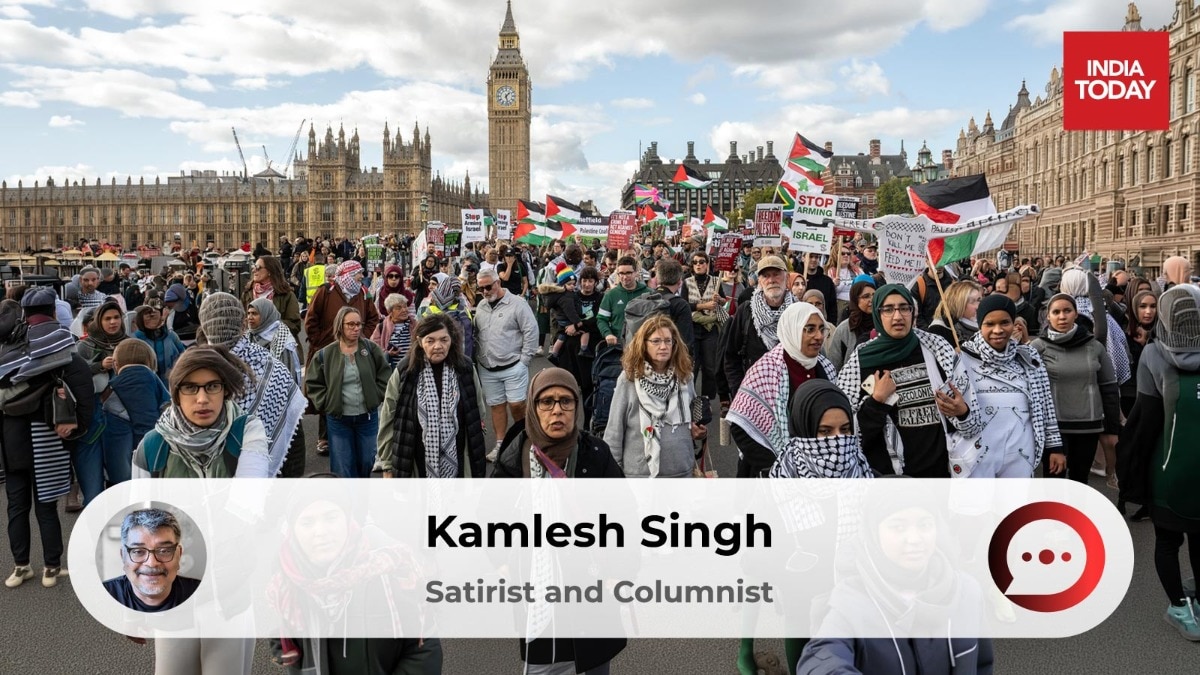
A boy and a girl from Mumbai are seen everywhere there is a protest. To raise the Palestinian flag and burn the Star of David.
The boy with a septum hoop and the girl with a nauseam loop make Free Palestine content with pure intent. Protest against NEET fine but Free Palestine.
Dharmendra Pradhan on the sign, Free Palestine. Gyaanu must resign, Free Palestine.From the river to the sea, they are not alone.
Across the world, the young feel aggrieved by what's been happening in Gaza before and after that cursed October 7. The grievance is real, the performance Reel.
You can't question the solidarity they feel. The world must heal.
If it takes two states, then turn back the wheel. This is all they do.
This is their life. This is their work.
No shirk.The Free Palestine fashion-and-fundraiser factory has perfected the profitable art of perpetual Palestinian pain. While Gazans endure shattered streets and shrinking survival statistics, the woke are laughing, err, sloganeering all the way to the West Bank.
Western wearers of the cause collect scarves, speaking fees, and the soft glow of Greta-ness. The conflict is no longer merely a war, but also a lifestyle line.
Free Palestine.The keffiyeh, once a practical piece of Palestinian headwear, has been polished into a portable political prop that photographs well from three angles. After the Hamas massacre of roughly 1,200 Israelis, Amazon sales of the scarves surged 75% in 56 days.
Search spikes turned the black-and-white weave into the season's signature statement of selective solidarity. Models strutted in it.
Rappers wrapped it. Runways rebranded it as resistance chic.
Fast-fashion fakes flooded the market while the last West Bank workshop watched its output vanish in days. The garment that once signalled local identity now signals foreign fashion sense and a working knowledge of the algorithm.
Buy the scarf, broadcast the slogan, and the suffering becomes someone else's problem dressed in someone else's pattern.Dedicated shops and drop-shippers quickly expanded the catalogue: keffiyeh-print dog bandanas for the committed canine, crop tops for the campus core, evening bags for the gala set, flag-and-sticker combos, watermelon-themed pins (the fruit adopted as a low-risk stand-in), embroidered tote bags, football jerseys, bracelets, and "Palestine University" sweatshirts for institutions that do not exist. Some vendors claim a percentage of proceeds reaches Gaza; many prefer the cleaner profit of pure posture.
Globalise the Intifada has globalised a fad. Meanwhile, 70,000 Gazans are dead.Campus chaos has been the curious feature, a seasonal theatre.
Not just JNU and Jamia, it's a worldwide phenomenon. Not long ago, more than 1,360 American student demonstrations produced over 170 encampments.
Police arrested more than 3,100 people across dozens of campuses. Lectures collapsed.
Graduations were cancelled. Buildings were occupied.Activists treated other people's universities as their own open-air theatre and other people's tuition as the production budget.
They blocked roads and disrupted classes while collecting the social currency of confrontation, then returned to ordinary life when the semester ended and the content calendar needed new material.In London, protesters climbed the Battle of Britain memorial, trampled poppy wreaths, and, in one case, made a Nazi salute. Across the Channel the pattern was worse.
A curse. During nationwide French riots, Palestinian flags and keffiyehs appeared among masked groups who looted shops and set vehicles alight.
In Italy's Milan, a march that began with Palestinian flags and keffiyehs turned into looting and arson near the Duomo, the cathedral serving as a backdrop. In Madrid, a philosophy student was arrested last year after attempting to set fire to a pizzeria while it was full of customers, in reprisal for events in Gaza.Europe, the preferred home to the displaced Palestinians, has become a battleground, in spite of most nations souring their ties with Israel over Palestine.
The scarves travel well. The fires too.Money follows the spectacle with mechanical efficiency.
Researching for this piece, I could gather that roughly 20 US pro-Palestinian organisations raised more than $250 million in the last five years. UNRWA US (the special purpose refugee body for Palestine) alone collected over $51 million in 2024.
Students for Justice in Palestine chapters, operating through sponsors, draw multi-million-dollar flows from networks because the rich world feels guilty and wants to buy mental peace by charity.Foundations underwrote fellowships, campaign infrastructure, and legal defence. Celebrities added their own theatrical transfers: millions of dollars to calm their conscience irrigated by "Jewish-controlled" industry.
Each cheque sustains staff, offices, and the next round of social media outrage. Rage.Gaza's measured reality moved in the opposite direction.
The Palestinian Central Bureau of Statistics recorded a 10.6% population drop to about 2.13 million. UNCTAD documented an 83% GDP collapse in 2024, leaving per-capita output near $161–$212 and unemployment at 78%.
Reconstruction needs were assessed at $70–71.5 billion.Hamas documents indicated systematic diversion of 15–25% of incoming aid. UNRWA, whose Gaza workforce numbers in the thousands, faced documented cases of employee participation in the October 7 attacks.
None of these figures improved because scarves sold out. The Free-Palestine Industry doesn't require resolution but recurrence.
No offence.The grievance industry requires the dispute to remain unresolved. Israelis say multiple statehood offers were rejected by Palestinian leadership.
Camp David 2000, the Clinton parameters, the 2008 Olmert proposal, all came to a naught. Hardline Hamas beat the treaty-makers flat in the last elections that took place in Gaza.
They were elected because they didn't like the process of making peace with Israel. Hamas's charter and practice rejected recognition and demilitarisation.The near total decimation of Gaza has made the wound so deep and wide that Free Palestine Inc will show tremendous growth and, may I say, profits.
Gaza's misery is monetised.Each fresh round of violence resets the cycle of aid, protest, fundraising, and fashion. Activists in stable democracies acquire paid positions, platforms, and prestige by treating the conflict as an open-ended moral product.
Residents of Gaza acquire neither.A practical arrangement that ends the military capacity of groups that reject coexistence would shrink both the body count and the external economy that has grown around the absence of one. The present structure keeps the cash flowing, the keffiyehs selling, and the full-time professionals fully employed.Free Free Palestine!
The slogan keeps the season bright, the outrage pays for the flight. We do not need the streets to heal, we only need the next appeal: From the River to the Sea, Palestine WILL be Free.
Where there is that WILL, there is a way, to riches. Bitches.- Ends(Views expressed in the piece are those of the author)