


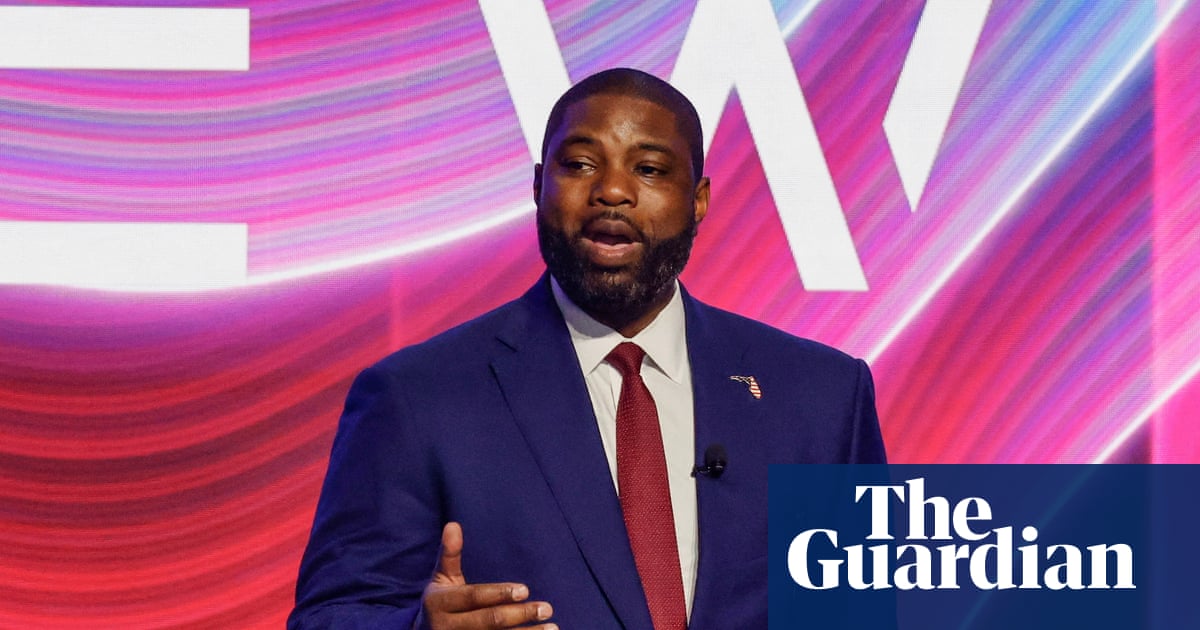
Three exonerated former death row prisoners in Florida have called on incoming governor Byron Donalds to halt the state’s record run of executions and review the cases of all 235 prisoners who are now condemned.At a press conference in Tallahassee on Thursday hosted by the advocacy group Floridians for Alternatives to the Death Penalty (FADP), the men said they were seeking a roundtable discussion with Donalds, a Republican, as well as the state’s new legislative leaders in pursuit of a moratorium.Florida leads the country in both executions and exonerations, and next Thursday’s scheduled execution of convicted murderer Thomas Overton will be the state’s 20th this year, one more than the record of 19 set in 2025.Herman Lindsey, who was exonerated in 2009 after spending three years on death row after his wrongful conviction for the 1994 killing of a pawn shop owner, said he hoped Donalds would be more sympathetic than termed-out governor Ron DeSantis, who will have signed 50 death warrants by the time he leaves office.All but two of those death sentences were carried out during DeSantis’ second term, which will end in January.“Mr Byron, you don’t look like you are a person that is barbaric,” said Lindsey, who is also executive director of Witness to Innocence, an organization that supports death row exonerees. “I hope that you consider re-evaluating the death penalty before you use it, and investigate.“It’s not about him ending the death penalty, but I want to give him the knowledge and assist him to learn anything that he needed about the death penalty so he can make valid, right decisions.”Lindsey’s call was backed by Joaquín José Martínez and Seth Penalver, other Witness to Innocence advocates who were also among the 30 condemned prisoners exonerated in Florida since the death penalty was reintroduced nationwide in 1976.“Thirty men were convicted and sentenced to die, and those convictions were wrong,” said Penalver, who was in prison for 18 years, 13 on death row, for a triple homicide in 1994 for which he was later acquitted.“Each of us had to find a way to get someone to listen and look again. When you are the person facing execution, you cannot afford for everyone to assume that somebody else has already checked everything.“You need someone who is willing to examine the evidence and take your questions seriously.”Martínez was sentenced to death in 1997 for a double murder and exonerated in 2001 when a court heard that some evidence against him was fabricated by one of the victim’s relatives, who worked at the investigating sheriff’s office, and that several informants were promised rewards for false testimony.“It’s easier to believe that a person that’s exonerated, who is taken out of death row, got out because he was lucky than it is to believe that our system is failing,” he said.“It’s time to evolve; it’s time to change.
It’s time we end the death penalty.”Grace Hanna, executive director of FADP, said her group was keen to work with Donalds after he takes office.“We and our partner organizations regularly share information with lawmakers and elected officials about capital punishment,” she said.“Today, some of the people most impacted by Florida’s broken death penalty, people who had been wrongfully convicted and sentenced to death, used their voices to reach our incoming governor and advocate for a pause in executions.”The Guardian has contacted Donalds’ office for comment.In a statement to the Miami Herald, a representative for his transition team suggested such a moratorium was unlikely. Donalds, the spokesperson said, “is a staunch supporter of the death penalty and will govern as such”.