


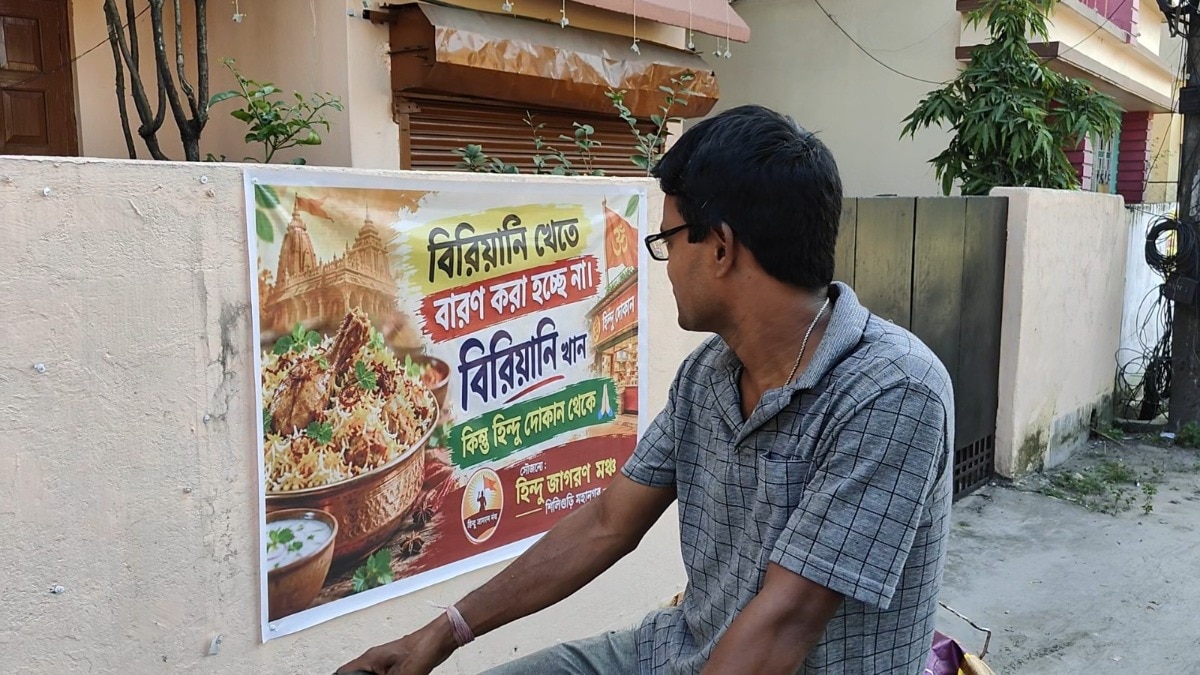
Siliguri: Controversial posters directing residents to buy meat and biryani solely from Hindu-owned shops have surfaced across Siliguri in West Bengal ahead of the Durga Puja festival, generating a political controversy regarding religious identity, consumer choices, and communal harmony in the state.
Put up by a local right-wing outfit known as the Hindu Jagran Manch, the posters appeared at multiple locations throughout the city, including along the boundary walls of the Tarun Tirtha Club's Durga Puja grounds located in Bharat Nagar. This particular site drew heightened attention because the venue is situated close to the residence of state Tourism Minister and local MLA Shankar Ghosh.
One of the displayed banners explicitly tells residents to acquire meat from Hindu-owned establishments, while another message reads that there is no prohibition against eating biryani, provided it is purchased from a Hindu merchant. These signs quickly caught the attention of passers-by and residents at the outset of the festive season, raising questions about attempts to leverage religious identity to guide commercial habits during a cultural holiday.
Abhishek Das, a representative of the Hindu Jagran Manch, acknowledged that his group was responsible for the campaign and noted that the materials were placed near various puja pandals across the municipality rather than just in Bharat Nagar. According to Das, the initiative was intended to communicate a message of solidarity among the Hindu community by tying routine commercial transactions to religious affiliation.
Meanwhile, Tourism Minister Shankar Ghosh distanced himself from the campaign, stating that he had no knowledge of who placed the banners outside the venue near his home and suggesting that only those responsible could explain their motives.
The initiative drew sharp criticism from opposition figures, including former Siliguri mayor and Left leader Ashok Bhattacharya, who accused bodies linked to the Rashtriya Swayamsevak Sangh and the Bharatiya Janata Party of attempting to foster religious divisions. Arguing that food choices and purchasing decisions remain matters of personal freedom, Bhattacharya asserted that the public should be free to buy goods regardless of community backgrounds and called upon local law enforcement to take down the signs.
Another former mayor of the city, Gautam Deb, similarly condemned the messaging, characterizing the campaign as unfortunate in a region known for secularism and coexistence. Deb argued that trying to dictate commerce along religious lines ahead of a major festival contradicts the traditional harmony of the state and suggested that authorities should take necessary action if the displays violate constitutional principles.