


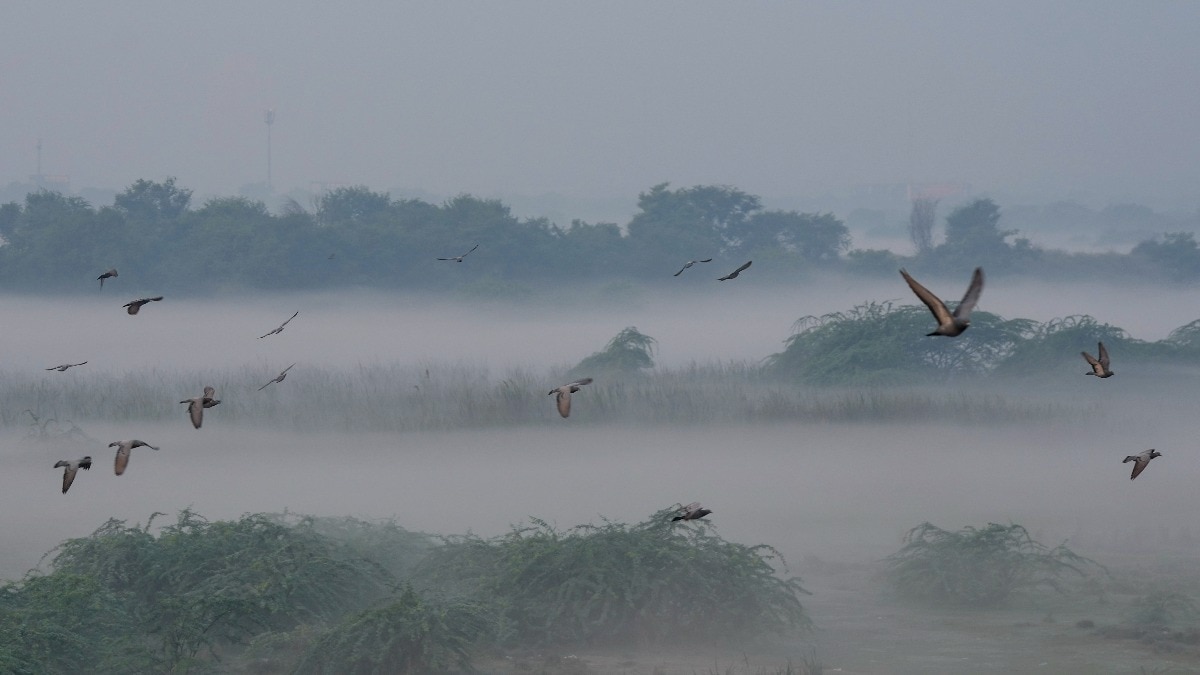
Delhi-NCR is choking under a thick layer of toxic haze, with the capital's air quality slipping into the 'Severe' category as fine particulate pollution surges.Delhi's average AQI touched 402 on Friday, while PM2.5 concentration stood at 296 micrograms per cubic metre at 9:30 am, nearly 20 times the safety limit, according to AQI.in data.The decline in air quality is being driven by a combination of smoke travelling from farm fires in neighbouring states and weather conditions that are allowing pollutants to accumulate over the region.The direction of the wind also plays a major role. Commuters ride two-wheelers with headlights on through dense dust and smog.
Earlier this week, easterly and northeasterly winds had limited the movement of smoke from Punjab towards Delhi, but the northwesterly flow has since returned, creating a pathway for smoke from the farm-fire belt to reach the capital.Northwesterly winds were recorded to be blowing at around 34 kmph at an altitude of 1–2 km on Thursday, November 12. However, winds closer to the ground have been considerably weaker.
This means that while smoke can travel towards Delhi at higher altitudes, pollution already present near the surface is not being dispersed efficiently. People drive with their headlights on amid dense smog on the Delhi-Meerut Expressway.
THE TRAPPED POLLUTIONAnother important factor is a shrinking atmospheric mixing layer, which is the lower part of the atmosphere in which pollutants released at the surface spread and dilute.With less vertical space available for pollutants to spread, emissions from vehicles, industries and other sources can remain concentrated closer to the ground.Calm conditions overnight have further limited the dispersal of pollutants. Dark smoke billows from a field after farmers burn stubble.
The absence of significant rainfall has also meant there has been little opportunity for rain to wash suspended particles out of the atmosphere.FARM SMOKE ENVELOPS DELHIThe contribution of stubble burning to Delhi's pollution load has been fluctuating.The government's estimation suggests that farm fires accounted for 8.9% of the city's pollution on Thursday, while transport contributed around 16%, showing that pollution is not coming from a single source, with local emissions and smoke transported from neighbouring states adding to the burden. Smoke billows from a paddy field as a farmer burns crop stubble.
A western disturbance has brought rain and snowfall to parts of the western Himalayas, but Delhi has not received a comparable spell of rain.The IMD forecast indicates dry conditions for the capital, with no immediate rainfall expected to help clear the air.With smoke continuing to travel towards the city and unfavourable weather limiting its dispersal, Delhi remains vulnerable to a prolonged spell of toxic haze.- Ends