


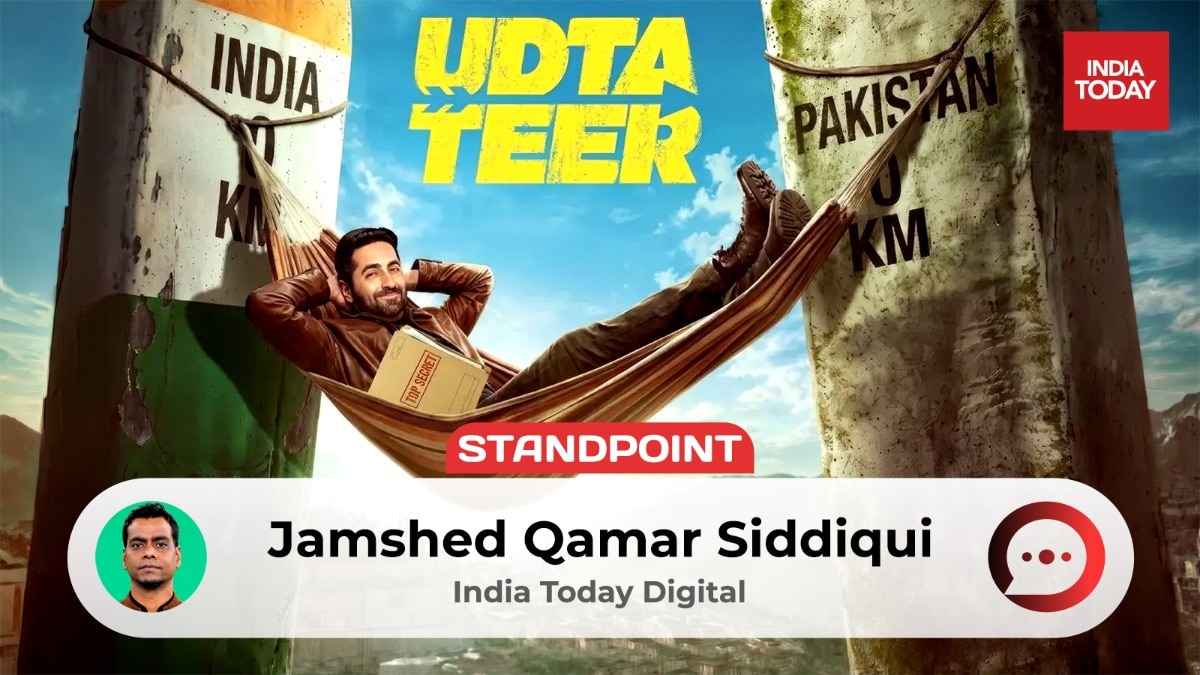
I watched a comedy film last weekend, Udta Teer, starring Ayushmann Khurrana. The premise is fairly straightforward.
A Pakistani spy enters India, joins the Indian Army and plans to gather classified information to help Pakistan. But fate has other plans.
He meets with an accident, loses his memory, forgets that he is Pakistani and begins serving India with complete sincerity. Back in Pakistan, people are left scratching their heads, wondering how to deal with this rather unusual national identity crisis and it creates comedy.Fantastic storyline but there is a scene in the film that was apparently written to make the audience laugh.
Unfortunately, it made me want to cry. Not because it was emotional, but because it was so spectacularly ignorant.Someone tries to remind Ayushmann's character of his Pakistani identity.
He tells him, "You are a Pakistani working secretly in India. You are not Indian." Ayushmann refuses to believe him and asks a perfectly reasonable question: "Do you have any proof?" The man produces an Urdu newspaper and asks him to read it. "Can you read this?" he asks. "Yes," says Ayushmann.And then comes the masterstroke of cinematic intelligence: "If you are an Indian Hindu, how can you read Urdu?" That's it.
Case closed. Nationality established.
Passport recovered. Intelligence agencies can go home.I wonder what went through the writer's mind while writing this scene.
Did nobody involved in the film pause for a moment and ask: Since when did knowing Urdu become proof of being Pakistani or Muslim? Has the writer never heard of Munshi Premchand, one of the greatest writers of the Indian subcontinent, who began his literary journey in Urdu?
Has he never heard of Firaq Gorakhpuri, born Raghupati Sahay, one of the finest Urdu poets, who received the Jnanpith Award (India's oldest and highest literary honour) for Gul-e-Naghma? What about Pandit Ratan Nath Sarshar, whose Fasana-e-Azad remains a classic of Urdu fiction?
Or Daya Shankar Kaul Nasim, remembered for his celebrated masnavi Gulzar-e-Nasim? And Brij Narayan Chakbast, whose poetry reflected nationalism, social consciousness and national unity?
The list doesn't end there. Krishan Chander was among Urdu's most celebrated fiction writers.
Rajinder Singh Bedi gave Urdu literature some of its finest short stories, including Ek Chadar Maili Si. Upendranath Ashk made significant contributions as a novelist, playwright and storyteller.
And Gopi Chand Narang, one of the most distinguished Urdu critics and linguists, received the Jnanpith Award for his contribution to literature.Now, I have a question: Were all these people secretly Pakistani agents? Was Premchand working for the ISI before the ISI was even established?
Did Firaq Gorakhpuri need to apply for a Pakistani visa every time he wrote a ghazal?These were not outsiders contributing to somebody else's language. They were an integral part of its literary history.
Their religion did not make their Urdu any less Urdu, just as their Urdu did not make them any less Indian.Urdu is not the property of one religion. It evolved in the Indian subcontinent, drawing from several linguistic traditions and developing a magnificent literary heritage.
It has been spoken, written, read and celebrated by people across religious communities.And it’s even more heartbreaking because it's Ayushmann Khurrana in the scene, who comes from Punjab and knows this history. I am sure his father and grandfather's generations were familiar with Urdu.
Did that make them Pakistani? Should we start checking the Urdu-reading abilities of every Punjabi household before issuing Indian citizenship certificates?What makes this scene particularly disappointing is that Ayushmann has built a reputation for choosing meaningful cinema and playing characters that challenge stereotypes.
I find it difficult to understand how he could be comfortable delivering a dialogue that reduces an entire language to a religious identity.Of course, a comedy film is entitled to exaggeration, absurdity and even ridiculous situations. That's the whole point of comedy.
But there is a difference between laughing at absurdity and manufacturing absurdity out of historical ignorance.I am not even getting into the film's larger problem of presenting patriotism through familiar religious symbols and suggesting that certain expressions of religious identity are somehow incompatible with nationalism. Apparently, to prove your love for India, you must know when to perform an aarti, when to shout Jai Shri Ram and, more importantly, when not to say Assalamualaikum.
But that's a separate discussion.After Ayushmann loses his memory and forgets that he is Pakistani, the next scene shows him inside a mandir, performing aarti. Writer Akash A.
Kaushik, who began his career with F.A.L.T.U., seems to have muddled the distinction between national identity and religious identity here, almost suggesting that forgetting one's Pakistani identity naturally leads to embracing Hindu religious practices.In another scene, a character greets his superior with Assalamualaikum but immediately catches himself, realising that the officer is Indian, and switches to Jai Hind. The implication is equally troubling as though someone who says Assalamualaikum cannot possibly be Indian.My concern here is very specific – when a film tells its audience that an Indian Hindu reading an Urdu newspaper is proof of his Pakistani identity, it does more than make a silly joke.
It normalises a dangerous misconception. It tells people that Urdu belongs to Muslims and, by extension, that Muslims somehow belong outside the idea of India.Urdu is as Indian as Hindi.
Its history is our history, its literature is our literature, and its cultural legacy belongs to all of us. Perhaps the writer needs to read a little Urdu literature.
And perhaps Ayushmann Khurrana owes his audience an explanation, if not an apology for lending his voice to such a deeply problematic idea, because the joke is not funny.- EndsViews expressed in this opinion piece are those of the author.