


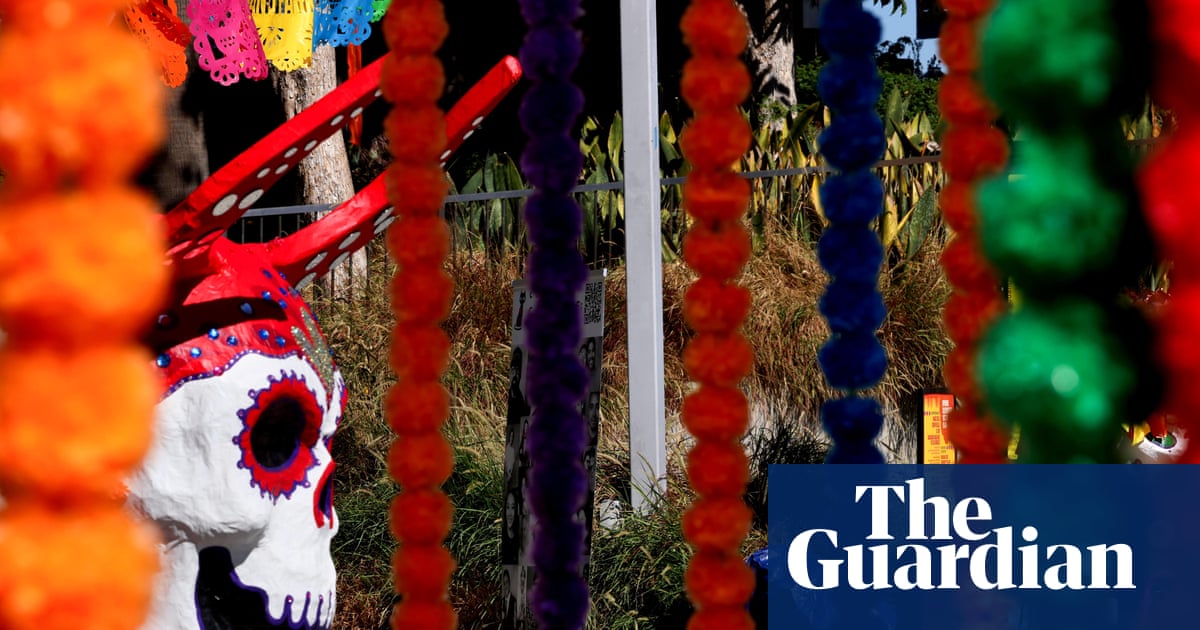
Julia, a 19-year-old born in the US, and her parents, undocumented immigrants from Mexico, enjoyed attending the Día de los Muertos (Day of the Dead) celebration each year in Henderson, Kentucky, and selling aguas frescas, horchatas and a sweet bread traditionally eaten on the Mexican holiday.Last year, her family also built an ofrenda, or altar, featuring flowers and a violin, to honor her grandfather, who played the instrument and died in 2023 in Mexico.Unfortunately, organizers of the event in the town of 27,000 people canceled the party in 2025 because of concerns that Immigration and Customs Enforcement (ICE) would use it as an opportunity to arrest undocumented immigrants.“The political climate around immigration was so difficult and controversial that we got a clear message from folks in the Latino community here” that “they would not come”, said Brad Schneider, the judge/executive of Henderson county, who co-founded the event.This year, however, Henderson is among the US cities reviving public Day of the Dead celebrations after canceling last year. Meanwhile, some places that held events last year canceled because, in at least one case, of fears of ICE ramping up raids in their area.The decisions over whether to hold a public Day of the Dead celebration reveal that while in some parts of the country, ICE does not incite the same worries as a year ago, the agency’s ongoing deportation efforts still unnerve many Latino immigrants across the US, and that is having a serious impact on community life.“I trust in the leadership that we have in our community, and if they believe it’s safe to have it, then I trust in that,” said Julia, who is studying political science and secondary education in college.Día de los Muertos, which takes place over several days, dates back thousands of years to the Aztecs, who believed that death was just part of a larger cycle of existence.
The popular belief is that during the holiday, souls of the deceased can return to earth to be with their loved ones. As such, the living build ofrendas to welcome their spirits.Millions attend celebrations in Mexico.
In the United States, cities like Los Angeles and San Antonio have held Day of the Dead celebrations that can attract tens of thousands of people.Schneider grew up in Arizona and California and developed deep connections to Latino people, food and culture. Almost 40 years ago, he moved to Henderson.
He has since watched as more Latinos moved to the area; they now comprise about 5% of the local population, according to the Census Bureau.After watching the 2015 James Bond film Spectre, which opens at a Day of the Dead celebration in Mexico City, Schneider asked Abraham Brown, owner of a Mexican restaurant in nearby Evansville, Indiana, whether they could hold such a celebration in Henderson.Brown told him it was a great idea. In 2019, they held the inaugural event.
The celebration has included mariachi bands, Mexican food, a faux graveyard where people decorate headstones, and face-painting.“It was a huge hit, much to our surprise,” Schneider said.But in 2025, local Latinos were “reading the newspaper reports and media accounts, children were separated from adults, and that was all very scary for people”, Schneider said.This year, he and Brown again asked people at Mexican groceries and restaurants about holding a celebration, and “the overwhelming response was that they wanted it”, Schneider said.In Long Beach, California, the local government also decided to hold its festival after canceling last year because of concerns over immigration enforcement.“I think that it’s important to continue those traditions and be able to celebrate with family and friends, and so I wanted to give our city the opportunity to continue to do that,” city council member Mary Zendejas, who requested that organizers cancel the event in 2025, told the Long Beach Post.In Worcester, Massachusetts, organizers canceled the city’s celebration last year. Instead, they held smaller events and did not announce them on social media.“It had to be at a private location where not anyone could walk in, that wasn’t open to the general public, and we had to make sure that parking was close to the door, so people didn’t have to walk really far to get to their car,” said Raquel Castro, who runs the city’s division of youth opportunities and co-founded Casita Cultura Latina, which organizes the city’s Día de los Muertos celebration.This year, they decided to again hold a public gathering on 24 October at a local park with a mariachi band, a DJ and art in honor of this year’s theme, “Amor como resiliencia”, which means: “Love as resilience.”About 2,000 people attended, Castro said.“It’s not easy to exist and to still bring joy in dark times, and we thought it was really important to do so,” said Castro, who immigrated from Ecuador, of why they held the party.While some Latino residents have become more comfortable coming to public events, ICE has not gone anywhere.
While the agency has avoided some of the negative publicity it generated during its operation in late 2025 and early 2026 in Minneapolis, its monthly arrests and detentions actually increased in June and July, according to the Deportation Data Project.In San Antonio, ICE recently signed leases worth $51m for two office spaces and is preparing to open a detention center that can house 1,500 people per day, the San Antonio Express-News reported.Amid the effort to expand its footprint, a local retailer, Planet K, canceled its annual Día de los Muertos celebration, which it started holding 20 years ago.“This decision was not made lightly,” organizers posted on Facebook. “We refuse to bring people together under Ice terrorism.”Marina Alderete Gavito, a San Antonio city council member, particularly enjoyed the event’s fireworks show and said it’s “just really sad that we are seeing these traditions” taken “away from us”.Organizers also canceled Day of the Dead celebrations in Asbury Park, New Jersey, and Fresno, California.The Guardian asked ICE’s public affairs office whether the agency planned to send officers to Day of the Dead celebrations but did not receive a response.ICE has also appeared in Henderson. In July, federal agents arrested eight people there, the Hendersonian reported.They included members of Julia’s church and one of her relatives.“He was the one that brought in the money, so it was a very difficult situation for them,” Julia said of her relative’s immediate family. “Julia” is a pseudonym, which the Guardian is using for her protection.Julia’s mother recently obtained permanent residency; her father is still working on it.
Still, they all plan to attend and sell food at the Día de los Muertos celebration Saturday.“I love seeing the same customers come back, but with more people that they love” to celebrate “what a different culture looks like and what it can look like anywhere, like, for example, in Henderson”, Julia said. “It makes me happy to see that we are able to celebrate that again, hopefully in a peaceful manner.”