


Above me, a lively breeze moves through the tall elms, branches creaking between gusts. Most of the crowns look healthy, but a few stand skeletal against the sky, suggesting Dutch elm disease.
Below them, the woodland floor is scattered with fallen trunks. I find pale bonnet fungi rising from the mossy bark and the frilled fans of tripe fungus.
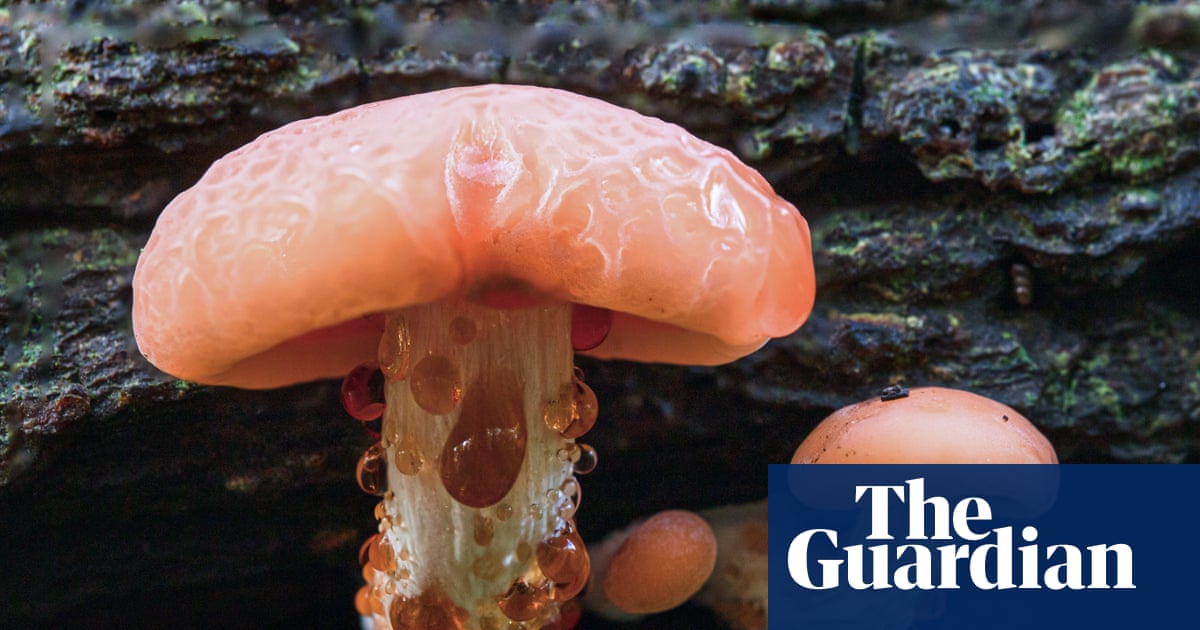
Where older logs have shed their bark, the exposed wood is marked by elm bark beetle etchings (or “galleries”) and the emergence holes of deadwood beetles.Raveley Wood is one of a chain of small, elm-rich woods along the Cambridgeshire fen edge. I’m here searching for wrinkled peach, a contender for Britain’s most beautiful mushroom: it has a salmon-pink cap, delicately wrinkled, and gills of the same shade.
Ruddy-orange, jewel-like droplets often gather on its stem, a process known as guttation.Its fortunes follow the elm’s. Usually found on decaying, often barkless trunks, it was rare in Britain before Dutch elm disease struck in the late 1960s.
For a decade or two it flourished among the dead trees. Now, with fewer mature elms remaining across Britain and Europe, it’s classified as “vulnerable”.
But here, in Cambridgeshire’s elm woods, it persists.Raveley Wood in Cambridgeshire, a UK stronghold for elm trees. Photograph: Sarah LambertOff the trampled path, I pick my way between fallen branches and low bramble, searching trunk after trunk.
Underfoot, the clay still bears scars from the summer drought: fissures wide enough to turn an ankle. After the extreme summer weather, the fungus season seems reluctant to begin; many species are less abundant than usual.
An hour passes. No wrinkled peach.
I’m losing heart.As I turn to leave, my heart leaps as the low afternoon sun catches a pink speck on an elm log. Less than a centimetre across, it’s the tiniest wrinkled peach I’ve ever seen.
Its cap is barely wrinkled, but its slightly grubby stem holds a small cluster of sparkling droplets. I kneel in the leaf mould and lean close.
Accounts describe a scent of peach or apricot, or no distinctive odour. I detect nothing.Later in the season I may find a finer specimen.
For now, this pink speck is beauty enough.