


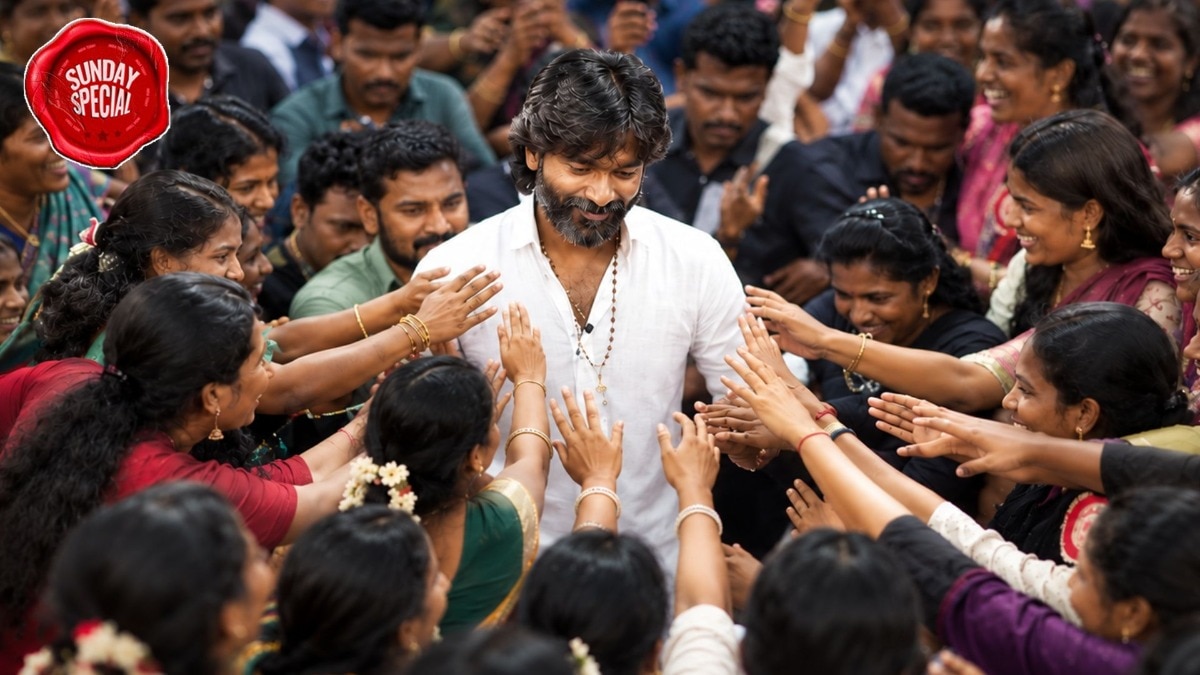
"From his initial days in the film industry, Dhanush was written off by many. Nobody took him seriously.
He was called a naramban (a Tamil word used to mock his lanky physique). But he overcame that, and today he is one of the most versatile actors of our time," says a journalist who is a big Dhanush fan. "Now, with the buzz of his possible entry into politics, people are again writing him off.
But he can prove everyone wrong again."The remark perfectly captures the mood surrounding Dhanush's possible political ambitions. The actor, who has built a reputation for taking on challenging roles and establishing himself beyond conventional ideas of a Tamil cinema hero, is now at the centre of speculation about whether he could follow Tamil Nadu Chief Minister C Joseph Vijay from the silver screen into electoral politics.Dhanush has not announced any plans to enter politics.
But the restructuring of his fan network into the Dhanush Narpani Iyakkam, its growing focus on welfare activities and a recent gathering of women supporters have sparked questions about his next move.The developments surrounding Dhanush have drawn comparisons with Vijay's journey from fan clubs to a political movement. Dhanush meeting members of Dhanush Narpani Iyakkam, a fan club-turned-welfare association, at the success event of Magalir Ani Sandhippu 2026. (Video credit: X/@Dnarpaniiyakkam)Vijay, who joined politics and established the Tamilaga Vettri Kazagham (TVK) party in 2024, and achieved electoral success in the 2026 Assembly elections, has made the questions around Dhanush's entry stronger.
In the 2026 Assembly polls, TVK won 108 of the 234 seats and secured 35% of the votes, roughly one in every three votes cast. S Ramesh, a senior journalist with the Tamil-language weekly news magazine Thuglak, tells India Today Digital that many had expected Vijay to secure around 8% to 10% of the vote share, making the actual result much stronger than anticipated.
It demonstrated the scale of the political opening available to a film star capable of converting popularity into votes in Tamil Nadu.What makes speculation around Dhanush even more interesting is the contrast between the screen identities of the two actors. Vijay's films have positioned him as a larger-than-life saviour who confronts powerful institutions on behalf of ordinary people, particularly backward communities and Dalits.
Dhanush, meanwhile, has earned praise for portraying Dalit men dealing with caste oppression, poverty, humiliation and social exclusion.The question, therefore, is whether Dhanush, if he enters politics, could attract the voters who helped Vijay upset Tamil Nadu's established political order, long dominated by two Dravidian giants."Dhanush's screen image of being a person who represented Dalits can help him reach sections of Scheduled Caste (SC) communities that have supported Vijay. Dhanush's Other Backward Classes (OBC) community could potentially offer him a connection with other social groups," Ravindran Duraisamy, a Chennai-based social and political expert, tells India Today Digital.Sandhya Ravishankar, a Chennai-based senior journalist, says, "Dhanush could eat into Vijay's vote share, but he has yet to establish a clear ideology, political positioning or vision for governance."Obviously, the 43-year-old, if he decides to enter politics, will have to establish these at the right time.Tamil Nadu, a state which has witnessed duopoly competition in movies and politics since the 1950s, is clearly showing a vacuum for the position of a credible and contemporary challenger to Chief Minister Vijay, who has a persona built on his films, which his current opponent, the Leader of Opposition in the Tamil Nadu Assembly, Udhayanidhi Stalin lacks.
Dhanush receiving his sixth National Film Award from President Droupadi Murmu in September 2026. The actor is known for his versatility. (PTI) DECODING VIJAY AND DHANUSH'S FILMS: A SAVIOUR AND A WOUNDED HEROThe contrast between Dhanush and Vijay becomes sharper when their films are examined through the relationship each hero shares with the people he represents.In Asuran (2019), Dhanush plays Sivasamy, a Dalit farmer whose family gets caught in a violent conflict over land and caste power.
His struggle is not just against an individual villain but against a social order built on land ownership and entrenched hierarchies, where the dignity and survival of Dalit communities remain at stake.In Karnan (2021), Dhanush plays a young Dalit man from the Devendra Kula Velalar (DKV) community in Podiyankulam, a village in southern Tamil Nadu. He fights humiliation and institutional discrimination, with the denial of basic facilities, including access to a bus stop, becoming a symbol of the community's exclusion.
His resistance emerges from the collective experience of people denied dignity and recognition.Captain Miller (2024), set during British rule, also explores oppression and exclusion, placing Dhanush's character in conflict with those who exercise power over marginalised people. Together, these roles have established a recurring screen image of a man shaped by injustice who eventually resists it.Dhanush's films are more socially conscious, often making audiences experience injustice from the perspective of those subjected to it.
Dhanush enjoys a strong connection with audiences, particularly younger viewers and sections of the working class, who relate to his humble beginnings, understated personality and grounded screen presence. (PTI) In Vijay's films, meanwhile, audiences frequently rally behind a resourceful hero who takes on the system on behalf of others.For example, in Kaththi (2014), Vijay takes on corporate interests and the exploitation of farmers. In Mersal (2017), he confronts corruption and inequality in healthcare, while Sarkar (2018) places electoral malpractice and political accountability at the centre of its story.
The protagonists are powerful, confident and publicly influential figures who challenge institutions that ordinary citizens struggle against. This is a recurring theme in Vijay's films.This larger-than-life screen image has become a significant part of Vijay's appeal.
When his popularity translated into electoral success, political pundits largely attributed it to films that had consistently framed him as a leader.MK Raghavendra, a Bengaluru-based film scholar and author, tells India Today Digital that cinema and politics in southern India should not be understood separately from the region's social and caste dynamics."Hindi cinema addresses a pan-Indian audience, whereas regional-language cinemas of the south operate within more geographically and culturally defined spaces. Caste, particularly jati, is rooted in local social structures, which makes it easier for regional cinemas to reflect caste identities and local power relations," he says."Therefore, in southern cinema, regional narratives and local caste dynamics can play a more direct role in shaping the hero and the audience's identification with him," Raghavendra, who has authored seven volumes of film criticism, including three academic works on Bollywood and one on Kannada cinema, adds.Raghavendra also cautions against reducing either actor's political appeal to caste identity alone, particularly given Tamil Nadu's social scenario."Vijay's popularity must be understood within Tamil cinema's Dravidian political and cultural tradition, where a broader regional identity can sometimes matter more than an individual's caste background," he says.
Udhayanidhi Stalin, then Deputy CM of Tamil Nadu, presenting an award to actor Dhanush during a ceremony of the Tamil Nadu State Film Awards for the years 2016 to 2022, in Chennai. (PTI) THE CASTE FACTOR: AN OPENING, NOT A GUARANTEE FOR DHANUSHAccording to experts, Tamil Nadu's social landscape could offer Dhanush a political opening, mainly due to the fondness he enjoys among Dalit communities and him belonging to the Gavara Naidu community."Dhanush is a prominent actor who has portrayed Dalit characters in several films, and people from communities such as the Arunthathiyars, Paraiyars and DKV, hold him in high regard and feel a strong affinity towards him. Although he belongs to the Gavara Naidu OBC community," Duraisamy says.Duraisamy lists Arunthathiyars, Paraiyars and Devendra Kula Velalar (DKV) as Tamil Nadu's three largest Scheduled Caste communities.
He estimates that they account for nearly 25% of the state's population, including Christians who converted from these communities. According to him, around 20% of the members of these communities are Hindus and the rest 5% are Christians."Dhanush has been repeatedly speaking about the spiritual beliefs of the Hindus of these communities to woo them," he says."Vijay enjoys considerable support among Dalit communities and has often played the saviour of the downtrodden in his films.
Dhanush, however, has portrayed characters from these communities and is perceived by some sections as someone who understands their lived experiences. This distinction could yield political dividends for him," the political and social expert adds.Dhanush participating in a welfare event organised by his fan club. (Video credits: X/@Dnarpaniiyakkam)The attempt to build an appeal across OBC and Dalit communities, however, could face contradictions.
These blocs are diverse, and their interests do not always align. A hero fighting caste oppression on screen does not necessarily resolve the social tensions that shape everyday politics.Perasiriyar Ayya, a retired professor at Thiagarajar College, who belongs to the DKV community, cautions against reducing Dhanush's political prospects to SC support alone."In Tamil Nadu's political history, MG Ramachandran (MGR) was active in politics for many years.
Alongside his film fame, he earned a reputation as a fundamentally good person. On three foundations: popular devotion, a political background, and personal virtue, he was able to win huge success in politics," Perasiriyar Ayya says."It must be understood that MGR did not win that success merely because he was an actor," Ayya adds.So, Dhanush's films might bring questions of caste and social exclusion to the forefront.
But whether he can turn that connection into lasting political support would depend on the positions he takes outside cinema and the work his organisation carries out on the ground. Dhanush fans celebrate the actor's birthday in Senthoor village, Villupuram district, Tamil Nadu. (Special Arrangement) HINTS BY DHANUSH ON ENTRY INTO POLITICS: FROM FAN CLUBS TO A POLITICAL MOVEMENTSpeculation about Dhanush entering politics has intensified following developments within his fan network in 2026.In July, he urged supporters to move beyond film-related celebrations and direct their collective strength towards community welfare.
The message came at a blood donation camp organised by his fans and prompted comparisons with the way Vijay's fan network developed a public-service profile before TVK's formation.The organisational changes became more visible in October, when Dhanush's fan club was restructured as the Dhanush Narpani Iyakkam, or Dhanush Welfare Movement. The group signalled an emphasis on organised social service.On October 25, Dhanush met around 3,000 women supporters at a private college near Chennai.
He posed for photographs and distributed silver Kamatchi lamps. The lamps are associated with Goddess Kamakshi, symbolising prosperity and auspiciousness.
The gathering raised eyeballs because of the timing of the reorganisation. However, there was no political announcement made at the event.Dhanush received a grand welcome by the members of his women's club in Chennai. (Video credits: X/@Dnarpaniiyakkam)His supporters have also been involved in blood donation, educational assistance, relief work and other welfare activities.
Dhanush also has plans to expand educational support across the 234 Assembly constituencies of Tamil Nadu, which has added to the impression that the network is trying to build a more structured presence.Dhanush's reported meetings with a senior RSS leader have also fuelled speculation, but there is no established evidence that they resulted in a political agreement.TN Raghu, a Chennai-based journalist and political observer, says he is sceptical that Dhanush currently has the mass following needed to match Vijay."Dhanush is a fantastic actor, there is no doubt about that. He is a commercial hit as well as having made several movies with intense social messages.
Any day we can argue that Dhanush's acting is better than Vijay's. But I'm sceptical of Dhanush's political success like Vijay because there is no competition between Vijay and Dhanush in terms of fan following," Raghu tells India Today Digital.Raghu adds, "Dhanush has a smaller fanbase when compared to Vijay's.
His meeting with women fan clubs recently looks like a deliberate strategy to understand the circumstances of his political entry."So, for Dhanush, the actual test would be whether welfare activity can develop into sustained grassroots engagement, and whether that support can survive the shift from celebrity fandom to electoral politics. Dhanush's welfare activities are not new.
He has been providing financial assistance and other help to families for years. THE LESSON FOR DHANUSH FROM MGR, SIVAJI AND VIJAYAKANTHTamil Nadu has a long history of film stars seeking to turn screen popularity into political power.
Their journeys offer both inspiration and caution.MGR built his political career through association with the Dravidian movement before rebelling and launching the AIADMK. His screen image, public reputation, political experience with the DMK reinforced one another.
His success showed how cinema could amplify a political identity that had already developed beyond the screen.Sivaji Ganesan, did not achieve comparable electoral success, despite his stature as one of Tamil cinema's most decorated actors. Vijayakanth founded the DMDK party and made a more substantial political impact, but his journey also demonstrated the difficulty of maintaining a party around a popular personality.The lesson from these towering actors is that stardom can open the door, but it cannot do all the work in Tamil Nadu.To understand Tamil Nadu's politics, films and social history, read: India Today's, Time, Tide & Tamil, 50-part seriesAyya makes a similar point about Vijay. "We must understand that Vijay set foot in politics after correctly grasping the vacuum left by the absence of two towering personalities, K Karunanidhi and Jayalalithaa," he tells India Today Digital."Therefore, it is wrong to say this success came only from film glamour.
The weakness of the existing political leadership is also an important reason," Ayya adds.Vijay's 2026 result gives Dhanush a model to study, but not a ready-made formula to copy. The political landscape keeps changing, and an actor entering now or in the near future would have to compete with a sitting CM who has already demonstrated his ability to mobilise voters across the state.Chennai-based journalist Sandhya believes Tamil Nadu will see greater voter fragmentation if more actors enter politics."Tamil Nadu is likely to witness significant fragmentation of votes in the coming years, with several actors harbouring political ambitions.
Dhanush is one of them and could emerge as a challenger to Vijay. Another prominent actor, Sivakarthikeyan, is also working on the ground towards a possible political entry," she says."Going forward, Tamil Nadu politics could revolve around a contest between Vijay, Dhanush and Sivakarthikeyan," Sandhya says.
Members of Dhanush's fan association pull the golden chariot, Thanga Ther, during a special prayer at the Arulmigu Thiru Ardhanareeswarar Temple on the occasion of the actor's 43rd birthday, in Tiruchengode, Namakkal district. (PTI) WILL CHIEF MINISTER VIJAY'S VOTE BANK GET FRAGMENTED IN TAMIL NADU?If Dhanush enters the political arena, the first question will be whether he can draw support away from Vijay. Senior journalist S Ramesh tells India Today Digital, "If Dhanush enters politics, even a small erosion in Vijay's vote share could make a difference.""Vijay attracted voters across party lines, castes and communities.
Dhanush's entry could eat into that support," he adds.Dhanush could appeal to some of those voters, including people drawn to his film roles and sections of Rajinikanth's fan base."Dhanush would certainly be able to attract a section of Rajinikanth's supporters. The characters he has portrayed, particularly those representing Dalits and the downtrodden, could also influence his political appeal," Ramesh says.After his fan club's meet-and-greet event, Dhanush thanked journalists and wished them 'Happy Diwali'. (Video Credit: India Today Group)The Thuglak journalist believes Dhanush would need an alliance if he wanted to challenge Vijay seriously in his first election."If Dhanush decides to enter politics, he will need an alliance from the very first election he contests, particularly if he wants to take on Vijay.
The NDA bloc, comprising the BJP and the AIADMK, could be the best option for him," Ramesh tells India Today Digital.The possibility of a contest between the two actors also depends on Vijay's performance in office. TVK's 108 seats in the Assembly polls have given Vijay a strong electoral platform, but his party's long-term prospects will depend on governance, delivery of promises and its ability to maintain a diverse coalition.Dhanush could find political space if Tamil Nadu voters get dissatisfied with Vijay.
But he would need to offer a credible alternative, not merely an alternative personality. If Vijay's government delivers on the expectations of voters, the room for a new entrant could become narrow.
If it disappoints, the opening for Dhanush could widen.Vijay's rise has shown that Tamil Nadu's cinema-politics equation can always deliver surprises. Whether Dhanush can repeat that feat will depend not on how convincingly he portrays the Dalit roles on screen, but on whether he can convince voters that he is ready to lead them in real lifeOnce dismissed as naramban for his lanky physique, Dhanush went on to prove his critics wrong with his acting.
With his upcoming mega movie, he has another opportunity to silence doubters on the big screen. Whether he can do the same in politics, we might have to wait till 2031 to find out.- Ends