


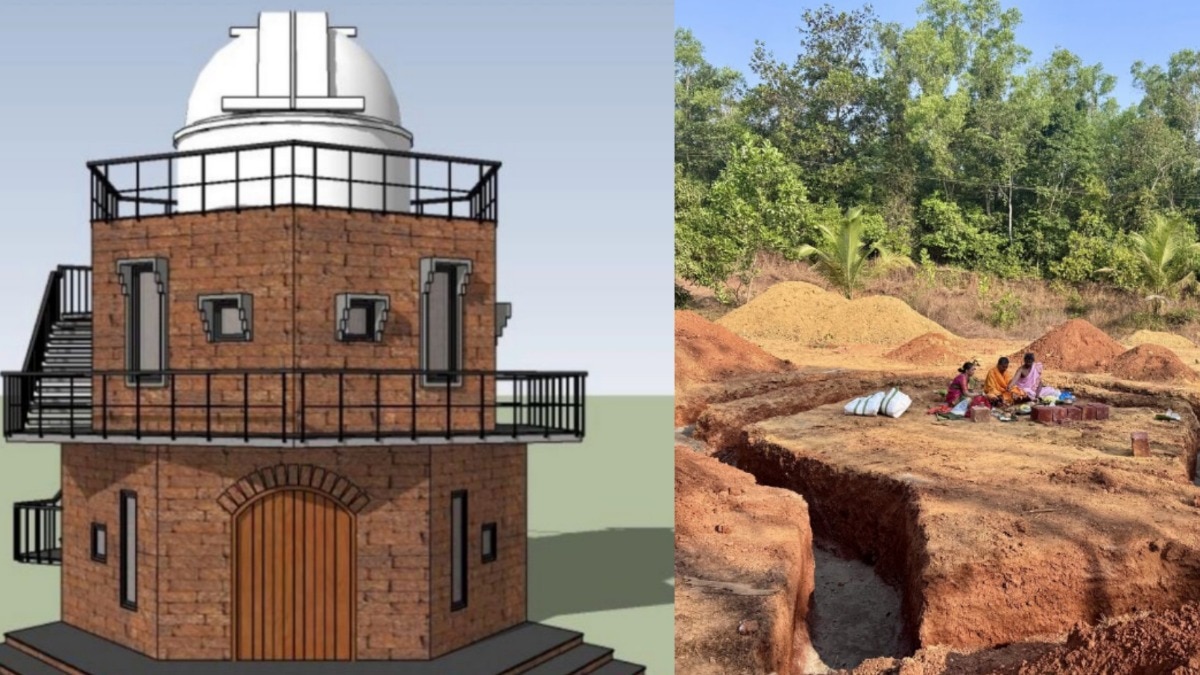
A Bengaluru-based engineer is working to bring a space observatory to the small town of Honnavar, giving rural students an opportunity to explore astronomy. Led by Sandeep Hegde, the Honnavar Foundation's initiative also aims to promote astro-tourism, an emerging concept in India.
The foundation's journey has only just begun. A curiosity to reach beyond stars gave rise to ISRO, India's space organisation, which, within decades of its establishment, accomplished what once seemed beyond the reach of the nation.
From launching its first rocket, carried on bicycles and bullock carts, to placing satellites for countries such as the US and France into orbit, ISRO has travelled a far distance.In a small town of Karnataka, an engineer is stilly walking along a similar path, seeking to bring the wonders of universe within the reach of students from rural government schools.Sandeep Hegde, a software engineer by profession, is presently based in Bengaluru.Hegde's undertaking is associated with a trust – the Honnavar Foundation – which, despite limited resources, is endeavouring to establish an infrastructure that may awaken in rural students a lasting curiosity about the stars, planets and the mysteries of the universe. Perhaps, from among these young minds, another Kalam may one day emerge.He himself hails from the small town of Honnavar, where the setting sun lends the landscape a particular charm and the night sky offers a clear view, a perfect location for an observatory.
Taken by a telescope at Honavar facility. It is from this connection with his native place that his ambition for a rural space observatory and education centre has taken shape.The proposed centre, named Hontara, carries within its name a deeper meaning, drawing upon indigenous vocabulary and bringing together elements of Kannada and Sanskrit.For Hegde, the undertaking is not merely about erecting a structure and installing a telescope.
It is about making the study of space accessible to those who might otherwise have little opportunity to encounter it beyond the pages of a textbook.As a trustee, Hegde is seeking wider support for the initiative.The project, as he envisions it, seeks to bridge an educational divide by strengthening STEM learning and encouraging a keener interest in planetary movements, astronomy and the possibility of life beyond our solar system.In his view, much of the existing infrastructure for astronomical observation is situated in urban surroundings, where light pollution and the difficulty of obtaining clear skies can become obstacles to observing the movement of stars, planets and different developments above our heads.As described by the Foundation on its LinkedIn account, the initiative is intended primarily for government school students and is conceived as a community-level centre for scientific learning.The facility, which is presently under construction, has already witnessed its foundation-stone ceremony this year. The proposed arrangements include an outdoor observation area for night-sky viewing and solar observations, alongside practical demonstrations through which students may encounter scientific principles.As reported by TOI, the different floors of the proposed observatory are intended to serve distinct purposes.
The facility is expected to house a motorised, 360-degree rotating dome and advanced telescope mounts.The centre also envisages a space for visitors, and, as reported by TOI, approximately 800 people recently turned up at the location. Hegde, however, expressed concern that the site then had only four telescopes to accommodate the interest shown by visitors.The response, encouraging as it may be, has also brought into view the scale of the infrastructure required to serve the public adequately.The trust is consequently planning to install around ten telescopes and deploy a dedicated team to oversee the facility and its activities.A particularly major aspect of the undertaking is its intention to provide free visits for school students.At the same time, the trust is considering ways of making the centre self-sustaining through astro-tourism, an avenue that is increasingly attracting attention in different parts of the world.Countries such as China and the United States have advanced considerably in the development of space-related infrastructure and public engagement with astronomy, and the proposed centre seeks to establish a modest but meaningful presence in this larger field.The foundation stone for the observatory was laid on February 22, with initial support extended by Vayavya Labs Private Limited.Experts from the field have also been advising the project on its technical specifications.
Thus far, a Dobsonian telescope has been procured.The Foundation is actively seeking funds to bring the undertaking to completion, with the aim of realising its vision by the end of 2026, Hegde added.- Ends