


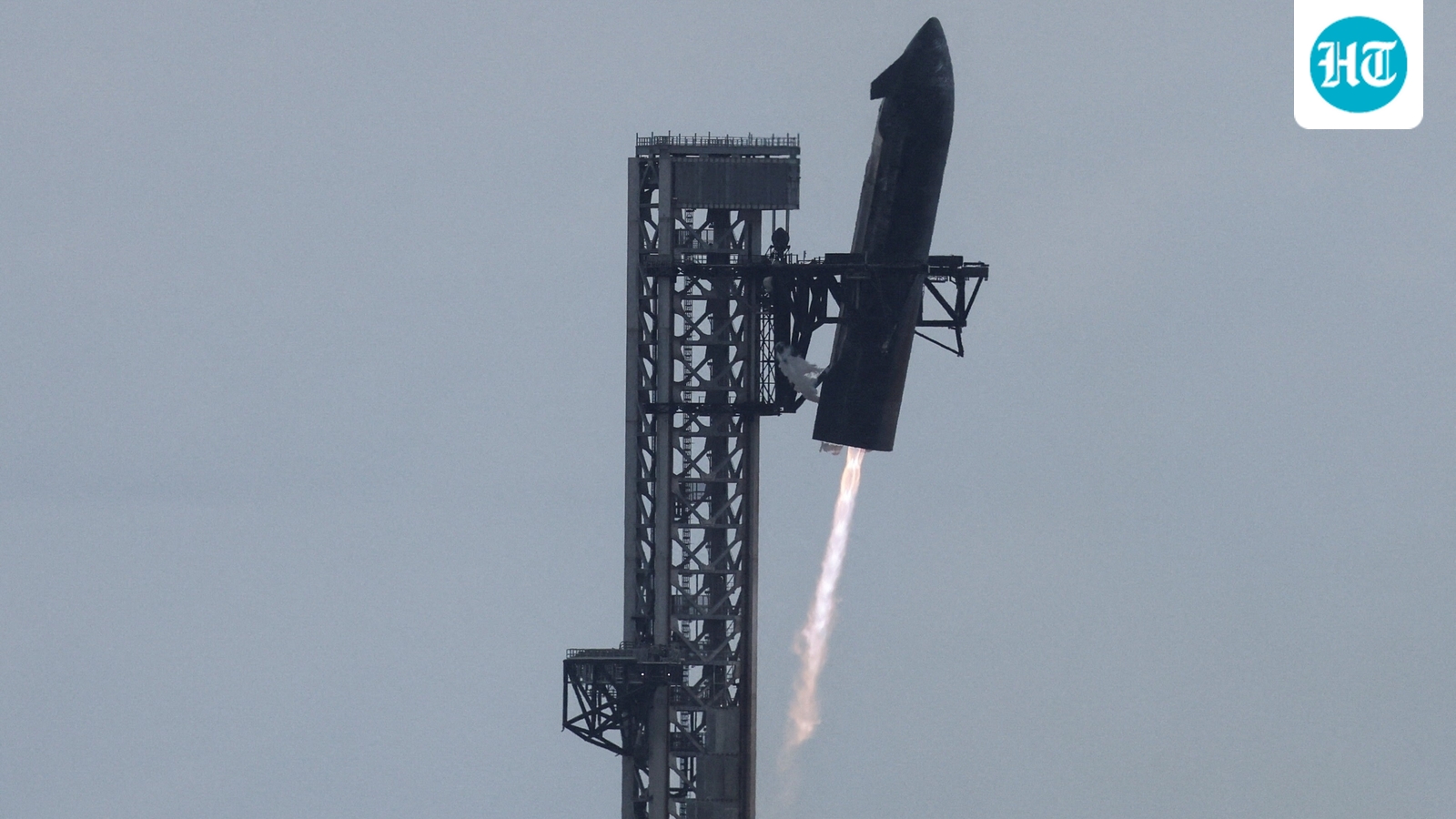
This marked a major technical achievement as it was the first-ever "catch" of a spacecraft. SpaceX Starship 42 returns from orbit to the launch pad on the 15th test flight from the SpaceX launch complex in Starbase, Texas, US, November 14, 2026. (REUTERS)The milestone also demonstrated the potential of fully reusable rockets, which could make space travel more affordable.The 171-foot-tall spacecraft descended through thick clouds over SpaceX's Starbase launch facility before reigniting its engines to turn upright and slowly approach the launch tower.
Its two small fittings near the top were caught by the mechanical arms, allowing the spacecraft to hang above the ground, as reported by news agency Reuters.The spacecraft had completed 14 orbits around Earth before returning to the same facility from which it had taken off on Friday. It was charred from the heat of atmospheric re-entry but remained stable after its engines shut down.SpaceX mission commentator Dan Huot described the achievement as a major breakthrough, according to Reuters. "That was the missing link, the holy grail of spaceflight," Huot said.Starship deploys 26 Starlink satellitesStarship lifted off from SpaceX's Starbase facility in Texas on Friday for its 15th flight.
During the mission, it reached orbit and deployed 26 Starlink satellites at an altitude of around 161 miles (260 km).According to SpaceX, the Super Heavy booster initially lifted the rocket using 33 Raptor engines before separating from Starship through a hot-staging manoeuvre. The spacecraft then continued its journey using six Raptor engines.Starship lifted off on Friday for its 15th flight from SpaceX's Starbase facility in Texas. (X/@SpaceX)The booster attempted to return to the launch site but could not complete the planned recovery.
Its boostback burn ended earlier than expected because of low fuel mass, according to SpaceX.The vehicle subsequently diverted to an offshore landing location following an automated abort triggered by its guidance, navigation and control system.Starship, meanwhile, continued its mission and remained in orbit for more than 20 hours. After deploying the satellites, the spacecraft began preparing for its return.It reignited one of its engines to perform a deorbit burn before descending through Earth's atmosphere towards the Texas coast.
Three Raptor engines then ignited to help it turn upright and slow down before the mechanical arms caught it.A step towards fully reusable rocketsThe successful recovery is an important step in SpaceX's plan to bring both stages of its rocket system back to Earth for reuse.The company's Falcon 9 rocket already allows the recovery and reuse of its first stage. However, its second stage, which carries payloads into orbit, is discarded into the ocean after each flight.With Starship, SpaceX aims to develop a system that can travel to space and return in a way similar to commercial aircraft, requiring minimal refurbishment between missions.However, the company has not yet recovered both stages of Starship in a single mission.
Its heat shield, made up of hundreds of black hexagonal tiles designed to protect the spacecraft during atmospheric re-entry, also requires further development before it can be reused with little or no refurbishment.SpaceX CEO Elon Musk congratulated the teams involved in the mission, sharing photographs and videos of the recovered spacecraft on X."Congratulations to an incredible team at SpaceX!!!" Musk said in a X post.NASA administrator Jared Isaacman also congratulated the company, describing the achievement as a step towards future lunar missions. "Congrats to @elonmusk and the @SpaceX team! It was almost magic..Making more believers by the day....one step closer," Isaacman said in an X post.Google CEO Sundar Pichai congratulated the team for the achievement.“Congrats @SpaceX for that Starship catch, still feels like science fiction!
Watching it live was incredible. Upwards!,” Pichai posted on X.SpaceX has spent more than $15 billion developing Starship.
NASA has also committed $3.2 billion through a contract awarded in 2021 to use the spacecraft to return astronauts to the Moon under its Artemis programme.One of the major challenges for Starship is demonstrating fuel transfers between tanker spacecraft in orbit. The process is essential for enabling the vehicle to travel beyond Earth's orbit and reach the Moon.The successful recovery of Starship's upper stage is therefore a significant engineering achievement, although the company still has work to do before it can make the entire rocket system reusable.(With inputs from agencies)Roshan Tony is an early career journalist at Hindustan Times whose.
He joined the organisation as an intern before becoming part of the newsroom team. Roshan holds a Master's degree in Mass Communication and Journalism from the Central University of Karnataka and a Postgraduate Diploma in English Journalism from the Indian Institute of Mass Communication (IIMC).
His academic interests include critical theories and film studies, and he is particularly interested in developing research that connects media, philosophy and politics. Before joining Hindustan Times, Roshan interned with Mathrubhumi, where he primarily worked on regional news, gaining hands-on experience in newsroom operations, reporting and news production.
Beyond journalism, Roshan is a writer and filmmaker with a passion for storytelling across mediums. He has written and directed short fiction films and directed a documentary on the Lavender Revolution in Doda for the Ministry of Information and Broadcasting, exploring the region's socio-economic transformation.
His creative interests extend to philosophy, literature and reading, which continue to shape his perspective on journalism and storytelling. He is also interested in developing academic papers that bridge media studies, philosophy and politics.
Through his work, Roshan aims to combine accuracy, depth and compelling narratives to produce journalism that informs, resonates and develops readers.Read MoreSpacexSpacecraftElon Musk