


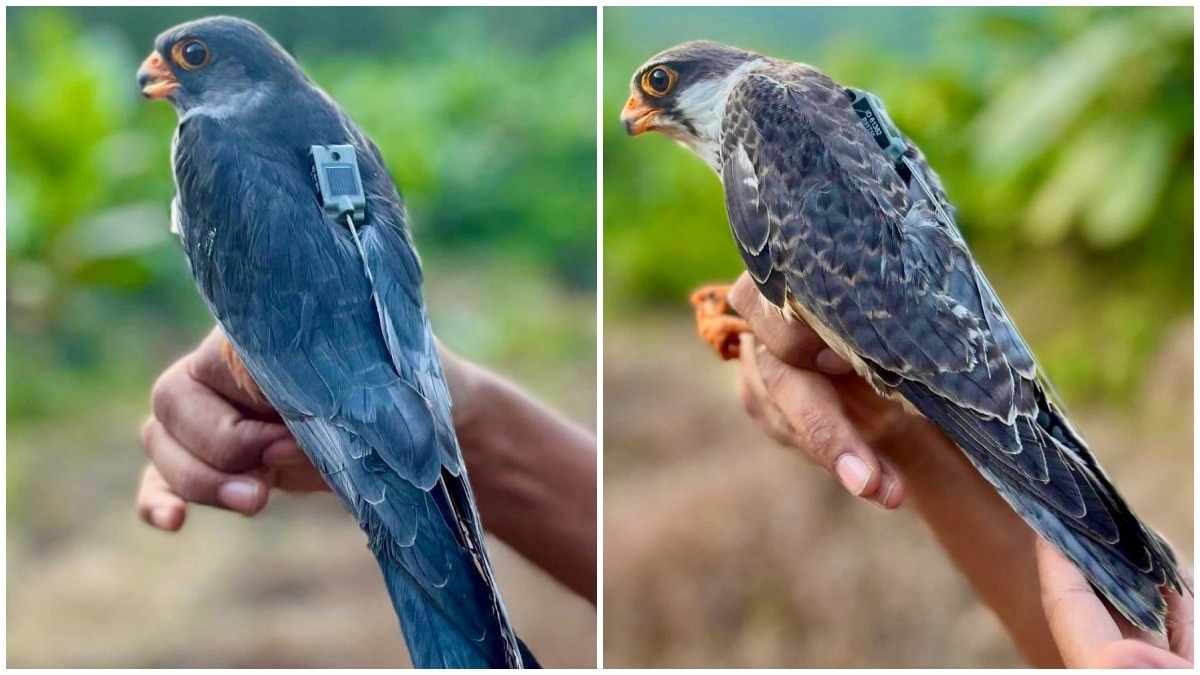
Satellite-tagged Amur falcons Apapang and Alang have returned to Manipur after crossing 23 countries. Nearly a year of tracking is revealing their migration routes, endurance and stopover behaviour.Apapang and Alang are expected to spend two to three weeks at selected stopover sites in the mountainous terrain of Manipur's Tamenglong district.
NNew Delhi,Oct 23, 2026 15:32 ISTTwo satellite-tagged Amur falcons, Apapang and Alang, have returned to Manipur after travelling across 23 countries during their remarkable migratory journey spanning Asia and Africa, Union Environment Minister Bhupender Yadav said.The birds arrived in Manipur after setting off from their breeding grounds in northeastern China 11 days earlier, completing their round-trip journey to the state since scientists from the Wildlife Institute of India (WII) tagged them in November 2025.Sharing the update, Yadav described the falcons as “truly global citizens”, highlighting the extraordinary distances covered by the migratory birds and the importance of tracking their movements across continents.The return also marks the successful completion of nearly a year of tracking, offering scientists valuable insights into the migration routes and behaviour of one of the world's most remarkable long-distance migrants. A journey to India through 23 countries!
Having started from their breeding areas in northeastern China 11 days ago, the two Amur Falcons Apapang and Alang arrived in Manipur yesterday. This marks the successful completion of their nearly year-long tracking and also their round-trip journey back to Manipur since tagging by scientists of WII in November 2025; travelling through 23 countries on their journey across Africa and Asia, the Amur Falcons are truly global citizens.
The two Amur falcons are expected to now make a two to three week stopover at select sites in the beautiful mountainous tracts of Tamenglong district in Manipur, where local people now eagerly wait for their return year after year and protect the falcons. Feasting on the termites emerging in and around their stopover sites the Amurs will put on fat reserves that is critical for their next leg of migration, which will be a 6-day nonstop flight of nearly 6000 km from here to Somalia that also includes a 3000 km Arabian Sea crossing.
The Amur Falcons are truly remarkable for their migration journeys.— Bhupender Yadav (@byadavbjp) October 23, 2026 MANIPUR STOPOVER PREPARES FALCONS FOR NEXT JOURNEYApapang and Alang are expected to spend two to three weeks at selected stopover sites in the mountainous terrain of Manipur's Tamenglong district.The region has become an important resting point for Amur falcons during their annual migration. Local communities eagerly await the birds' return each year and play a crucial role in protecting them.
During their stay, the falcons will feed on termites emerging around their stopover sites. This feeding helps the birds accumulate fat reserves, providing the energy required for their next demanding leg of migration.Their journey from Manipur is expected to take them towards Somalia in Africa, involving an approximately six-day nonstop flight covering nearly 6,000 kilometres.
The journey includes a challenging 3,000-kilometre crossing of the Arabian Sea.WHY AMUR FALCONS ARE REMARKABLE MIGRANTSAmur falcons (Falco amurensis) are small migratory raptors that breed in northeastern Asia and travel thousands of kilometres to reach their wintering grounds in Africa.India, particularly the northeastern states, serves as a crucial stopover during their migration. The birds' annual arrival in Manipur has also become an example of how community-led conservation can protect migratory wildlife.In the past, Amur falcons faced threats from hunting in parts of the region.
Sustained conservation efforts and the involvement of local communities have helped establish a culture of protection around their seasonal arrival.The satellite-tracking of Apapang and Alang is helping researchers understand the scale of these migrations, including the birds' routes across multiple countries and their endurance during long ocean crossings.- Ends