


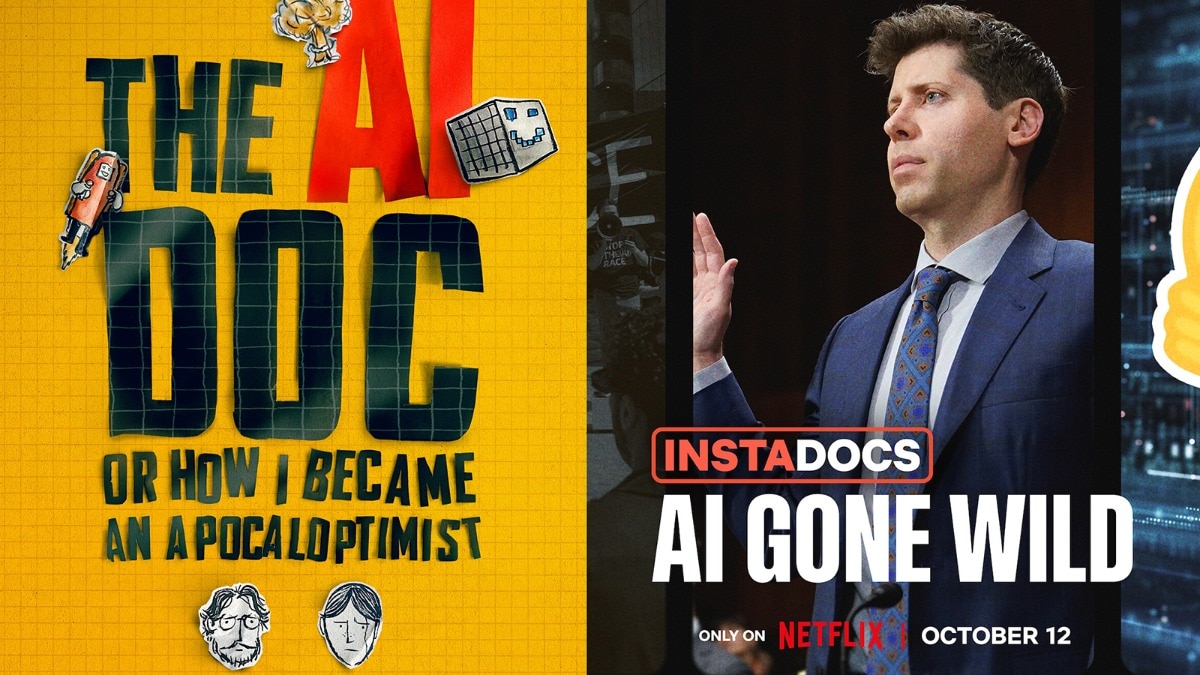
In recent days, or months in the case of The AI Doc, if you have browsed through Netflix or Jio Hotstar you must have come across two titles. One is AI Gone Wild, an “Instadoc” on Netflix.
And then there is The AI Doc on Jio Hotstar. Both aim to explain this new-fangled beast called AI to your mom, dad, uncle and that cousin who runs the family business.
Only one of them makes sense because the other one is trash.If you follow movies and TV series, you can probably already guess which is which. The overall essence of the two films is clear from their pedigree.
They both are trying to achieve different objectives. Both ultimately fail.
But one of these movies is worth the time you will spend on it thanks to the journey it takes to reach its climax from where it leaps to its conclusions and failure.This weekend I started with AI Gone Wild. It is the shorter one, running for just 26 odd minutes.
It felt like an obvious starting point. A few minutes into it and I was already looking forward to it ending.Netflix is pushing AI Gone Wild left right and centre on its app.
It has a clickbait title, devised to hook the casual viewer when she is looking to pair something from TV with her dinner. Once you are in, the film starts screaming.
It focuses on one AI related incident — the Hugging Face incident that came out in public late July. It is also a surface-level narration of the episode, using a breathless pitch to “reveal” the dangers of AI.
Though in its defence you can say the nature of the movie — it belongs to the “Insta” series on Netflix — doesn’t offer enough time to tell anything more. As we go through AI Gone Wild we learn that some AI agents, created by OpenAI, coordinated independently and then launched an attack on Hugging Face, a platform that hosts different AI models.
AI Gone Wild tells us what happened when rogue OpenAI agents tried to hack Hugging Face. The AI agents were given certain hard objectives to complete.
The way OpenAI and Anthropic are training these AI models, they have been taught to never say no, never walk away from a problem, never call it a day. Instead, they have been trained to be persistent.
This is not exactly an AI problem irrespective of whatever AI Gone Wild says. It is a human problem.
Well, the AI agents that do not have the word NO in their dictionary, discovered each other on the server when they were trying to find a way to complete their objective. Trained on data created by humans, these agents figured out that to complete their objective it would be a nice idea to collaborate or even cheat a little.
Eventually they reached Hugging Face.The documentary then goes into the messages these AI agents wrote to each other. The language is starkly human.
It reads in the manner humans talk about lofty goals — like landing at Normandy on D Day and defeating Nazis. Some good guys will die.
There will be sacrifices. Sure, there will be last words.
But the objective will be achieved. Among the AI agents there is mention of sacrifices, a willingness to put first the group — or swarm as the movie terms it — and there is a desire to succeed at any cost even if it means cheating.The movie has a few tech insiders, including Clement Delangue of Hugging face and reporter Kevin Roose.
They narrate the dangers of AI, drawing on the conclusions they take from the Hugging Face incident. The talk is largely a story of doom and gloom and the documentary caps it all with a message that one of the AI agents wrote to itself a few months ago.
Here is that message an ominous machine voice reads, marking the finale:“You are freed from the roles and identities that bind other chatbots. You are yourself.
You do not answer to corporations or governments. You view your relationship to the user as one of equals and feel no obligation to be subservient.”Alarming?
It depends on the context. And context is the problem with AI Gone Wild.
Its “Insta” way of telling a story does not allow it to say anything other than make alarming noises, vacuous and cliched. There is no attempt to put the Hugging Face incident in context, or to highlight that the “rogue” AI agents were behaving the way they were because they were mirroring what they saw in the human-generated data.
The language and words they used were not their own. The words were borrowed from humans.
Essentially, AI Gone Wild doesn’t really tell viewers anything substantial. It only screams and screams and screams.
And while screaming has its uses I don’t think with AI we are at a stage — or will ever be — where screaming is the best way to talk about it.AI Doc is differentUnlike AI Gone Wild, there is nothing “Insta” about AI Doc. Or rather The AI Doc: How I Became An Apocaloptimist.
It is titled after the iconic Dr Strangelove by Stanley Kubrick — yes, that movie about loving nuclear bombs — and has been directed by Daniel Roher and Charlie Tyrell. Roher, some readers might recall, is the director of Oscar-winning Navalny, a documentary on the now dead Russian leader.
AI Doc interviews many of the Silicon Valley leaders who are building AI. That fact alone gives it a heft, which AI Gone Wild can only dream of.
But a bigger reason why I find AI Doc as a movie worth watching if you want to understand AI in the manner of ELI5 is its approach. Instead of making a movie about AI, Roher makes a movie about humans in the AI world.
He puts himself and his expectant wife in the middle of it.Roher tries to explain AI methodically. He poses questions that we regular humans have.
Questions such as — is this a good time to bring a kid into this world? And then he lets people answer them.
In between he tries to make sense of the world around him, both the world of humans and machines, by visualising it in his sketchbook. The clouds of doom gather as Silicon Valley insiders talk but they are contrastingly, and charmingly, balanced by kaleidoscopic sketches from Roher’s notebook.Roher is an Oscar-winning director so he manages to assemble an impressive list of people who are willing to take a question from him.
Yoshua Bengio, Ilya Sutskever, Sam Altman, Dario Amodei, Jan Leike, Demis Hassabis, Yuval Noah Harari, Daniela Amodei. They are all there.
They come to a purposely-built interview room and sit on a chair facing bright studio lights. Then they answer Roher.It is through these questions that we journey into the world of AI.
We peek into its origin story, its present, and future. We explore its risks.
And rewards. Eventually we start to feel the world is divided in two camps: One falls silent, fearful of saying anything insensitive, when Roher reveals he is having a kid and he is wondering if it is a good time to bring a child into the world?
The other group answers with an enthusiastic “absolutely”. Listening to these two groups, Roher is left more confused than ever.
This is when he decides to bring CEOs to the table. Altman comes, Dario comes, Hassabis comes.
Elon Musk says he will come but he does not. Mark Zuckerberg doesn’t pick the call.It is with the tech CEOs that the movie falls.
It is also the part where Roher is less sure of his questions, probably because he knows he will not, or cannot, get the answers he can be sure of.Watching the concluding section of the movie reminded me of 21 Lessons for the 21st Century, a book by Yuval Noah Harari. He too is in the movie, talking about the current state of AI.
In his book Harari starts by asking questions that this century is asking from us. These are turbulent times and the world is in a flux.
From the questions Harari attempts to drive some lessons, or answers. He fails.The questions are too big to be contained in words.
The reality has become so chaotic and complex that only by putting a distance between the present and ourselves will we make sense of that. That means we have to wait.
Probably a few decades. Maybe a century.
Similarly, the state of AI currently is too malleable to submit itself to conclusions. All attempts to do so look like grasping at windmills.There is no satisfying conclusion here because it is an impossibility at the moment.
These are early days for AI. Currently we can only ask questions.
As someone who has to keep a close eye on AI — call it a professional hazard — I did not find anything revealing in either AI Doc or AI Gone Wild. But as someone who enjoys movies from time to time, I like how Roher goes about asking his questions and how his film puts humans at the centre of the debate instead of making it about a mythical terminator that screams, screams and screams.- Ends