


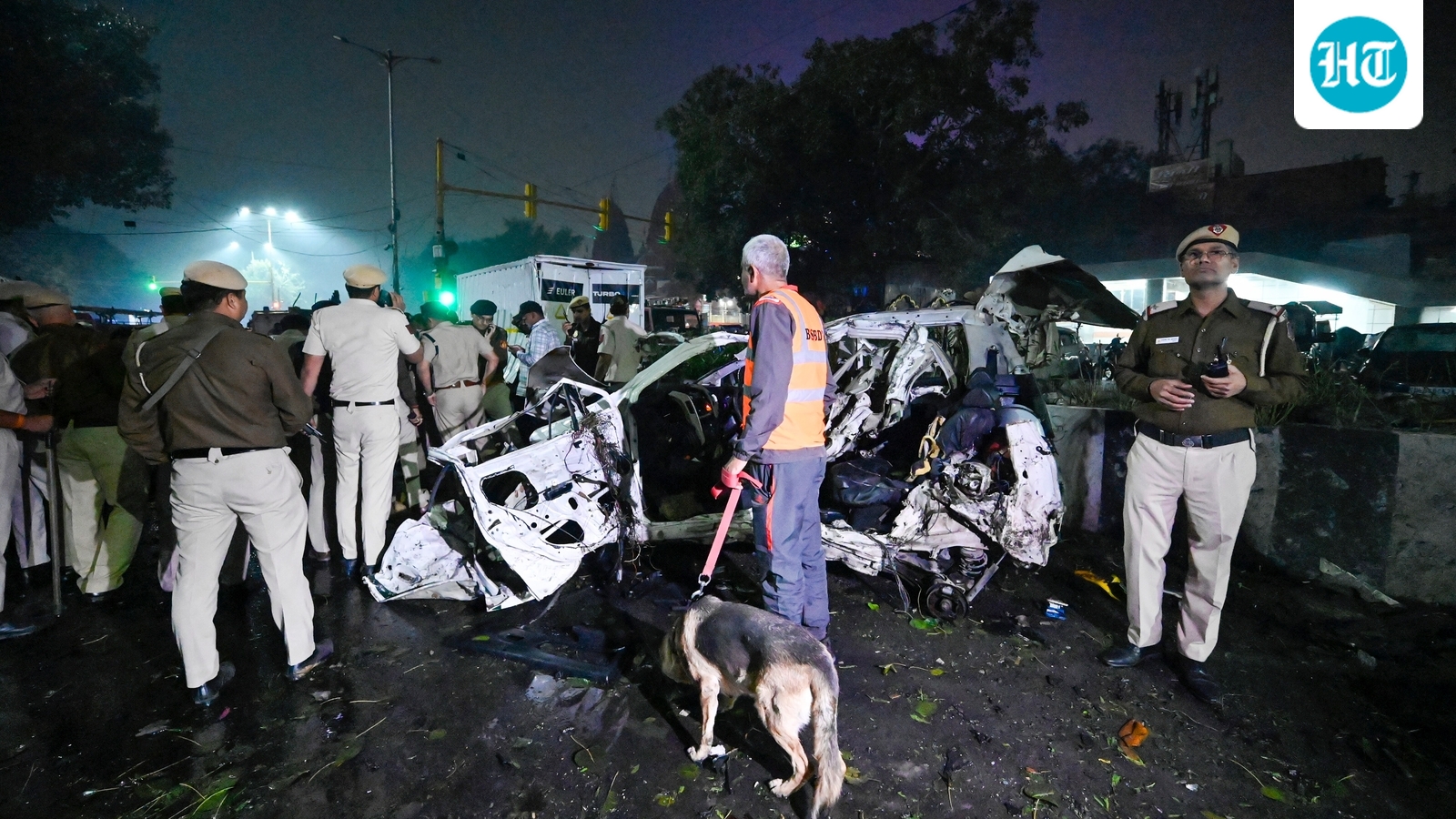
Three doctors associated with its medical college were linked to the investigation, and while the institution has made progress in restoring academic activities, filling seats and bringing patients back to its hospital, rebuilding public confidence remains its biggest challenge.Delhi Police, fire department and other personnel at the blast site after the car blast near Red Fort metro station. (HT Photo/Sanjeev Verma)Un-Nabi was an assistant professor at the medical college, while two other doctors, Dr Muzammil Shakeel Ganaie and Dr Shaheen Saeed, were arrested and remain in jail.Also Read | Red Fort blast a year on: Families still waiting for justice and closureThe investigation had an immediate impact on the university. Several faculty members resigned, students left the campus or stayed away from classes, and the hospital witnessed a steep fall in patient footfall.
The scrutiny intensified after the university’s founder-chairman, Jawad Ahmed Siddiqui, was arrested by the ED in November 2025 in a separate money-laundering case.A senior university official, who requested anonymity, said rebuilding the confidence of the local population was proving more difficult than restoring academic activities.“The common masses are yet to trust us fully, which is reflected in the number of patients at the hospital. We are working hard to rebuild that trust.”Leena Dhankhar is Senior Editor and Bureau Chief, Gurugram, at Hindustan Times, where she has spent over 17 years chronicling the transformation of one of India's fastest-growing urban regions.
From starting her career as a crime reporter to leading the Gurugram bureau, her journalism has been defined by investigative reporting, in-depth storytelling and an unwavering focus on public interest. Over nearly two decades, she has reported extensively across crime, politics, civic governance, elections, real estate, environment, courts, sports, education and entertainment, covering Gurugram, Faridabad, Nuh and Palwal.
Her reporting has exposed several major scams and systemic failures, including insurance frauds, waste management irregularities, illegal arms manufacturing units in Nuh, illegal mining in the Aravallis, organised crime networks and governance lapses affecting millions of residents. Known for her investigative work and exclusive stories, Leena has reported on high-impact national issues, including the Nicaragua charter flight carrying Indian migrants that was turned back amid allegations of human trafficking, exposing the growing network of illegal immigration rackets.
Her work has also focused on gang wars, prison administration, juvenile crime, women and child protection systems, the functioning of the Juvenile Justice Board and Child Welfare Committee, and environmental challenges such as pollution, waterlogging and deteriorating civic infrastructure. Beyond hard news, Leena has extensively documented Haryana's rich heritage, forests and wildlife, bringing attention to the state's historical landmarks, biodiversity, conservation efforts and ecological challenges through immersive reportage and feature writing.
Her journalism has consistently gone beyond breaking news. She has documented Gurugram's rapid urbanisation through long-form narratives and enterprise reporting on issues ranging from pothole-ridden roads, flooding and waste management to the changing social fabric of India's Millennium City.
She also writes widely read feature columns, including The Outsider, Changemaker, and Concern for Gurugram, profiling people, places and ideas shaping the city's identity. Leena is the author of Gurugram School Murder, published by Juggernaut Books, a deeply reported account of one of India's most high-profile school murder investigations.
She is currently working on her second book, an investigative work exploring some of India's most significant scams and fraud investigations. Beyond print journalism, she has expanded her storytelling through public speaking and digital media.
She is a TEDx speaker and has produced podcasts exploring Gurugram's transformation, civic challenges and untold stories. Her work reflects a commitment to narrative journalism that combines rigorous reporting with compelling storytelling.
A law graduate with an MBA in Human Resources, Leena brings a multidisciplinary perspective to her reporting, particularly on governance, public policy and legal affairs. She has travelled extensively across India to pursue investigative assignments, often reporting from remote locations and conflict-prone areas in search of stories that matter.Read MoreDebashish Karmakar is a principal correspondent with the Hindustan Times, Gurugram bureau.
He has a vast journalistic experience of almost 14 years of covering crime, court, power, transport, administration, weather and other beats while working across various organisations. He has been covering Gurugram, Faridabad, Nuh, Palwal and other districts of southern Haryana for more than four and a half years.
He has produced several breaking and exclusive stories while reporting from the ground where he maintains a strong presence on a daily basis. He writes news articles which are hard-hitting and accurate.
With his strong bureaucratic sources, he frequently writes stories to expose the failure of the system forcing authorities to take necessary course-corrective steps. Besides crime, important convictions and court orders, he also writes on human-angle stories, on power issues and challenges faced by the residents on a daily basis in Gurugram and neighbouring areas.
In the past, he worked for media houses like The Times of India, where he extensively reported on important government matters and daily proceedings at the Patna High Court. He has also worked in the electronic media and had done ground coverage on the Kedarnath deluge that wrecked Uttarakhand in 2013.Read More