


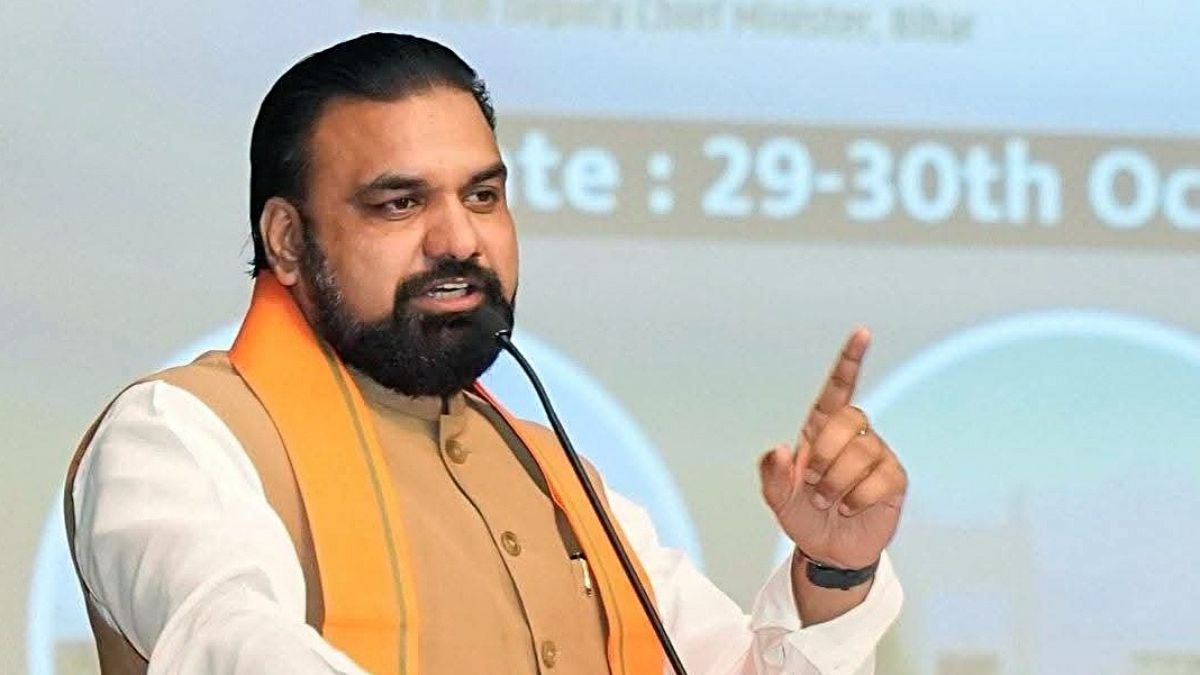
On November 1, while inaugurating the two-day Pataliputra National Youth Parliament 2.0 in Patna, Bihar chief minister Samrat Choudhary made an appeal that brought into sharp focus the fiscal arithmetic of the state’s expanding welfare model.Choudhary urged affluent and income tax-paying households to voluntarily surrender the benefit of 125 units of free electricity, saying the state was spending around Rs 23,000 crore annually on power subsidies, at a cost of roughly Rs 8,000-10,000 per household. The benefit, he pointed out, was available to the rich and poor alike.
Those who could afford to pay, he suggested, should step aside and contribute towards Bihar’s development.There was, however, no accompanying proposal for a phased withdrawal or a formal mechanism to identify households that could afford to forgo the subsidy. It was a voluntary appeal whose significance lay less in the immediate prospect of savings than in what it revealed: the government was publicly acknowledging the cost of a universal benefit it had committed itself to providing.The timing is difficult to overlook.
The free electricity scheme was announced by then chief minister Nitish Kumar in July 2025, just months before the assembly polls. It was expected to benefit around 16.7 million domestic consumers.
The announcement generated considerable goodwill and the ruling National Democratic Alliance (NDA) may have reaped dividends from it in the assembly election, which the alliance won decisively. Now, under a new chief minister, the NDA government is drawing attention to the cost of that very entitlement and asking the better-off beneficiaries to relinquish it.
The sequence invites an uncomfortable question: were the freebies that apparently helped the NDA secure its mandate politically attractive when votes were being sought, only to become a fiscal concern once the bill began to accumulate?Electricity is not the only example. Under the Mukhyamantri Mahila Rojgar Yojana, the government transferred Rs 10,000 each to 18.1 million women, taking the total disbursement to Rs 18,100 crore by February 2026.
The bulk of the transfers took place in five phases between September 26 and November 28, 2025, overlapping with the assembly election campaign. The scheme was presented as seed capital for women seeking self-employment, with the possibility of further assistance of up to Rs 2 lakh after they established an enterprise and underwent assessment.The economic question is what this initial transfer has achieved.
Rs 10,000 can help a woman buy a sewing machine, acquire livestock, stock a small shop or meet the initial costs of a modest enterprise. But it is a limited sum to establish a sustainable business with, particularly in a state where access to credit, skills, markets and infrastructure remains uneven.Ground reports and beneficiary accounts suggest the money has gone towards small livelihood activities, and also household expenses and consumption.
Limited pre-election reports found that a little over half the recipients claimed to have started some economic activity. Yet there is no comprehensive statewide evidence establishing how many of these ventures have survived, generated regular income or created employment.The promised second-stage assistance is conditional.
The scheme has put money into the hands of an unprecedented number of women; whether it has translated into durable economic independence remains a more difficult question.Together, the two flagship schemes represent a substantial claim on public resources, though their fiscal implications differ. The electricity subsidy is a recurring commitment while the Rs 18,100 crore transferred under the women’s scheme represents expenditure already incurred.The 2026-27 budget has sanctioned Rs 23,165 crore under the Mukhyamantri Vidyut Upbhokta Sahayata Yojana, including the consumer assistance that supports the free electricity benefit.
This is a budgetary sanction, not necessarily the final expenditure on the 125 free units alone.The broader fiscal picture makes the question more consequential. Bihar’s 2026-27 budget projects a modest revenue surplus of Rs 1,143 crore or 0.1 per cent of the Gross State Domestic Product (GSDP).
This follows a sharp deterioration in the current year. At the budget stage for 2025-26, the state had projected a revenue surplus of Rs 8,831 crore (0.8 per cent of GSDP).The revised estimates for 2025-26, however, show a revenue deficit of Rs 76,315 crore or 6.7 per cent of GSDP.
The fiscal deficit for 2026-27 is projected at 3 per cent of GSDP, against 11.8 per cent in the previous year’s revised estimates. These numbers point to a significant challenges in 2025-26 and an attempt at correction in the following year.In a state with limited own-tax resources and substantial dependence on central transfers, the question is not simply how much the government spends but what it gets in return—and whether large, universal welfare commitments can be sustained without affecting other priorities.These figures point to a sharp projected correction, but also underline the pressure that revenue expenditure and welfare commitments can place on the state’s finances.
In a state with limited own-tax resources and substantial dependence on central transfers, the question is not simply how much the government spends but what it gets in return.The government has also signalled a measure of administrative restraint. In May 2026, chief secretary Pratyaya Amrit issued an austerity directive covering video-conferencing, car-pooling, office electricity consumption and restrictions on official foreign travel.
These steps may improve administrative discipline, but they are unlikely, by themselves, to alter the arithmetic of two large welfare commitments. There has been no formal move to restrict the free electricity benefit by income or to redesign the initial Rs 10,000 transfer around demonstrated enterprise plans.Opposition parties have described the schemes as electoral inducements.
The timing lends some weight to that charge. Yet voluntary surrender is unlikely to produce substantial savings on its own.
Unless households are given a clear mechanism and a compelling reason to opt out, most are likely to retain a benefit to which they are already entitled. The chief minister’s appeal is therefore better understood as an acknowledgement of fiscal pressure than as a credible expenditure-control measure.There is a larger policy question here.
Universal free electricity up to a fixed consumption threshold is relatively simple to administer and politically popular. But it is not necessarily well targeted.
A household that can comfortably pay its electricity bill receives the same absolute benefit as one for which the subsidy makes a material difference to the monthly budget.In Bihar, where public resources are limited, the opportunity cost is significant. Money committed to universal subsidies is money that cannot be spent elsewhere on power infrastructure, agricultural investment or more carefully designed livelihood programmes.
The same distinction applies to cash transfers. A one-time grant can provide relief and help a woman acquire a productive asset, but it cannot substitute for sustained access to credit, training, markets and reliable infrastructure.None of this makes welfare transfers inherently undesirable.
In a poor state, predictable support can reduce vulnerability, ease household pressures and improve consumption. The problem arises when schemes are presented as transformative without adequate attention to their long-term outcomes or when universal entitlements are expanded without a clear assessment of their recurring cost.
The political appeal of a benefit is immediate; its fiscal consequences are spread over years.Choudhary’s November 1 appeal is the clearest public acknowledgement yet of the tension between Bihar’s welfare promises and its fiscal capacity. But asking the affluent to voluntarily surrender free electricity does not resolve that tension.
The harder choices lie ahead: whether to target subsidies more carefully, assess the actual livelihood outcomes of the women’s scheme, and protect investment in infrastructure and public services. Until the government confronts those choices, the welfare bill will remain easier to announce than to pay.Subscribe to India Today Magazine- Ends