


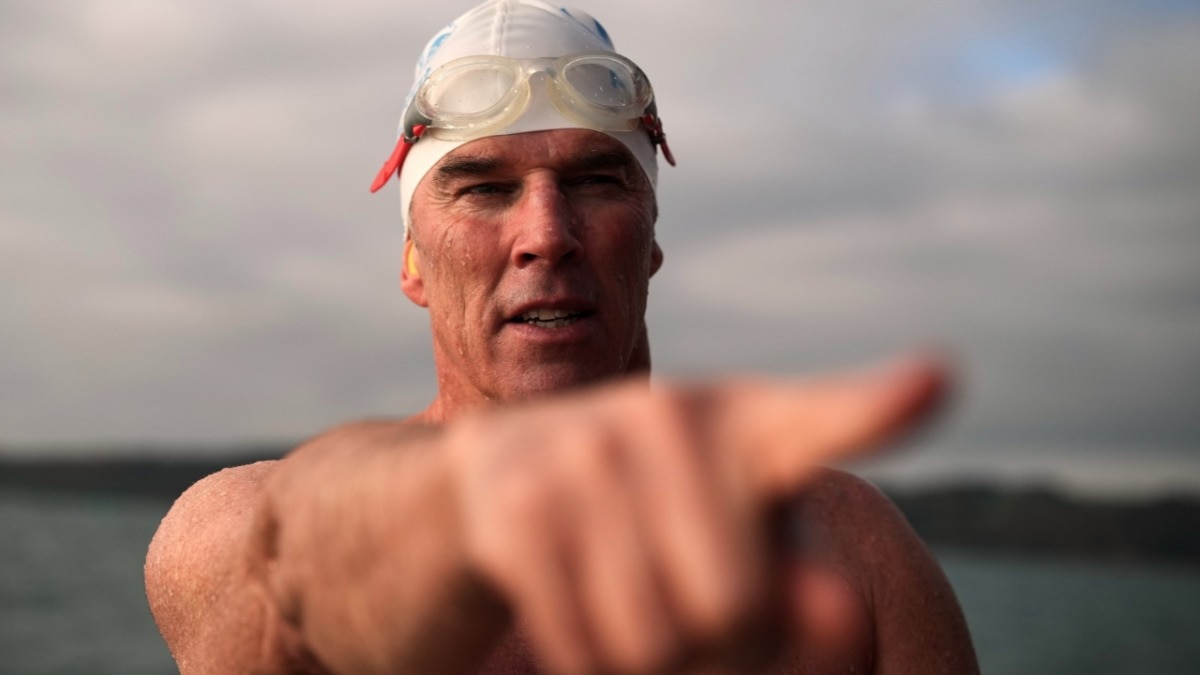
British endurance swimmer Lewis Pugh has braved the freezing waters of the North Pole and Antarctica, faced dangerous marine predators and taken on some of the world's toughest swimming challenges to raise awareness about environmental threats. But his latest expedition brought him face to face with the dangers of an active war zone, as he swam through the Strait of Hormuz amid explosions, fighter jets and burning oil tankers.The 56-year-old swimmer spent three days navigating parts of the Strait of Hormuz, one of the world's most strategically important shipping routes, to draw attention to the threat the US-Israeli war against Iran poses to marine life and fragile coastal ecosystems.The dangers became apparent almost immediately.
Just minutes after entering the water on Monday, Pugh heard two massive explosions. Looking towards the source, he spotted an oil tanker about four kilometres away that had been struck."I looked up and I could see that an oil tanker about four kilometers away had been hit," he told The Associated Press after returning to London. "The explosion was so loud, two booms, and then fighter jets coming in.
And at that moment I realized we have to get out of here right now." Despite the frightening start, Pugh eventually completed approximately 15 kilometres (9.3 miles) of swimming, beginning from the Musandam peninsula on the southern side of the strait and finishing around the Cape of Hormuz. He is believed to be the first person to undertake a long-distance swim in the waterway since the war began on February 28.Wearing only swimming trunks, goggles and a cap bearing the United Nations logo, the UN Patron of the Oceans completed the challenge in sections over three days, spending around six and a half hours in the water.AN ENDURANCE TEST AMID WAR AND EXPLOSIONS The dangers did not end with the first explosion.
On the second day, Pugh encountered another vessel that had been attacked, with flames shooting into the sky as he passed it on his way back to the harbour.The experience left a lasting impression on the endurance swimmer, who has spent nearly four decades pushing his physical limits in the name of environmental protection."I'll never ever forget going past that gas carrier, the smell of the chemicals and then the flames, they were literally like fireballs going up into the sky. Around the ship, the water was on fire," Pugh said.
He added that the environmental consequences of such incidents were particularly alarming."And to think of the impact which a casualty like this has on nature -- it was very, very acute."Pugh has previously faced freezing temperatures and dangerous marine predators, including great white sharks. However, swimming in waters where commercial vessels were being attacked presented a threat unlike anything he had encountered before.For him, the challenge was not simply about completing another endurance feat.
It was also about drawing attention to an environmental crisis unfolding alongside the military conflict."Most people, when they think about the Strait of Hormuz, they think of a shipping lane," he said. "But it is also one of the most beautiful places I have ever been it's one of the treasure troves of the natural world.""With all these ships being sunk, this area is under severe threat," he added. "It's going to take years, decades for this area to recover."WHY THE HORMUZ'S WILDLIFE IS AT RISKThe Strait of Hormuz is widely known for its importance to global energy supplies. Before the US and Israel launched their war against Iran on February 28, roughly a fifth of the world's oil trade passed through the narrow waterway.
But beneath its busy shipping lanes lies a marine ecosystem that is now facing growing risks from the conflict.Iran has intensified attacks on vessels it says have travelled through unauthorised routes, seeking to assert control over the strategic passage. Several tankers have also struck sea mines laid by Tehran, with some exploding and catching fire.
One such vessel was carrying more than two million barrels of oil last month.The damage to commercial vessels raises concerns about oil spills and chemical contamination. Damaged tankers can release pollutants into surrounding waters, threatening marine animals, coral reefs, mangrove forests and coastal habitats.
Pugh warned that the consequences could extend far beyond the immediate aftermath of the attacks.During his journey, he spotted dolphins swimming alongside his boat, as well as turtles and ospreys. He also recalled seeing hundreds of turtles during an earlier swim along the Omani coastline before the war.
The possibility of oil reaching these habitats, he said, was particularly worrying because cleaning up pollution in sensitive marine environments can be extremely difficult."When oil gets in there, when chemical pollution gets in there, it becomes very, very difficult to clean up that type of mess," he said. "It lasts for generations."The concern is that even after the fighting ends, the environmental damage could remain. Oil contamination can affect marine species and coastal ecosystems long after the ships involved in the attacks have disappeared from the headlines.Pugh has spent much of the past 40 years turning extraordinary swimming challenges into campaigns for environmental protection.
He became the first person to complete a long-distance swim at the North Pole and has undertaken endurance swims across all of the world's oceans. His previous challenges have taken him through Antarctica, the Red Sea and the English Channel.In 2023, he swam the entire 315-mile (507-kilometre) length of the Hudson River in the United States to highlight the importance of clean rivers.
His foundation says these campaigns have helped secure official agreements to protect more than 3.5 million square kilometres of vulnerable ocean.The approach, sometimes described as 'Speedo diplomacy', uses sporting achievements to draw political attention to environmental issues and encourage governments to take action.For Pugh, the Strait of Hormuz swim was another attempt to make an environmental issue impossible to ignore, particularly as international attention remains focused on the war, attacks on shipping and disruptions to energy supplies.- EndsWith inputs from agencies