


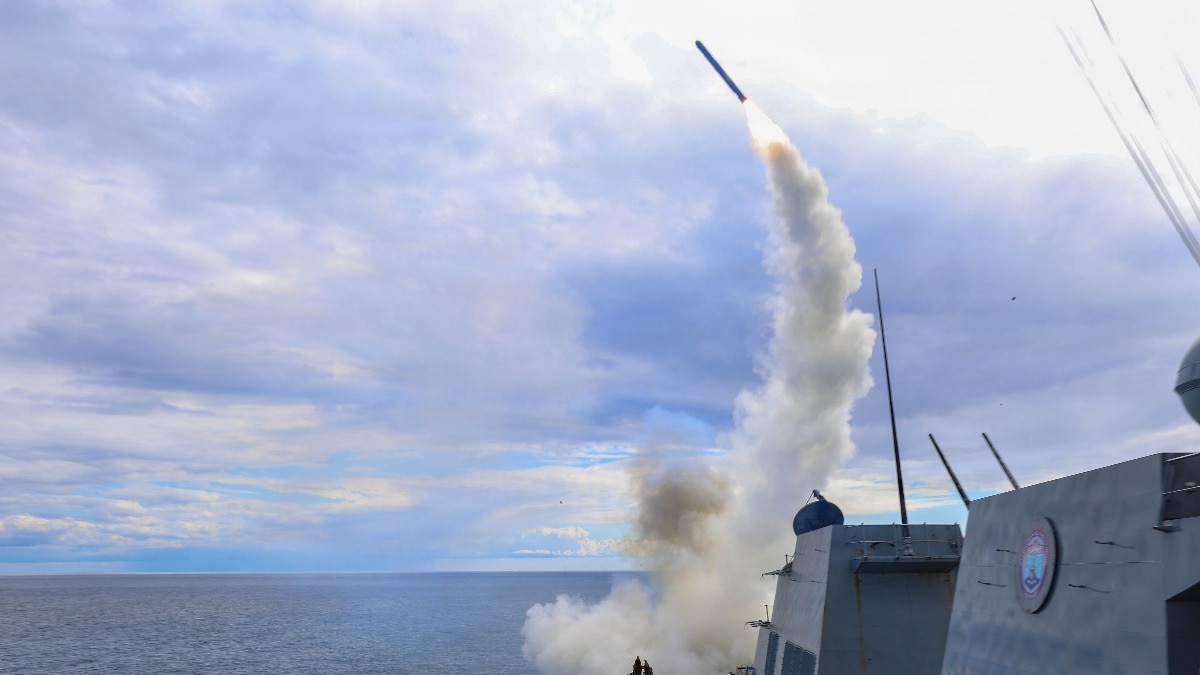
The US Navy has acknowledged using expired munitions, including Tomahawk cruise missiles during its war with Iran, raising questions about the state of American weapons stockpiles, and the risks of relying on ageing missiles amid a growing shortage of precision-strike weapons.Acting US Navy Secretary Hung Cao disclosed the practice during his confirmation hearing before the Senate Armed Services Committee on Tuesday, November 17 (US Time). According to reports in The Business Insider and The Wall Street Journal (WSJ), Cao stated the Navy had taken the munitions classified as expired or unserviceable, changed their operation codes, and put them back into use during Operation Epic Fury, which started back in February this year.Cao compared the process to trying to make stale bread edible again. "You can put a little water on it, put it in the microwave, and it becomes edible again", he told the American lawmakers on Monday, after being asked how the Navy had restored its ageing weapons.However, Cao did not specify how many expired Tomahawks were used, how old they were or whether all the recoded weapons were cruise missiles.
Nor did he disclose how many had undergone inspection or refurbishment before being fired. Cao's disclosure comes as American missile stocks have been severely depleted after their heavy usage in the first weeks of the ongoing US-Iran war.A March 27 report in The Washington Post noted that the US military fired more than 850 Tomahawk cruise missiles in just four weeks of fighting.
A subsequent April 21 assessment by the Centre for Strategic and International Studies (CSIS) put the expenditure at more than 1,000 missiles by the time the campaign paused. The scale of consumption is particularly concerning because Tomahawks are expensive and take considerable time to manufacture.
The Washington Post reported that the latest versions cost up to $3.6 million a piece and can take as long as two years to build.The US Navy had requested just 57 Tomahawks in its fiscal year 2026 budget. CSIS estimated that the US may have had around 3,100 missiles in its inventory before the Iran war, although the Pentagon does not publicly disclose its exact stockpile.The shortage was also acknowledged by Cao during his testimony.
According to Business Insider, he said Tomahawk production had increased from approximately 125 missiles annually during his military career to more than 60 a month currently.WHY USING EXPIRED MUNITIONS MIGHT NOT BE A GOOD IDEAAn expiry date on a missile does not necessarily mean that it becomes immediately unusable or dangerous. Rather, it indicates that its components can no longer be assumed to meet the manufacturer's specified standards of safety, reliability and performance without further testing.According to the United Nations' Manual on Ammunition Management, ageing munitions can suffer from several forms of deterioration.These include chemical degradation of propellants and explosives, depletion of stabilising compounds, damage to electronic components, deterioration of seals, corrosion and structural damage.
Such changes can affect whether a weapon launches properly, follows its intended flight path and detonates as designed.The risks are particularly high for sophisticated cruise missiles such as the Tomahawk, which rely on propulsion systems, electronic components, navigation technology and warheads working together. Deterioration in even one critical component can compromise the missile's reliability or effectiveness.However, the US Navy does have procedures for extending the operational life of its missiles.
Its fiscal year 2026 budget justification document says Tomahawk Block IV and V missiles have a service life of 30 years, with a 15-year deployment and recertification cycle. The latter process includes extensive testing of critical components of the missile, and repairing or replacing damaged components.This means that an expired missile can potentially be restored to service after the necessary checks.
But recoding its ammunition condition does not, by itself, establish that every component has been refurbished or that the weapon carries no additional risk.The concerns are not entirely theoretical either. The Wall Street Journal, in its November 17 report on Cao's hearing, noted that some refurbished Tomahawks used in an earlier US military operation had reportedly failed to explode, with missiles subsequently found intact.The bigger concern, therefore, is not simply that the US is using older weapons against Iran.
It is that the world's most powerful military is having to draw on previously unserviceable stockpiles while expending precision weapons faster than its defence industry can replenish them.- Ends(Written by Shounak Sanyal)