


Donald Trump faced a political reckoning on Tuesday as millions of Americans voted in midterm elections that could shift the balance of power in Washington and define the final two years of his divisive presidency.Based on consistently favourable opinion polls, Democrats were optimistic about regaining control of the House of Representatives and potentially also the Senate, although the party has suffered enough anguish during the Trump era to remain wary.“Now, we don’t want to count our chickens before they hatch,” said Chuck Schumer, the Democratic minority leader in the Senate. “So I characterise our mood as nauseously optimistic.”The elections are widely seen as a referendum on Trump’s second term, with voters concerned about the cost of living, rising fuel prices and an unpopular war with Iran. The president’s approval rating has slumped to record lows, saddling Republicans with an unenviable task as they defend narrow majorities in both chambers of Congress.Trump has held 30 campaign rallies over the past month.
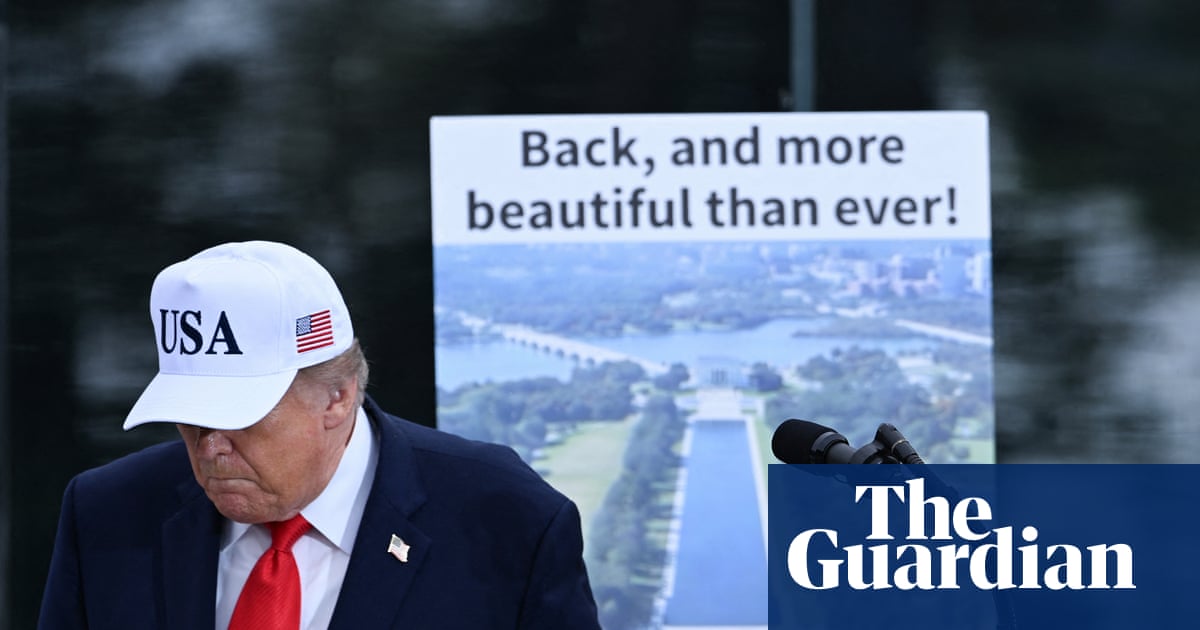
The 80-year-old’s speeches have been strewn with lies, prejudice, repetitions and ruminations on men’s physiques including the “ass” of the Ohio senator Jon Husted. His closing address at the Lincoln Memorial Reflecting Pool on Monday focused mainly on algae, granite, re-caulking and grass.In remarks apparently aimed at swaying largely Democratic-leaning voters unhappy with US support for Israel, Trump said the US would stop $4bn in annual funding to Israel after the end of this year.
The president also said he would be watching the results come in later on Tuesday night at the White House, where he is hosting a viewing reception.Trump’s campaign message has increasingly appeared at odds with voters’ priorities. He has sought to cast Democratic candidates as radical, un-American and even communist. “The Democrat party has nominated the most extreme and dangerous slate of candidates in American history,” the president said on Monday.But polls suggest voters care more about their economic situation and the affordability message that swept Trump to power in 2024 could now come back to bite him.The current price of gasoline is displayed at a gas station in Encinitas, California, on 21 October.
Photograph: Mike Blake/ReutersA Reuters/Ipsos poll found that 48% of voters considered the cost of living their most important issue in deciding how to vote, compared with 26% who cited democratic norms and 13% immigration. Nearly half of Americans said their household finances had deteriorated since Trump returned to office in January 2025.More than 57 million Americans had already cast ballots by Monday, exceeding the early voting total recorded in 2022.
Democrats, who deployed former president Barack Obama on the campaign trail, are hoping greater enthusiasm among their supporters, combined with dissatisfaction over the economy and the war with Iran, will translate into higher turnout.All 435 seats in the House are being contested, alongside 35 of the Senate’s 100 seats. Democrats need a net gain of three seats in the House and four in the Senate to take control of both chambers.
The party out of power traditionally makes gains in midterm elections, with the president’s party having lost ground in the House in all but two such contests since the second world war.The fight for the Senate is concentrated in about a dozen competitive races, many in states that Trump carried comfortably in 2024. Democrats are seeking victories in traditionally Republican territory including Texas, Kansas, Iowa and Alaska, while also defending vulnerable seats.In Texas, Democrat James Talarico is seeking to end his party’s three-decade drought in statewide elections against the Republican state attorney general, Ken Paxton.
The race has attracted national attention and huge financial backing, including more than $150m in Republican support from the billionaire Elon Musk.Paxton, who has faced a series of scandals, has attacked Talarico on cultural issues, while the Democrat – who combines proud religious faith with economic populism – has focused on the economic consequences of Trump’s tariffs and the war in Iran.At a packed rally in Austin on Monday night, Talarico said Musk and other big money groups were desperately trying to stop him: “They are scared. They are terrified.
They see what we see: that we are about to win this election tomorrow night.”Texas Democratic Senate candidate James Talarico waves to supporters after speaking at a campaign rally with gubernatorial candidate Gina Hinojosa on Monday in Austin, Texas. Photograph: Chip Somodevilla/Getty ImagesIn Kansas, Democrat Adam Hamilton, a megachurch pastor, is narrowly ahead of the Republican senator Roger Marshall in opinion polls.
The state voted for Trump by more than 16 percentage points in 2024 and has not elected a Democratic senator in nearly a century.Michigan has emerged as another critical battleground. The progressive Democrat Abdul El-Sayed is facing the former Republican congressman Mike Rogers in a contest complicated by an extraordinary intervention from Haley Stevens, who lost to El-Sayed in the Democratic primary before endorsing Rogers on Sunday.The Republican told reporters on Tuesday: “I’m proud of her for doing what she believes was the right thing to do.”The dispute has exposed divisions within the Democratic party over Israel.
El-Sayed, who could become the country’s first Muslim senator, has been subjected to attacks questioning his loyalty and patriotism. He has dismissed them as shameful and argued that voters’ concerns about the cost of living should take precedence.In Alaska, the race between the Republican senator Dan Sullivan and Democrat Mary Peltola has been overshadowed by allegations that Peltola’s campaign helped recruit a a second candidate named Dan Sullivan to confuse voters.
Peltola has denied involvement.Senator Dan S Sullivan talks with members of the media after casting his ballot at a polling location at the Alaska zoo on election day on Tuesday in Anchorage, Alaska. Photograph: Justin Sullivan/Getty ImagesOther closely watched contests include Maine, where the Republican senator Susan Collins is seeking a sixth term, and Iowa, Nebraska, Ohio and South Carolina.Beyond Congress, voters are choosing governors in 36 states, alongside thousands of state legislative seats and ballot measures covering issues including abortion rights and taxes.The elections could have profound consequences for Trump’s ability to govern.
A Democratic takeover of either chamber of Congress would provide a check on the White House, potentially opening the way to investigations, attempts to block presidential nominees and renewed impeachment efforts.The House Democratic leader, Hakeem Jeffries, would be in line to become the first Black speaker of the House if his party takes control. He has promised an aggressive oversight agenda and a focus on reducing the cost of living.The campaign has been among the most expensive in US history, with a projected $11.9bn in spending by candidates and outside political groups.
Musk alone had spent about $366m supporting Republicans, according to campaign finance records.Republicans have also sought to improve their electoral prospects through an aggressive redistricting effort, although some of the gains anticipated by the White House appear unlikely to materialise. Much of the party’s advertising expenditure has gone into states and districts Trump won comfortably in 2024, underlining the extent to which Republicans have been forced on to the defensive.Alongside the political battle, the elections have been accompanied by mounting concerns about possible federal interference in the voting process.The justice department announced it would deploy about 1,000 election monitors across all 50 states, describing it as the biggest such effort in its history.
The department said the monitors would observe compliance with federal law, but Democrats and voting rights groups have warned that their presence could intimidate voters.The US Capitol looms in the distance as Donald Trump departs following his remarks ahead of the midterm elections at the National Mall in Washington DC on Monday. Photograph: Jonathan Ernst/ReutersThe Trump administration has also pursued an unprecedented series of legal challenges over alleged non-citizen voting, despite evidence that such cases are exceptionally rare.A separate legal battle has focused on Alaska, where the justice department has sought to prevent certification of the Senate result if Sullivan narrowly loses.
A federal judge dismissed the initial effort, although the administration has continued to pursue an appeal.Trump has repeatedly made false claims about widespread electoral fraud and urged Republicans to take greater control of voting in several states. He has also declined to rule out extraordinary measures, including declaring a national emergency, although the constitution gives the president no direct authority over the administration of elections.The elections are also likely to influence the early positioning for the 2028 presidential contest, potentially strengthening Democratic figures such as the California governor, Gavin Newsom, and Illinois governor, JB Pritzker, while testing the prospects of Vice-President JD Vance and other Republicans seeking to inherit Trump’s political coalition.