


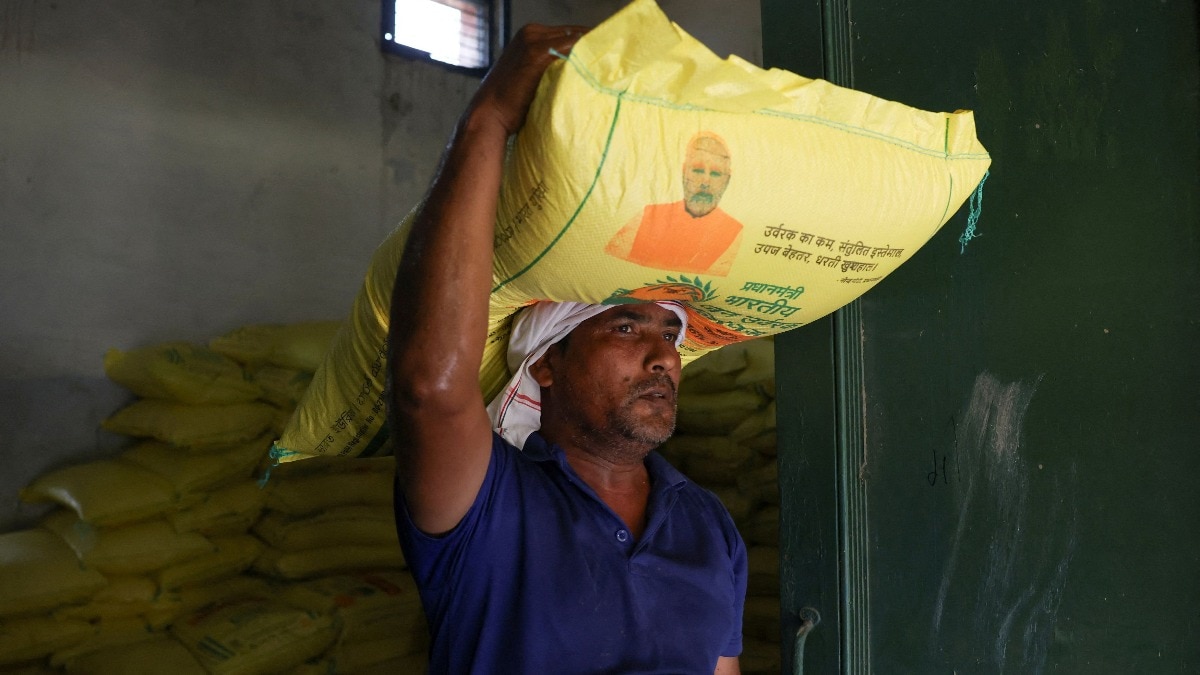
A bag of urea that costs around Rs 3,000 in the international market reaches Indian farmers for less than Rs 300. The gap, which was also highlighted by Prime Minister Narendra Modi recently, helps explain why subsidised fertiliser has become both a lifeline for farmers and a target for diversion and possible smuggling.
Now, the CAG has begun an all-India performance audit of the fertiliser subsidy, to focus on the alleged diversion of subsidised urea in 169 districts, according to reports.On November 12, while delivering the plenary address at the India Today Group's Kisan Tak Bharat Agriculture Conference, PM Modi spoke about the government's efforts to keep farm inputs affordable. After speaking about agricultural growth, crop diversification and value addition by farmers in Gujarat who process chillies, he turned to fertilisers.The government, he said, has spent Rs 16 lakh crore over the past 12 years to shield farmers from high prices.
A bag of urea priced at Rs 3,000 internationally is supplied for less than Rs 300, while a bag of chemical fertiliser Diammonium Phosphate (DAP) that costs Rs 5,000 abroad is made available for Rs 1,300. The remarks came just before he discussed the Centre's decision to limit diesel price rises amid conflict in the Middle East.The price difference is not a small matter.
India's annual urea use is estimated at around 400 lakh metric tonnes, of which more than 100 lakh tonnes are imported. Even domestic production depends heavily on imported natural gas, which accounts for the bulk of the cost.
When global prices spike — as they did after the Russia-Ukraine war and later tensions in the Middle East — the subsidy bill climbs sharply. The government has been spending more than Rs 2 lakh crore a year on fertiliser support, with urea forming the largest share.India spent around Rs 1.42 lakh crore on urea subsidies in 2025-26 alone, up from Rs 1.18 lakh crore in the previous financial year, according to government figures.
For 2026-27, the Centre has budgeted Rs 1.17 lakh crore towards urea subsidies.CAG AUDIT INTO OVERUSE AND DIVERSION OF UREAThat large subsidy has now drawn the attention of the Comptroller and Auditor General of India (CAG). According to a report by The Times of India newspaper, the CAG has begun an all-India performance audit of the fertiliser subsidy, focussing on alleged diversion of subsidised urea in 169 districts.
Fieldwork started around May-June 2026. The first phase is expected to finish by mid-2027 so that the report can be tabled in the winter session of Parliament that year.
A second phase will continue into the following year.The CAG, which is the supreme audit institution of India, selected 149 districts where urea use exceeds both the national average of about 180 kg per hectare and the respective state averages. Another 20 districts were added later on the Centre's recommendation.
Uttar Pradesh tops the list with 37 districts under scrutiny, followed by 16 each in Bihar and Tamil Nadu, and 14 each in Punjab and Gujarat. The additional districts are spread across Karnataka, Rajasthan, Madhya Pradesh and Maharashtra.The audit is the first comprehensive look at the urea subsidy system since 2011.Officials cited in news reports say the audit will examine how the demand is estimated, how supplies are planned and moved, the working of freight subsidy, and the systems meant to prevent misuse.
It will also look at whether the long-running scheme of neem-coated urea has reduced leakage. Departments including the GST network, the agriculture ministry and the railways are expected to share data, so auditors can track the full chain from production or import to the farmer's field.A senior official quoted in Business Standard newspaper put the economic logic plainly — agricultural urea is sold at roughly Rs 600 per quintal while industrial-grade urea can fetch between Rs 2,400 and Rs 7,000 per quintal.
That gap creates a strong incentive for diversion.Technical-grade urea is used in resins, glues, plywood, crockery, cattle feed and commercial explosives. Because farm urea is heavily subsidised and not strictly rationed by farm size or income, substantial volumes have historically found their way into non-farm uses.INDIA'S CROSS-BORDER UREA WORRIESParticular attention is being paid to border areas, according to PSU Watch, a business news centre that focusses on PSUs, bureaucracy, defence and public policy.
Officials have raised doubts about whether subsidised urea moving through districts in Uttar Pradesh, Rajasthan, Punjab and Bihar is staying inside the country.The Finance Ministry recently flagged unusual patterns in e-way bills — the electronic documents that track goods movement. Trucks carrying fertiliser were found taking detours or making multiple stops instead of following the declared route, according to a report by The Times of India.
A parliamentary panel had earlier pointed to similar problems, including partial unloading during transit and movement without proper papers, especially in border and hilly districts.The government has also acknowledged the risk of subsidised fertiliser being diverted from agricultural to non-agricultural use. In a written reply to the Lok Sabha on August 4, 2023, the Ministry of Chemicals and Fertilisers said it had constituted a special Fertiliser Flying Squad to conduct surprise inspections of units suspected of diversion, black marketing and hoarding.More recently, the Department of Fertilisers told the government that 4,84,663 raids were conducted across the country in 2025 against black marketing, hoarding and diversion of fertilisers, leading to 17,392 show-cause notices, 6,941 licence suspensions or cancellations and 847 FIRs, according to a July 28, 2026, Press Information Bureau (PIB) release.Independent seizures by the Sashastra Seema Bal along the India-Nepal border illustrate the ground reality.
In recent months, forces have recovered hundreds of bags of urea being moved on pick-ups, motorcycles and even bicycles toward Nepal, where the same bag can sell for several times the Indian subsidised price. Similar pressures exist along other borders along with Bangladesh and Myanmar, according to reports.
When local farmers in these districts report shortages while official figures show high "consumption", the suspicion of leakage grows.The audit comes at a time when the overall fertiliser subsidy is projected to rise further, possibly approaching Rs 3 lakh crore in the current fiscal year. Higher imports, elevated global prices and rising domestic use all add to the fiscal pressure.
Excess use also carries environmental costs: more greenhouse-gas emissions and greater strain on soil health when nitrogen is applied beyond recommended levels.For decades, India has treated urea as a special case. Unlike phosphatic and potassic fertilisers, whose prices are more market-linked, urea remains under strict price control for farmers.
The policy has kept input costs low and supported food production. But it has also created the very incentive that encourages diversion.
Neem coating was introduced years ago precisely to make the fertiliser less attractive for industrial users and to slow its release in soil. The CAG will test how well that measure has worked.The government has layered digital tools on top of the physical distribution system.
The Integrated Fertiliser Management System tracks allocation and sales. E-way bills now provide another trail.
Raids and notices against violators have increased. Yet the scale of the subsidy — and the sheer volume of material moving across a vast country — means leakages remain hard to eliminate completely.PM Modi's November 12 remarks framed the subsidy as a deliberate choice to protect farmers from international price shocks.
The CAG exercise, as described in The Times of India report and other official briefings, will test whether the money is reaching the intended beneficiaries and whether the demand figures that drive procurement and imports are realistic.Auditors will examine not only sales data but also transportation arrangements, freight claims and the effectiveness of monitoring at every stage.Cheap urea helps farmers grow more food. But when that same urea is diverted to factories or slips across borders, the public pays twice — once through higher subsidies and again when shortages appear in the fields.- Ends