


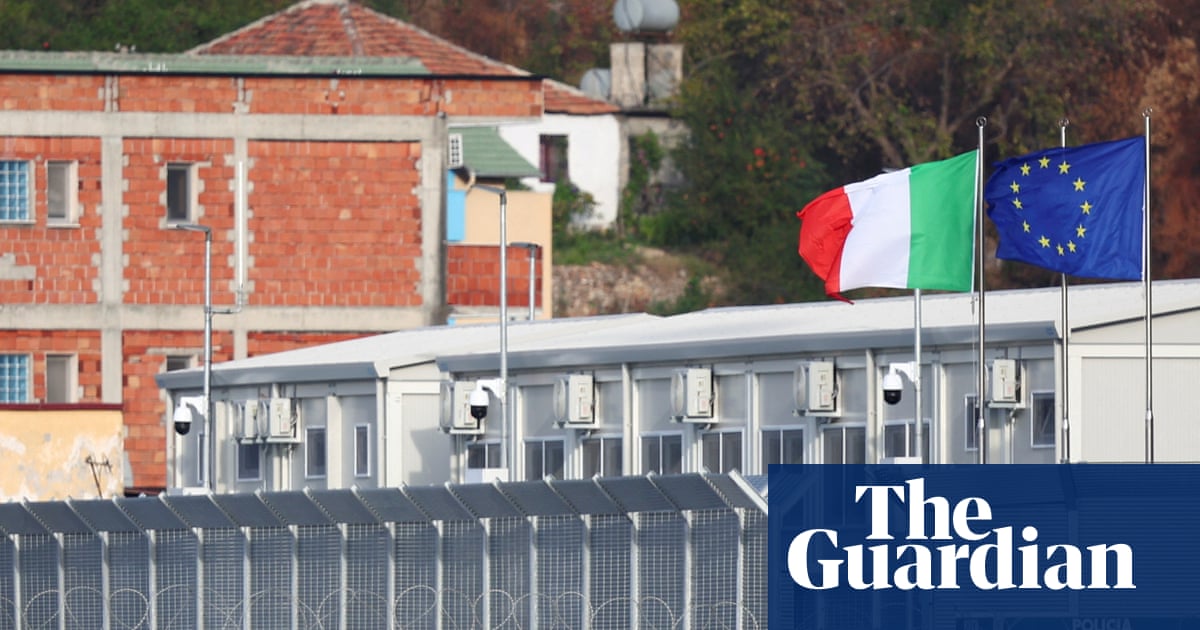
The UK and the EU plan to establish formal talks for the first time about sending rejected asylum seekers to third-country hubs, according to a leaked document.A draft of a joint statement expected to be signed by Andy Burnham and Ursula von der Leyen at a summit on Friday morning states that both sides will establish “a structured dialogue” to discuss “returns to third countries”.Until now, the Home Office has been seeking bilateral agreements with third countries allowing the removal of migrants, but with no obvious success.Last week, five EU countries – Austria, Denmark, Germany, Greece and the Netherlands – announced an agreement in principle with Rwanda to establish a migrant “return hub” there in 2027.Burnham hinted at possible cooperation with EU countries last week when he told reporters that the UK had not had direct discussions with European governments involved in return hubs but “we will watch that [the five-country deal] with interest, learning from what went on in the past”. He said: “The public want us to do whatever we can to deal with illegal immigration.”The UK has been fighting for deeper cooperation with the EU on migration, with the new deal on a “strategic dialogue” secured in the last two weeks by negotiators in Brussels.It is a key part of the UK-EU reset pact, which also covers a youth mobility scheme, tariffs on Chinese imports, food and drink exports to the EU and a wider restatement of commitment on defence and security.Informed sources confirmed this was the first time the UK and the EU had agreed to “open a dialogue on returns” after the launch of the bloc’s Channel action plan in June this year.Whitehall sources said the UK was now open to the possibility of sending rejected claimants to Rwanda – a recent pivot from the government’s position under Keir Starmer, which rejected the move.According to a draft of the joint agreement, negotiations over third-country hubs will be part of a ramping up of cooperation to tackle irregular migration.The document states: “The EU and UK … will establish a structured dialogue on migration covering in particular the joint activities under the Channel action plan, action against irregular migration and migrant smuggling networks, strategic communication and border management, upstream cooperation and engagement with third countries, returns to third countries, pull factors for irregular migrants and legal pathway.”In May, the UK and 45 other European countries signed an agreement that explicitly endorsed plans to send unwanted asylum seekers to third-country hubs.A political declaration from the 46 members of the Council of Europe, the body that oversees the European convention on human rights (ECHR), said states had an “undeniable sovereign right” to control their borders.It is understood that the UK has been seeking a deal with an unnamed third country, similar to the Italy-Albania agreement that allowed Rome to place detention centres in Albania.
Albania has ruled out a bilateral agreement on a return hub with the UK.Previous discussions have reportedly centred on 11 countries – Armenia, Egypt, Ethiopia, Ghana, Libya, Mauritania, Rwanda, Senegal, Tunisia, Uganda and Uzbekistan. Montenegro has denied reports that it is considering housing refused asylum seekers.Starmer scrapped a Tory plan to forcibly send small-boat arrivals to Rwanda where their asylum claims would have been processed.Before the election, the Conservative government had spent £700m on its Rwanda returns policy, which was meant to deter Channel crossings.
The scheme hit legal and political obstacles from the start, with the UK supreme court eventually ruling it illegal.Under Burnham, the Home Office has refused to close down the possibility of sending asylum seekers to Rwanda. This week, when asked if the UK might ever send asylum seekers to Rwanda, a Home Office spokesperson said: “The UK, like other European countries, is exploring innovative approaches including returns hubs to tackle illegal migration.”The UK has been looking for years to strengthen cooperation with France and other EU member states to tackle small boats carrying asylum seekers across the Channel.But sources say it is only in recent months that there has been a change of mood in the EU, with member states realising that the intensity of criminal trafficking across the Channel is “proving [to be] a pull factor” to enter the EU.
Those that fail to make it to British shores remain in the EU’s migrant support system.Responding to the planned cooperation on migrant hubs, Madeleine Sumption, the head of the Migration Observatory at Oxford University, said: “Its inclusion in the statement would confirm the now relatively widespread interest in ‘third country’ options.”In response, Imran Hussain, director of external affairs at the Refugee Council, said return hubs are likely to be difficult and costly to run.“Removing people to places they have never stepped foot will be difficult and distressing.“The last decade has shown that working with people to support their return to their countries is far more successful,” he said.A Home Office spokesperson said: “While we are not part of this EU member state initiative, there is widespread international agreement on the need to have practical and workable solutions to deal with the global challenge of illegal migration.“We continue to explore innovative approaches, including returns hubs, to build on the 80,000 people with no right to be in the UK returned or deported since July 2024. We have consistently made clear that we support the principle of returns hubs.”