


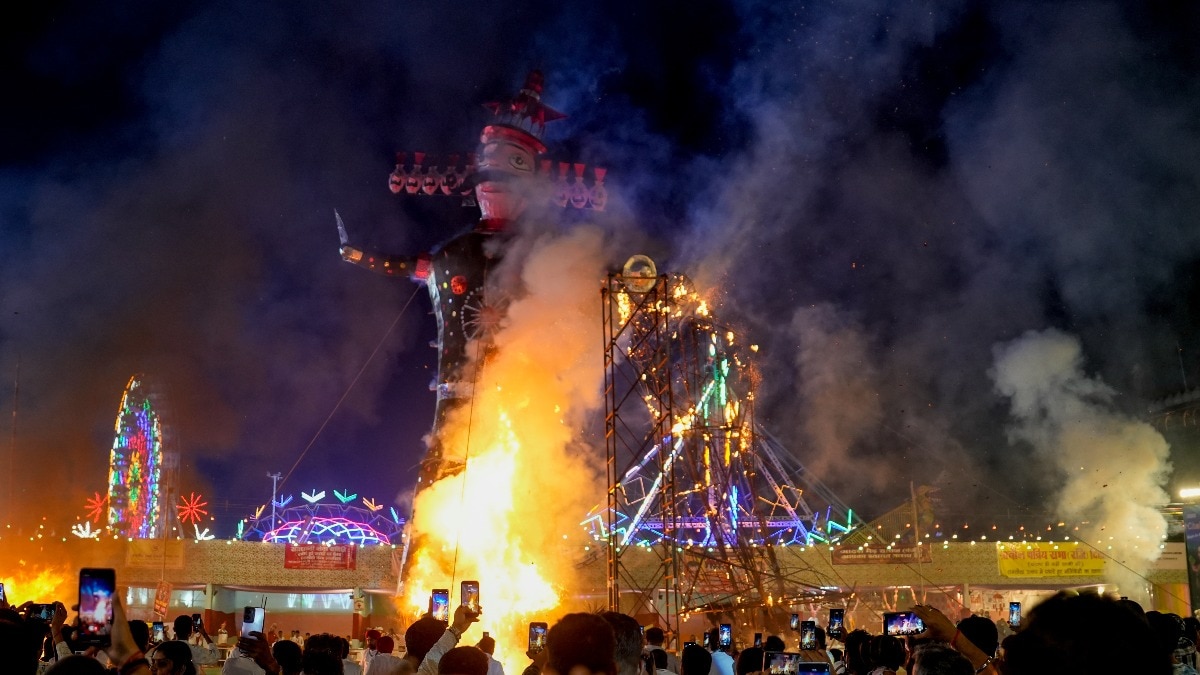
Delhi’s air slipped into the poor category after Dussehra, which saw fireworks burnt during the festival, and attention has again turned to what the crackers contributed. Fireworks clearly played a part, and the research on that is fairly consistent.
What remains less settled is the size of their share and how long their effect lasts once the festival night is over.Delhi's Air Quality Index (AQI) reached 245 on October 21, a day after Dusshera , with fine particle concentrations, considered most harmful for human health, ranging from a low of 81 g/m to a high of 217 g/m, and an average of 191.2 g/m recorded during the dirtiest night hours.In some parts of Delhi, such as Punjabi Bagh, the PM2.5 level reached over 300. Also, the city and adjoining areas recorded the worst air quality post-Dussehra this year and AQI remained 'poor' on Thursday as well.Sunil Dahiya, founder and lead analyst at Envirocatalysts, calls it a fact that toxic pollutants feeding high PM2.5 rise sharply during fireworks, and stay that way “for several hours or even a few days afterwards,” depending on meteorological conditions.
The chemistry explains the surge.Firecrackers run on black powder, roughly 75% potassium nitrate, 15% charcoal and 10% sulphur. Ignition oxidises and decomposes the solid mixture almost instantly into airborne soot, ash and salt crystals.
Colours, too, add metals. Strontium or lithium carbonate gives red, barium compounds green, copper blue and sodium chloride yellow, while aluminium, titanium or magnesium powders produce silver and white.
In the blast, these vaporise and then condense in the cooler air into ultra-fine particles and black carbon.Studies from leading institutes have quantified this. An important paper in Atmospheric Environment, from the 2024 analysis of the Diwali period by Indian Institute of Technology (IIT) Delhi researchers, attributed about 85% of the elemental PM2.5 mass during the festival to fireworks, while the contribution of pollutants from stubble burning was just about 4% during the period.An earlier collaboration with IIT Kanpur and PRL Ahmedabad, in Atmospheric Pollution Research, put the figure at 95% on Diwali night itself.SLICE, NOT WHOLEThose percentages refer to a fraction of the pollution.
PM2.5 is the entire mix of solid particles and liquid droplets of 2.5 micrometres or lesser, while the elemental portion covers individual elements such as heavy metals and crustal minerals.In a Delhi winter, the bulk of PM2.5 consists of carbonaceous aerosols, secondary inorganic ions and mineral dust. Fireworks dominate the metals, but they do not account for most of what residents inhale.Both studies found that the firecracker signature fades quickly, typically within 12 hours of the festival.
The researchers traced the dense haze afterwards to biomass burning, including regional stubble fires and winter heating.Dahiya’s account follows the same sequence. Roughly 10 to 12 hours after the fireworks, other contributors to PM2.5 begin to rise while the fireworks-derived share thins out.
Overall levels nonetheless stay high, he says, unless a long, good spell of rain intervenes.The human cost, in his telling, arrives sooner than the haze peaks: hospital admissions and medicine sales for respiratory conditions climb immediately after fireworks.WHY THE PARTICLES HURTDr Avi Kumar, additional director of pulmonology at Fortis Escorts, says the particles are small enough to “penetrate deep into the lungs and can enter the bloodstream.”Brief exposure can set off respiratory symptoms, worsen asthma and raise the risk of cardiac events. Children, the elderly and anyone with existing heart or lung conditions, he adds, need particular caution when pollution runs high.Dr Rajeev Kacker, pulmonologist with Regency Health in Kanpur, argues that Delhi’s AQI problem has become “a public health emergency from merely being a seasonal problem.”Residents routinely contend with throat and eye irritation, severe wheezing, and spikes in emergency admissions for asthma and acute bronchitis.Over the years, says Dr Kacker, the damage compounds into permanent lung injury, early-onset chronic obstructive pulmonary disease (COPD) and stunted lung growth in children.
He also links the plaque that builds up in blood vessels to ischemic heart disease, strokes and lung cancer among households across the national capital region.There is growing evidence that persistent high pollution levels are shortening the lifespans of people.- Ends