


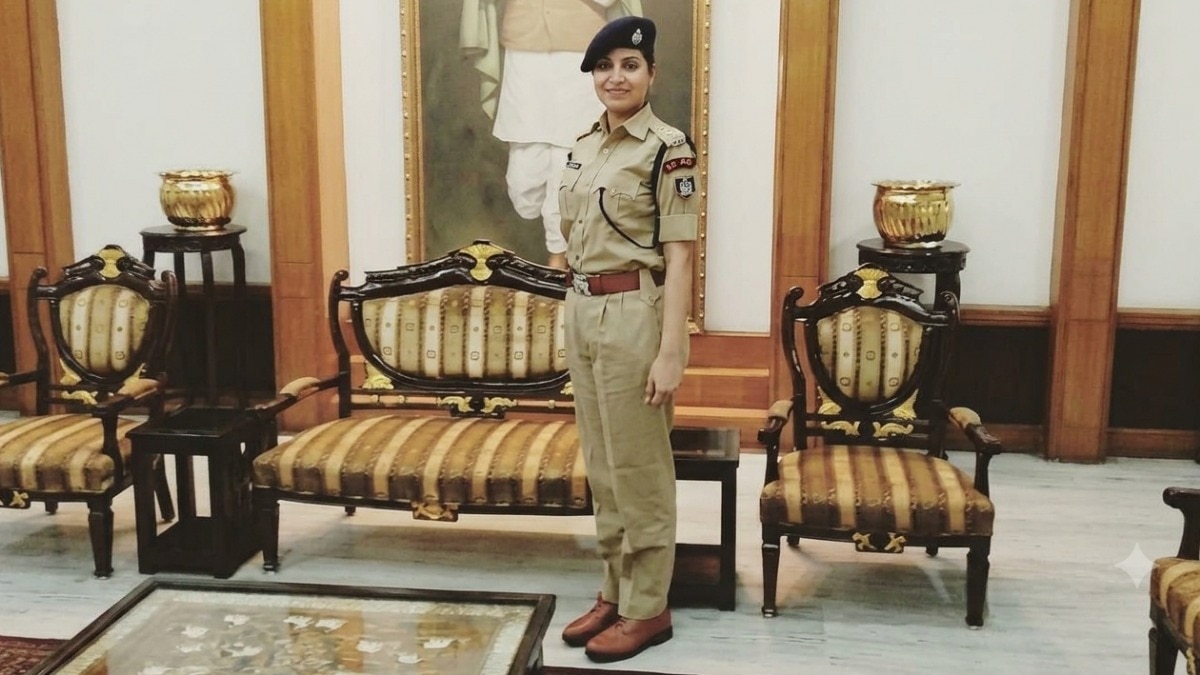
She was researching how nanoparticles could affect human health and whether new testing methods could help assess their safety.Today, her responsibilities look very different. As a 2015-batch Indian Police Service officer, she is currently posted as Superintendent of Police (Police Marine Force/Fire and Emergency Service) and Commandant, India Reserve Battalion (IRBn), in the Andaman and Nicobar Islands.The journey from a research laboratory in the United States to police leadership in India is not an ordinary career switch.
And Bhatt's educational and professional background makes it even more interesting.FROM LUCKNOW TO THE UNIVERSITY OF MICHIGANBhatt completed her BTech in Electronics and Instrumentation from Uttar Pradesh Technical University from 2007 to 2011. College was not limited to academics for her.
She served as chairperson of the IEEE students' chapter at IET Lucknow and was also involved in the college's cultural and technical events body, as well as the Electronics Department students' body.She then moved to the University of Michigan, where she pursued a master's degree in Biomedical Engineering for two years from 2011 to 2012. During this period, she also interned at Medtronic from May to August 2012.
The internship focused on cardiac surgery and perfusion technology. Her work involved assessing client requirements through interactions with stakeholders across four cities in China and analysing the findings with the research and development team in Minneapolis.INSIDE THE US FDA'S RESEARCH WORLDAfter her master's degree, Bhatt moved into biomedical research, joining a project associated with the National Science Foundation (NSF) and the US Food and Drug Administration (FDA) in September 2012.As an NSF/FDA Scholar in Residence, she worked on a project titled '3D Engineered Tissue Models for In Vitro Safety Testing of Nanoparticles'.
Her work involved assessing the safety and biocompatibility of nanoparticles.She subsequently became an ORISE fellow at the FDA's Center for Devices and Radiological Health in January 2014. There, she worked on developing a three-dimensional toxicology testing model to assess nanoparticle toxicity and examining whether the model could be used in regulatory testing.It was a specialised research career, but Bhatt eventually chose a different professional direction.FROM RESEARCH PAPERS TO POLICE POSTINGSBhatt joined the Indian Police Service as an officer trainee in July 2015.
Her training continued until December 2017, after which she began her field assignments as Assistant Superintendent of Police in Dehradun.Her subsequent postings took her to Chandigarh, where she served as ASP and later SP City. In August 2019, she moved to Puducherry as SSP Traffic and Commandant IRBn.She then served as SSP Karaikal from August 2020 to February 2022.
Her next assignment involved multiple responsibilities, including the Anti-Corruption Unit, Armed Police, Police Radio, recruitment and Commandant IRBn, from September 2022 to February 2024.In February 2024, she took charge as SP South Andaman, serving until December that year.Since December 2024, Bhatt has been posted as SP Police Marine Force, Fire and Emergency Service and Commandant IRBn.From studying the safety of nanoparticles to overseeing policing and emergency services, her career has moved across two very different fields. Her journey shows how a professional path that begins in a specialised technical discipline can eventually lead somewhere few might have expected.- Ends