


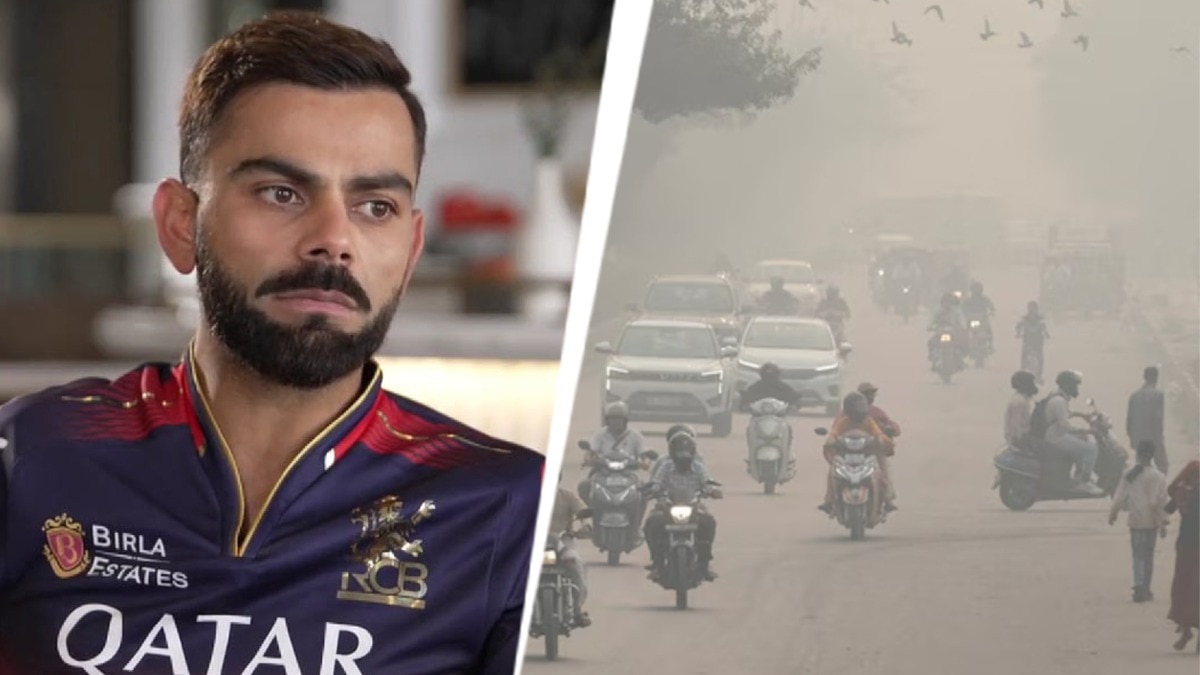
A Supreme Court bench of Justices MM Sundresh and Prasanna B Varale called for a new and innovative approach to tackling pollution, observing that its annual orders had become almost academic as violations continued. The judges stressed the need to raise awareness, particularly among the younger generation, and suggested involving influential personalities such as Virat Kohli to drive the message home.Petitioner Gopal Sankaranarayanan told the court that the government was seeking two weeks to complete its consultation process even as firecrackers continued to be sold and transported without any restrictions.The Supreme Court will hear the issue of permissible barium content in firecrackers after Diwali.
It is also examining other issues concerning firecrackers that contribute to pollution.Uttara Babbar, appearing for petitioner Arjun Gopal, said firecrackers bearing green-cracker labels were being sold in the market, but the labels were misleading. She said there was no reliable mechanism or QR code to verify whether the products were genuine green crackers.
HAZARDOUS PARTICULATE MATTER AND HEALTH RISKSAmicus curiae Aparajita Singh told the court that bursting firecrackers releases large quantities of hazardous chemical particles, including particulate matter (PM). Burning the chemicals and metals used to produce colours and sounds also leaves behind toxic gases.PM2.5 refers to particles measuring 2.5 micrometres or less.
These particles are small enough to enter the nose and lungs, pass into the bloodstream and spread throughout the body, including the brain, she said. Singh cited Delhi chest specialists who, she said, had observed a change in patients' lung health.
In the 1980s, the lungs of non-smoking patients were generally pink, but doctors now regularly see black spots on the lungs of patients who have never smoked, including children aged 14 to 16.She also said that in the 1980s, 90 per cent of lung cancer patients were smokers, whereas non-smokers now account for 50 per cent of patients.Singh said green crackers were subjected to certain tests and were claimed to emit lower levels of carbon and hazardous chemicals. However, she argued, the products being sold in the market did not match those claims.The Commission for Air Quality Management (CAQM) has advised state governments to conduct surprise inspections and collect samples directly from firecracker factories and sales outlets.
The checks are intended to establish whether manufacturers are following approved green-cracker formulations, whether only authorised products are being sold and whether actual emissions remain within prescribed limits.GREEN CRACKER LABELS UNDER SCRUTINYThe court was told that Delhi's air quality deteriorated sharply after Dussehra last week, with the Air Quality Index (AQI) rising from 179 on the festival day to 245 the following day.Despite the ban on conventional firecrackers, they continue to be sold widely, with some allegedly being marketed under green-cracker labels. Many reportedly do not carry QR codes that can be used for verification.Singh said the CAQM had reported last year that QR codes printed on some products were fake.
Even if the court lifted the ban and permitted green crackers, she argued, there was no reliable way to establish whether the products being sold were genuine.Green crackers are not pollution-free, she said. According to formulations developed by the Council of Scientific and Industrial Research (CSIR) and the National Environmental Engineering Research Institute (NEERI), they emit around 30 per cent less pollution than conventional crackers, but still release substantial pollutants that harm the environment.Singh referred to a Supreme Court observation dated April 3, 2025, that green crackers should not be permitted until the court was satisfied that pollution from them was negligible.
The court had also noted that a large section of the population working on the streets was among those most exposed to pollution, and that not everyone could install air purifiers at home or at work.Last year, the ban was partially relaxed for two days, with the court also calling for studies alongside the restrictions. Singh argued that the government had not filed a report on those studies in the intervening year and had returned to court seeking relaxation just before the festival.She said Delhi-NCR was already dealing with dangerously polluted air, which remained trapped for longer during the severe winter.
Citing a news report from last year, she said air quality deteriorated sharply after Diwali, accompanied by a significant rise in hospital visits for respiratory and pregnancy-related problems. Both outpatient department (OPD) and emergency cases increased as pollution levels rose, she said.When the Supreme Court asked whether she believed firecrackers should be banned, Singh said the ban should remain until an effective system was in place to regulate them.She pointed to the restrictions imposed under the Graded Response Action Plan (GRAP) when air pollution reaches severe levels.
These begin with curbs on certain activities and can extend to construction work, while schools may shift to virtual classes.If such stringent measures are necessary to control pollution and can disrupt essential activities, Singh argued, allowing firecrackers during periods of already hazardous air quality would be difficult to justify given the health risks.PETITIONER SEEKS COMPLETE BAN; FIRECRACKER INDUSTRY OPPOSES ITGopal Sankaranarayanan argued that the court had repeatedly faced questions about why its focus appeared to be on Diwali or Hindu festivals. He said noise-related concerns had already been addressed and that the petitioners wanted a complete ban on the manufacture of firecrackers, irrespective of the festival or reason for their use.He argued that the industry had begun in 1921 and that firecrackers had no historical or religious significance that could override Article 21 of the Constitution, which protects the right to life.Sankaranarayanan said even a single PM2.5 particle could remain suspended in the air for a month before reaching the ground.
As a result, he argued, pollutants released by firecrackers over two or three days could remain in the atmosphere for as long as three months, making them a significant contributor to Delhi's annual pollution.He also alleged that children had been employed in firecracker manufacturing since the industry's inception and that child labour continued. He added that storage regulations were routinely ignored at different stages of the supply chain.Appearing for firecracker manufacturers, advocate J Sai Deepak argued that there had not been a complete ban between 2018 and the 2024 order by Justice AS Oka, and that a blanket prohibition was ineffective.He said a complete ban had instead led to a flourishing black market, the sale of Chinese products and unlicensed firecrackers.
As an industry governed by the Explosives Act, he argued, manufacturers were subject to strict regulations, and those violating QR-code requirements should face action, including the cancellation of licences.Deepak said pollution levels had been substantially reduced with the involvement of CSIR and NEERI. He argued that manufacturers who complied with the law were being made to bear the cost of violations by others.A ban, he said, did not necessarily stop people from bursting firecrackers, particularly during festivals, but encouraged smuggling of products that were more harmful than green crackers.
A blanket prohibition without sufficient justification could also increase confrontation and make people more resistant to restrictions, he argued.COURT QUESTIONS GOVERNMENT ON ENFORCEMENTRepresenting the Delhi government and the CAQM, Additional Solicitor General Aishwarya Bhati told the court that air pollution was a genuine problem that the authorities faced every year and that several measures were being taken to address it.She said the Delhi government had a plan scheduled to begin on November 1 under which vehicles entering the national capital from outside would be required to meet BS-VI emission standards. Government office timings had also been changed to reduce traffic, while anti-smog guns had been deployed near construction sites.
Other measures included an anti-pollution plan, control centres and air wardens, she said. A total of 608 anti-smog guns had been deployed.Bhati said the government was better prepared to tackle pollution than it had been the previous year.
However, she acknowledged that AQI levels had been higher on days when firecrackers were permitted.The court questioned the Delhi government over why only nine of the 39 monitoring stations had been operational. It also asked what action had followed its previous orders and whether compliance reports had been filed.The bench sought details on whether enforcement teams had been deployed, which locations they had visited, the dates of their inspections, the data they had collected and whether that information had been submitted to the court.The court said orders and directions were meaningless if they were not implemented on the ground, warning that without an effective enforcement mechanism, judicial directives risked becoming a joke.
It said the government should already have the relevant data and stressed that pollution affected every person and living being.The bench also asked the government to determine whether Chinese firecrackers were being sold and what action had been taken against those responsible. It said authorities needed to regulate the trade strictly and send a strong message.COURT CALLS FOR AWARENESS, SAYS IT IS NOT IN FAVOUR OF A TOTAL BANThe bench said it understood the sentiments of people who wanted to celebrate the festival, noting that celebrations could boost morale and create positivity.
It said it was not in favour of imposing a complete ban because of the possible long-term consequences, and urged the government to ensure that all officials focused on enforcement during the two days in question.The court asked the government to assess the situation on the ground and take concrete action, including cancelling licences and registering cases where warranted. It said changing public attitudes would take time and that authorities needed to consider children, the elderly and persons with disabilities.The judges reiterated the need to involve prominent personalities, such as celebrated sportspersons like Virat Kohli, or respected figures from society in public awareness campaigns.The bench said today's generation was aware and willing to question established practices.
If children were educated about the effects of pollution, the court observed, they could encourage their parents not to burst firecrackers. It also noted that many young people no longer wanted to set off firecrackers.The court reserved its order on whether the existing restrictions should continue or be relaxed subject to conditions.- Ends