


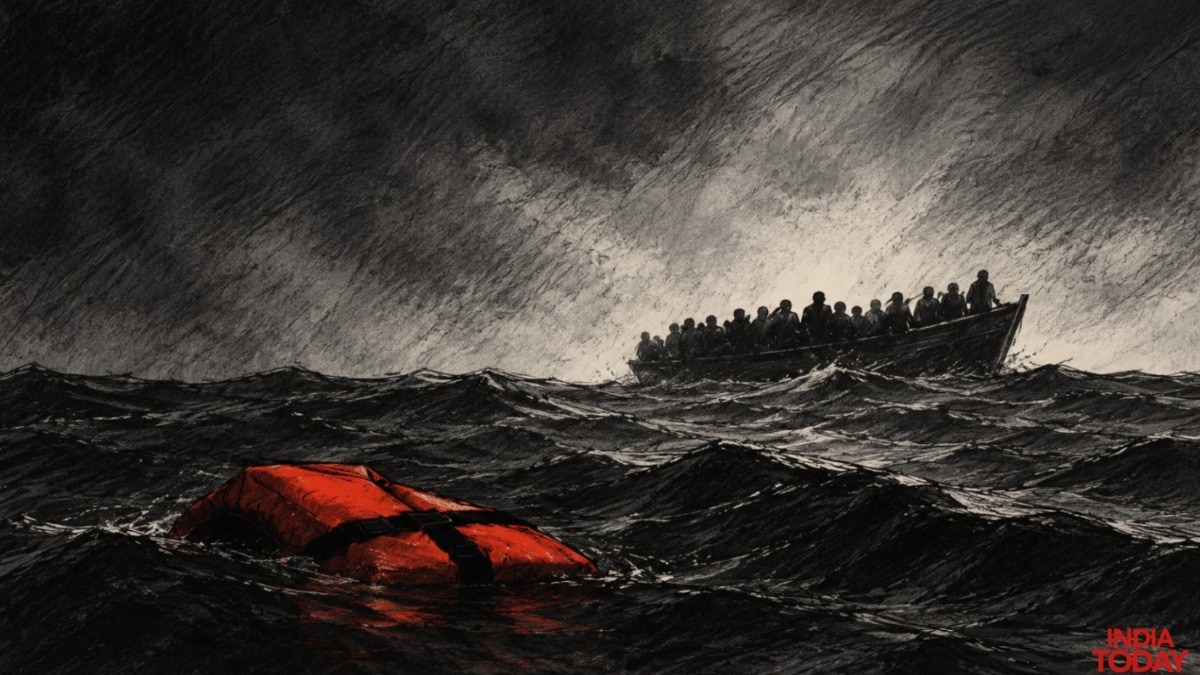
At least 39 people died, and only one survived after a wooden fishing boat, known locally as a pirogue, capsized off Kbmer on November 8 while carrying migrants from Saint-Louis in northern Senegal towards Spain, according to Senegalese state broadcaster RTS. Once used to sustain coastal livelihoods, such boats are increasingly being used for dangerous journeys to Europe.
The Atlantic migration route spans thousands of kilometres, linking West Africa to Spain’s Canary Islands. A recent shipwreck off Senegal left at least 39 people dead This was one wreck, but it is not an isolated one.
Across Europe’s sea routes, the latest data tells the same story: fewer people are getting through, and more are dying on the way.Fewer arrivals, more deathsNearly 60,000 people reached Europe by sea between January 1 and September 15, 39 per cent fewer than the 98,040 a year earlier. But at least 2,292 died or went missing, up 15 per cent from 1,999, according to the International Organization for Migration (IOM).
The contrast is stark: arrivals fell to 17,788 in 2025, while deaths and disappearances climbed to a record 1,214 in the series shown IOM chief Amy Pope said that "nearly every death and disappearance at sea is preventable." The true toll is likely higher. About 1,500 suspected deaths in 2025 could not be verified after aid cuts.When routes change, journeys get longerTighter border controls have not stopped departures from West Africa.
They have pushed boats towards more distant starting points in The Gambia, Guinea-Bissau and Guinea. Some journeys now cover more than 2,000 km and take up to 10 days, according to the Mixed Migration Centre.
But the flow has not stopped. Between November 1 and 6, 4,587 migrants reached the Canary Islands in 49 boats.
On El Hierro, which has a population of around 11,400, more than 3,300 arrivals in less than a week pushed the island to declare an emergency.Why they leaveIn Senegal, the crisis begins long before a boat reaches the Atlantic. Fishing supports livelihoods along the coast, but years of overfishing have put growing pressure on the sector.
According to the London-based Environmental Justice Foundation (EJF), fishing employs about 3 per cent of Senegal's workforce, while 57 per cent of the fish species assessed are either collapsing or already collapsed.EJF points to pressure from industrial fleets, particularly foreign vessels, though the problem is not limited to them. Decades of overfishing by both industrial and small-scale fleets have further depleted fish stocks.
For coastal communities that depend on fishing, dwindling catches mean shrinking incomes and fewer reasons to stay and, hence, for some, the sea that once sustained their livelihoods has become a route out.A business built on desperationUNODC estimates 190,000 to 209,000 people were smuggled across Europe's four main sea routes in 2025, paying between $388 million and $509 million. The Atlantic route accounted for 33,000.
UNODC says, "Perpetrators commit smuggling offences to make a profit."Some paid as little as $170 on the Atlantic route. Among survey respondents bound for Italy or Malta, nearly half paid more than $7,500.
Paying guarantees nothing. At least 3,404 people died or went missing on the four routes in 2025, and another 104,200 were intercepted and returned.The same danger on every route, even in India’s backyardThe pattern repeats across all of Europe’s sea routes.
On the Central Mediterranean to Italy, arrivals fell 55 per cent to 21,393, but deaths rose 18 per cent to 996. To Greece, arrivals dropped to 20,428 while deaths jumped 47 per cent to 417.
On the Atlantic and Western Mediterranean routes to Spain, arrivals fell 27 per cent to 16,794, yet 879 people died or went missing.Our calculation from IOM data shows deaths per 1,000 arrivals rose on every route: from 17 to 47 in the Central Mediterranean, 11 to 20 in the Eastern, and 38 to 52 on the Spain routes. Overall, one person died or went missing for every 26 arrivals, against one in 49 a year earlier.The Bay of Bengal is the starkest case.
UNHCR says “it has the highest death rate” of any major refugee or migrant sea route. In 2025, more than 6,500 Rohingya attempted the crossing and nearly 900 were dead or missing, roughly one in seven.Boats leave from Cox’s Bazar in Bangladesh or Rakhine State in Myanmar, heading for Malaysia or Indonesia.
Over half of those attempting the journey in recent years have been women and children.UNHCR said that “this sad and tragic trend continues” even now. A boat from Teknaf that capsized in the Andaman Sea this year carried Rohingya and Bangladeshi nationals, and about 250 went missing.- Ends