


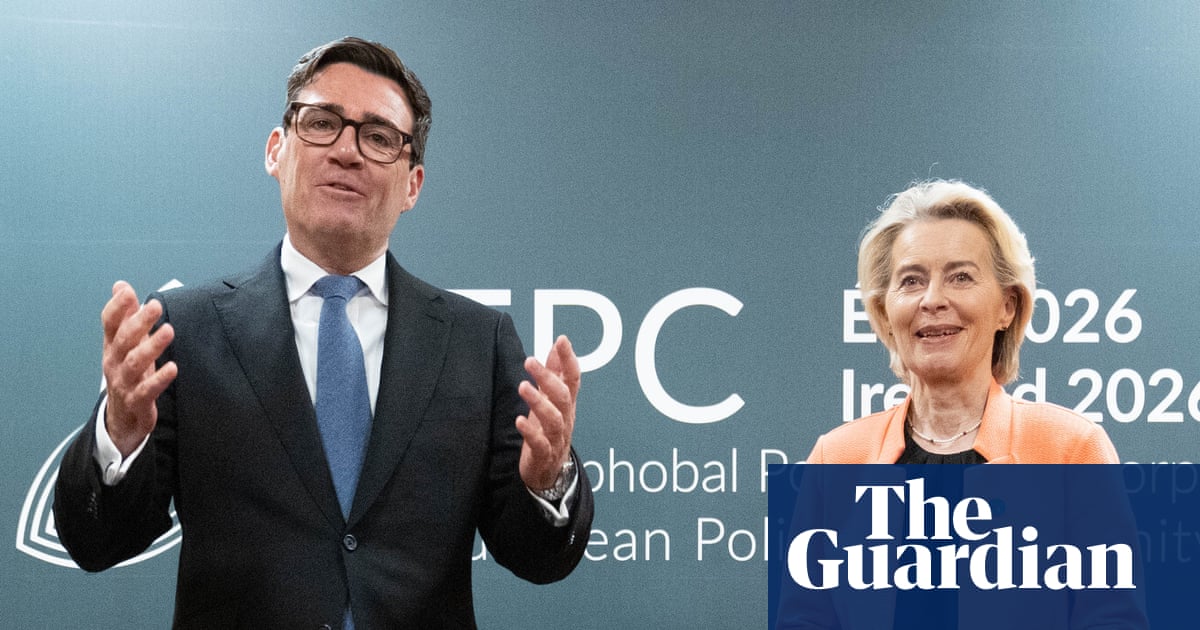
Good morning. Ahead of the hotly anticipated UK-EU summit this Friday, Andy Burnham is expected to make the reset of our relationship with Europe the pivotal theme of his white-tie speech at the lord mayor’s banquet in London tonight.The prospect of closer ties – and the possibility of going “all the way” to reversing Brexit – has been met with jubilation and relief in some quarters and vehement opposition in others, while around Westminster and across the media the psychodrama has been spiralling for weeks.At this point, I’m reminded of that Robert Burns couplet: “O wad some Pow’r the giftie gie us / To see oursels as ithers see us!” What does the EU think about all this?
Are they ready to reverse what leading figures have repeatedly described as a colossal act of self-harm? Or are they viewing this latest iteration with bombastic side-eye?
I posed these questions to Jennifer Rankin, the Guardian’s Brussels correspondent. First the headlines.Weekend roundup UK news | A woman who alleges she was raped by Russell Brand when she was 16 has waived her right to anonymity to campaign for a staggered age of consent, which would make it illegal for adults over a certain age to have sex with 16- and 17-year-olds.
Youth unemployment | Andy Burnham has pledged to intervene as early as childhood to tackle youth unemployment before a watershed review, promising “a root-and-branch rethink of how we support childhood in the modern world”. Environment | The strongest El Niño in centuries has added urgency to UN climate talks in Turkey as vulnerable countries face “compounding” crises.
In other Cop31 news, queer and gay protesters defied a crackdown on LGBTQ+ rights in Turkey to lead a civil society climate march. UK news | Two people aged 22 and 23 have died after their car was hit by a BMW being pursued by police.
West Yorkshire police said four people had been arrested and appealed for witnesses to come forward. Air transport | The Trump administration says Friday’s four-hour nationwide Federal Aviation Administration (FAA) ground stop that delayed or cancelled thousands of flight stemmed from routine maintenance.
The US transportation secretary, Sean Duffy, blamed prior presidents and Congress for the stoppage. In depth: ‘This is a real priority for the EU, in almost emotional terms’While official discussions about the UK rejoining the EU are not on the agenda this week, there is genuine enthusiasm about the matter.
Photograph: Andy Rain/EPAAhead of the summit, the pro-Brexit polity has been in broadcast mode: headlines from the past few days include: “Burnham’s plot to rejoin the EU would leave the average UK household £6,500 poorer” (Express); “Taxpayers funding pro-EU university courses” (Sunday Telegraph); “Staggering cost of PM’s EU reset” (Daily Mail).Stay Out, a new campaign against rejoining the European Union, launched last week. While the guy you really want to hear from right now – David Cameron, the prime minister who lost the 2016 Brexit referendum – has insisted the UK’s problems have nothing to do with its exit from the EU.Even within the Labour fold, there are rumblings of unease from MPs and unions.But the one-day summit in Brussels this Friday does not include any formal discussion of rejoining: instead, the EU and UK hope to sign deals on food and drink, emissions trading and the youth experience scheme (a work and study exchange programme).Still, the mood music is upbeat.
Back in September, when Burnham first opened the door to a Brexit reversal, French president Emmanual Macron responded: “welcome back.” while Spanish prime minister Pedro Sánchez said: “Spain would welcome Britain’s return with open arms.”The enthusiasm is genuine, says Jennifer. Indeed, some European diplomats have told her the technicalities could be wrapped up within a year because the UK remains closely aligned with the bloc in so many areas. “It would be such a vote of confidence in the European project for a country to decide to return after voting to leave”.Situationship: what’s at stake at this week’s summit?Though Burnham has predicted “some long nights” of negotiation this week, Jennifer says there’s optimism on each side as the first two deals on food and drink and emissions trading were largely agreed.There are two sticking points with the youth exchange deal.
First, the Home Office wants to limit numbers to the UK to keep migration figures low. Second, there’s disagreement over whether those students would pay UK domestic rates of tuition fees or the international rate, which is four or five times higher for some courses.The UK is offering concessions on tuition fees if it can join Made in Europe, the EU legislation designed to protect domestic manufacturing from cheap Chinese competition.
But the EU says it can’t make a deal on Made in Europe this week, because the law is still at a draft stage.And here’s where it gets complicated. The European Commission has proposed delaying an agreement on tuition fees for six months, which could allow time to get the UK into Made in Europe, a diplomatic win for Britain.
But there’s pushback from member states who want to pin down the UK on tuition fees this week. “This is a real priority for the EU, in almost emotional terms,” Jennifer says. “Lots of EU officials and diplomats studied in the UK, or their children did, and they felt this was one of the big losses of Brexit, that these person-to-person links were being eroded.”On-again, off-again: what else could get in the way of closer working?In play at Friday’s summit will also be a future deal on Britain’s return to the EU’s internal electricity market and a joint migration pact, with the UK pushing for access to EU crime databases to tackle the small boats crisis.Member states are already working hard to smooth things out on the electricity front, to stop it becoming a sticking point. A couple of weeks ago, Jennifer reported on leaders from Germany, Denmark and elsewhere calling for deeper cooperation on clean energy – which she reads as an attempt to head off a row about how much the UK should contribute to EU cohesion funds for the evident privilege of cutting red tape, easing trade and, ultimately, reducing costs.A similar row over UK contributions scuppered negotiations last year on our entry into a €150bn EU defence fund.It could also be a challenge for the UK to realign with the EU on farming, after changing to a payment model that puts more emphasis on delivering environmental benefits.
And past UK governments have been lukewarm about EU AI regulation, devised post Brexit.Conscious partnership: will the EU welcome future closeness this week?I learned long ago there’s no such thing as a stupid question, so I ask mine now: will there be a moment on Friday when Ursula von der Leyen offers the equivalent of Macron’s “welcome back”? Will there be a “just give us six months to sort out the paperwork Andy” vibe?The European Commission president is, by nature, a cautious politician, Jennifer tells me, so she doesn’t expect anything so specific. “I’m sure she – and António Costa, the European Council president – will get asked about it at the press conference, and they’ll want to send a signal about the UK being welcome to rejoin.”But behind closed doors, in Brussels and other capitals, what Jennifer hears repeatedly is that it’s up to the UK to decide what it wants.
And, while the prospect of Brexiteer Nigel Farage in Downing Street has faded in recent months, there remains a deal of caution about the vicissitudes of UK politics. “Now the Burnham government is exploring the options, but there’s also an awareness that you could have a very different government in a few years’ time,” she says.It’s not you, it’s me: what else is Europe worrying about?The EU and its member states are preoccupied with far weightier problems: the war in Ukraine (Volodymyr Zelenskyy attends every EU summit), the rise in support for the far right, street protests, hybrid threats from Russia, a trade deficit with China that has reached a staggering €1bn a day in 2026.“There are so many other issues crowding on the agenda,” says Jennifer. So it’s not all about us? “That’s actually been the theme of my decade of reporting from Brussels,” she says with a laugh.There’s profound concern about the prospect of Marine Le Pen winning the French presidential elections next year, which could tip the bloc into a crisis if she pursues her resolutely anti-EU agenda, which includes reducing France’s substantial contribution to the EU budget.Beyond that, there’s a broader question about increasingly divided and unstable politics across member states. “Every single member state has to agree to the UK’s re-entry,” Jennifer reminds me. “Who knows what the EU will look like in 2030 when Britain could be having a rejoin referendum?”skip past newsletter promotionafter newsletter promotionThe week to come Tuesday | The work and pensions secretary Alan Milburn’s long-awaited review into why increasing numbers of young people are falling out of work and education, is expected to be released.
Thursday | German chancellor Friedrich Merz, French president Emmanuel Macron and UK prime minister Andy Burnham will be among around 20 heads of state meeting in Berlin to discuss defence funding for Ukraine, and to establish a unified position on future peace negotiations in its war with Russia. Friday | This marks last day of the world’s biggest annual climate conference, Cop31, in Turkey, with final negotiations taking place.
What else we’ve been readingDavid Walliams kisses Jonathan Ross at the 2003 comedy awards. Composite: Guardian Design/Getty Images/Shutterstock With a stellar range of interviews, Nadia Khomami is excellent on 2000s pop culture, and how openly horrible it was to women.
Poppy Noor, newsletters team Emma Beddington’s piece on why gen Xer seem to have worse mental and physical health than boomers is a must-read. Poppy Amelia Gentleman’s report over the weekend on two very different rape trials and what happened in each of them is a difficult read – but enlightening about all of the ways culture has (and has not) changed since Russell Brand’s prominence.
Poppy SportEngland’s Ezri Konsa celebrates after scoring his side’s second goal. Photograph: Francisco Seco/APFootball | England risked throwing away a three-goal lead against Spain after Elliot Anderson was sent off, but held on for a thrilling 3-2 win in Madrid, which Thomas Tuchel hailed as a statement result and the best performance of his tenure.Cricket | Tom Banton’s century led England to emphatic win, with 135 runs, in second ODI amid Australian soap opera.Rugby union | Tries from Matt Fagerson and Jack Dempsey gave Scotland a 15-12 win against Australia in the Nations Championship at MurrayfieldThe front pages Photograph: The Guardian“PM vows early years interventions will tackle youth joblessness crisis”, is the Guardian’s front page today.The i Paper leads with “Pressure grows for new consent law to protect teenagers from adult predators”, Metro has “Rethink on the age of consent”, the Sun writes “Brand’s rant from prison”.The Telegraph says “Johnson: Britain would back Brexit again”, the Express writes “Brexit U-turn means ‘more asylum seekers’”.
The Times has “Zero-hours ban to cost billions”, the Mail has “£80,000 a day spent ferrying migrants around”, the Mirror’s splash is “Dying in the dark”, and the FT’s is “Nvidia scandal spurs drive to choke China’s AI chip supply”.Today in FocusAdvertisement for upcoming release of GTA 6 displayed in the Netherlands. Photograph: John van der Tol/EPAGrand Theft Auto VI: the cultural event of the decade?This week, after a 13-year wait, gamers will finally get hold of Grand Theft Auto VI, the latest instalment of the most successful console computer game in history.
How did a game of stealing cars and shooting strangers become such an enormous cultural phenomenon? The Guardian’s video games editor, Keza MacDonald, traces the history of games by Rockstar, GTA’s creator, and what its most successful product has told us about the US, the setting of all its games so far.Cartoon of the day | Ella Baron Illustration: Ella Baron/The GuardianThe UpsideA bit of good news to remind you that the world’s not all badHidde Burgmans with an accidental find in Palermo, Sicily.
He has used his skills as a digital designer to create a global app for sightings of special trees. Photograph: Nadia RoeleveldSome travellers seek out ancient landmarks when they visit a new place.
Hidde Burgmans, from the Netherlands, looks for ancient trees – and he’s created an app of the same name to help people find remarkable old trees around the world, from Malaysian baobabs to the Fortingall yew in Perthshire, Scotland, thought to be an astounding 5,000 years old.Users can review remarkable old trees around the world, and upload their favourites to the Ancient Trees app. “On Tuesday somebody photographed a tree in Edinburgh. Today, someone in Freiburg,” said Burgmans. “That just makes me happy.
I thought it was quite a niche, geeky thing, but apparently more people are interested in ancient trees than I thought.”Sign up here for a weekly roundup of The Upside, sent to you every SundayBored at work?And finally, the Guardian’s puzzles are here to keep you entertained throughout the day. Until tomorrow.
Quick crossword Cryptic crossword Wordiply