


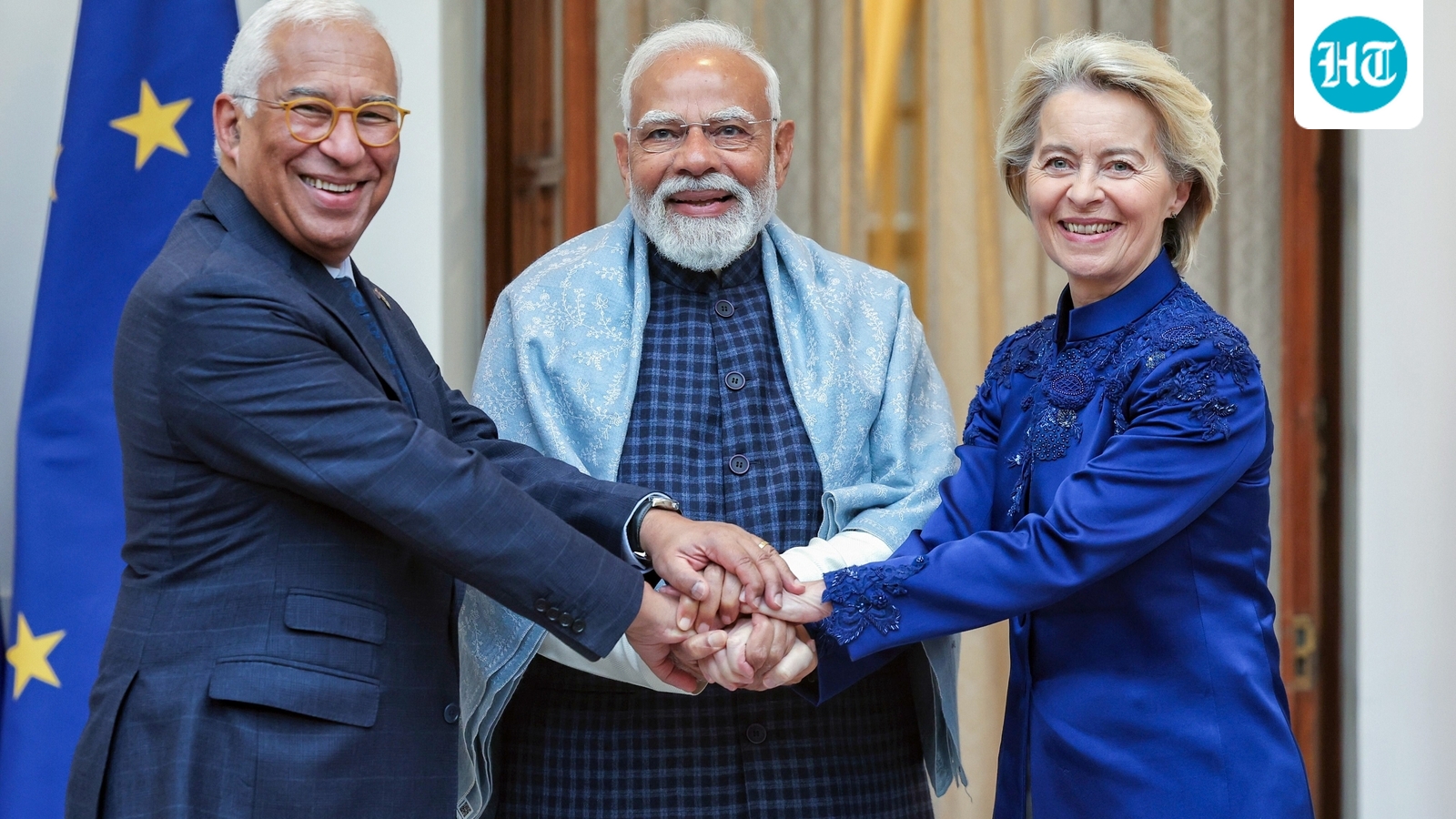
The European Union and India are intensely engaged to meet the December deadline for signing the India-EU Free Trade Agreement (FTA) to coincide with Prime Minister Narendra Modi’s expected Brussels visit as the European Commission proposed a “fast-track procedure” to its Council for expeditious approval, people in the know said.File photo of Prime Minister Narendra Modi with European Council President António Luís Santos da Costa and European Commission President Ursula von der Leyen in Delhi. (DPR PMO)The European Commission (EC) has urged the Council of the European Union (informally, the Council of Ministers) to approve the proposed FTA announced on January 27 through a fast-track procedure laid out by trade commissioner Maroš Šefčovič to speed up its implementation under prevailing turbulent global geopolitical situation, they said requesting anonymity.Also read: 'We cannot remain helpless spectators': Jaishankar presses for 'dialogue and diplomacy' amid Ukraine, West Asia conflictsThe Commission proposed to complete the legal process based on the original English version of the FTA, rather than waiting for translating the document in 24 EU official languages, which could delay the ratification process by over one year, they said.EU, India want to sign deal around Dec 17 or 18Both sides want to sign the agreement around December 17 or 18 in Brussels during Modi’s expected visit while returning from his proposed G20 meeting in Miami (USA), they said. After the Council (representing 27 members of the bloc) approves the FTA concluded on January 27, India and the EU would be able to sign the agreement.
Things are moving at a fast pace from both ends, but all timelines are still fluid unless announced officially, they added.Meanwhile, commerce secretary Rajesh Agrawal is expected in Brussels this week to resolve procedural issues. His visit follows the recent European tour of commerce minister Piyush Goyal, they said.
Goyal visited two key EU nations -- Germany and the Netherlands -- between October 22 and October 27.Also read: Saudi forces say 10 ballistic missiles launched by Houthis interceptedIn a social media post on Saturday, Goyal said that he “emphasised the transformative potential of the India-EU Free Trade Agreement in expanding market access, strengthening supply chains, and creating new avenues for trade and investment,” during his visit.In Germany he met the country’s federal minister for economic affairs and energy, Katherina Reiche, and the economic and financial policy advisor at the German Federal Chancellery, Levin Holle, according to a commerce ministry’s statement.During this period, a delegation from the EU’s Committee on Foreign Affairs is also scheduled to visit New Delhi from October 26-28. The delegation is led by its chair and member of the European Parliament, David McAllister.
This will be the committee's first official visit to India under the European Parliament's current mandate, they said.Also read: Iran dismisses Trump warning of fresh attacks: ‘They will not try again if there's any rationality'According to a research document of the EU parliament dated September 20, the conclusion of the negotiations for the FTA was announced on 27 January 2026, during the India-EU summit in New Delhi. “This comprehensive agreement, celebrated as 'the mother of all deals', will create the world’s biggest free trade zone: it covers one quarter of the world's population and 25% of the world's GDP,” it said.“After the announcement of the conclusion of negotiations in January 2026, EU Council President António Costa and Commission's President Ursula von der Leyen met with India's Prime Minister Modi on the sidelines of the G7 in Evian (France) on 17 June 2026. The[y] expressed the will to sign the FTA by the end of 2026, to accelerate work on an investment agreement and to step up security and defence cooperation,” it said.The European parliament supported negotiations with India for an FTA, an investment protection agreement (IPA) and an agreement on GI, namely through a resolution on EU-India future trade and investment cooperation adopted in July 2022, it said.
The deal is expected to be operational by early 2027.According to the EC, India is the bloc’s ninth largest trading partner for goods globally and the sixth for trade in services. Their bilateral trade in goods amounted to EUR 118 billion in 2025.
India’s main exports to the EU include machinery and appliances, chemicals, textiles, metals and petroleum products. The EU’s exports to India are largely dominated by industrial products, including machinery and appliances, transport equipment and chemical products.Bilateral trade in services amounted to EUR 67 billion in 2025, with EU exports amounting to EUR 29.2 billion and imports amounting to EUR 37.8 billion.
In 2024, the EU’s foreign direct investment stock in India amounted to EUR 132.8 billion, while India’s FDI stock in the EU was EUR 13.7 billion.In 2007 the Council of the bloc authorised the European Commission to enter into negotiations for an FTA with India. A first phase of negotiations took place until 2013, when the talks were suspended due to divergences on the level of ambition that the agreement should deliver, the document said.After an EU-India Leaders’ meeting on May 8, 2021 provided renewed impetus as it was agreed “to resume negotiations for a balanced, ambitious, comprehensive and mutually beneficial trade agreement which would respond to the current challenges,” it said.
On January 27, 2026, on the occasion of the 16th EU-India Summit in New Delhi, the negotiations were finalised at political level. The EU is a vast developed market comprising 27 countries with a combined economy of approximately $23 trillion.