


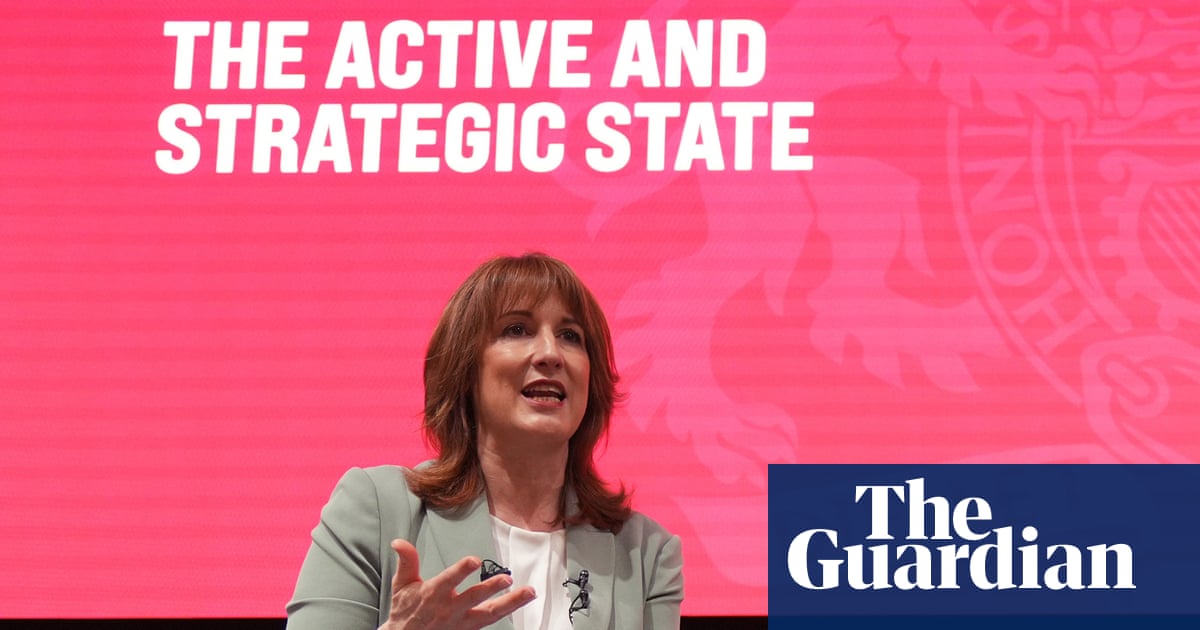
Which senior politician has argued that “Brexit did deep damage” and that the government seeks “not to turn back the clock but to look toward a new and stable, future relationship?”It was not Andy Burnham, who has been the torchbearer for thinking the unthinkable on Brexit since he became prime minister. Instead, these are the words of the former chancellor Rachel Reeves, in a lecture six months ago.Reeves has taken a more thoughtful approach on how to come to terms with life outside government than some of her fellow former ministers.A speech at Harvard on Monday will be her first public intervention on her own record and on Britain’s future, wisely left until after John Healey’s first budget.She will say no one in government could “be in any doubt” about her view on the damage of Brexit – and her belief that one day the UK should return to the EU fold. “Economic interests, common values and basic geographical reality all point towards Europe,” Reeves will say.The speech, which will examine how governments can meet the public’s appetite for radicalism while maintaining credibility with financial markets, will say that pursuing a closer relationship with the EU, even rejoining, may be credible as well as radical.“Economically, it is the credible choice.
Britain’s values, and a serious assessment of the geopolitical scene today, tell us it is the radical choice too,” she will say, giving Burnham “credit for his willingness to face reality head on”.The Treasury, where the blueprints for the Remain campaign’s “Project Fear” were drawn up, has always been the heart of pro-European sentiment in government and Reeves its biggest champion under Keir Starmer.Her sentiment seems more aligned though with that of Burnham, who cast her out of government, than with Healey, her successor as chancellor. He has joked about his own age when asked if the UK would rejoin the EU “in his lifetime”, saying it was his job to “try and make the most of Britain’s position now”.Within Westminster, there are more than whispers from some MPs that they have judged Reeves’s legacy and influence too harshly.
Healey’s first outing at the International Monetary Fund in Bangkok saw its economists lavish praise on his predecessor, saying the UK’s deficit reduction plan “stands out” among G7 peers.It is particularly striking how the themes of Reeves’s lecture have become the agenda for Burnham’s government. In it, she argued: “Today, what most distinguishes Britain from our closest peers is the relative underperformance of our major cities outside London, compared to their European counterparts.”Reeves, who is the MP for Leeds West and Pudsey, said the north of England had “waited for far too long, for a government that matches warm words with concerted ambition”.Her call to “liberate our regions from stifling Whitehall orthodoxies” sounds strikingly Burnhamesque.
The main policy announced in the speech? A plan to begin giving regional leaders a share of national taxes “which have, for too long, been allocated by central government”.That work now forms the centrepiece of Healey’s budget.
If this government has its own theory of growth – Brexit and devolution – it is awkward at best that it removed the key backer of both under Starmer.But Reeves’s main theory of growth was investment, in pursuit of which she raised employers’ national insurance.That is the other reason for Burnham’s government to be grateful to Reeves – and for which she has received no credit. Those tax raises – despite being unpopular – gave a sense of a government willing to make hard choices while taking the risk to borrow for public investment.
The fiscal rules were changed to allow for a multi-year commitment to an eventual £100bn in new capital spending.The cash is now beginning to flow into NHS infrastructure, roads, housing, rail upgrades and energy and industrial investments. Reeves will lay out her theory in her Harvard speech this week that the shift to an investment-led growth model “required sacrifices” that a Starmer-led government failed to get the public to back.“The challenge is to make the politics and economics, those dual tests of credibility and radicalism, line up,” Reeves will say.She will not say – although others have – that much of the problem with Starmer’s government was the man himself, rather than the agenda.Burnham, if he avoids an early election, may start to see some of that investment bear fruit in public and market confidence, both in upgraded public services and in Britain’s appeal as a location for private investment.There is much that could derail all this – not least further international turmoil – but when Burnham’s government counts its success on public services, Europe, devolution and growth, Reeves will be able to claim some credit.