


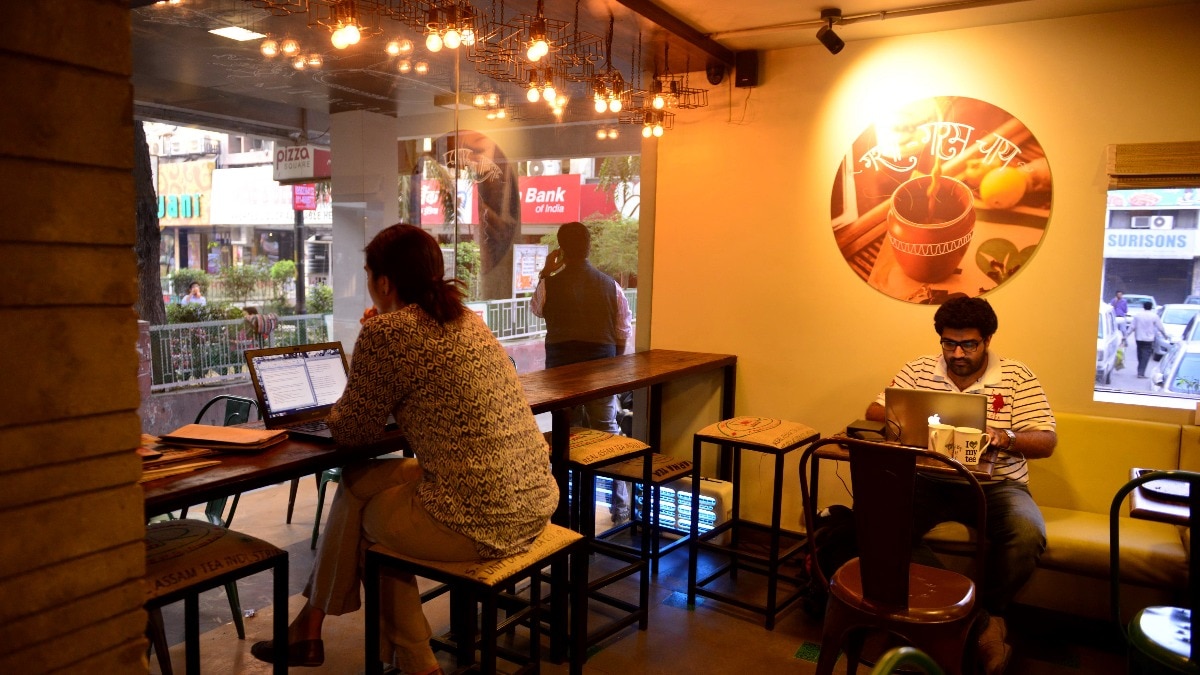
Work-from-cafe culture has become a part of urban life, more so after the Covid pandemic. Whether it's escaping the monotony of working from home, meeting a client or simply finding a change of scenery, cafes have become convenient workspaces.
And, of course, there's always a cup of joe to keep you going.This growing cafe culture is now at the centre of a debate. A recent post on X has gone viral and sparked a full-blown conversation: Is it fair to order just one cup of coffee and occupy a table for hours?
Is that good business, bad etiquette or simply the new cafe culture?The internet, as expected, had plenty to say. Some sided with cafe owners, while others argued that customers were paying for the ambience and experience, not just the coffee and called out this trend of putting up signboards that restrict laptop use.Meanwhile, suggestions ranged from a one-coffee-per-hour rule to charging customers for the time they spent.
Sanvi Sharma, a Pune-based marketing professional, admits that she never really gave it much thought. "I have occupied a table for four hours straight with one cup of cappuccino once. But honestly, I have never been asked to leave or asked to order, so it never really occurred to me because I'm usually too engrossed in work and lose track of time.
And if someone does ask me to order or leave, I might feel bad about it because I did make a purchase, right?"And perhaps that's how it happens for many of us. Nobody walks into a cafe planning to spend four hours nursing one cappuccino.
Sometimes, the deadlines simply outlast the coffee. The comment section also had people sharing this sentiment.
But what about cafe owners, then? While in some cafes you could spend 10 hours with one coffee and nobody would bat an eyelid, few don't want laptops at all.
So, we spoke to a few owners to understand the business side of things as well.And let's just say, this debate is brewing stronger than an espresso.Not every cafe is your workspace"Atithi Devo Bhava" has been at the core of Indian hospitality for ages. However, some cafe owners, while respecting this philosophy, still ask: at what cost?Earlier, a Bengaluru cafe reportedly made headlines for putting up a sign saying "No meetings allowed" and charging people who worked on an hourly basis.Similarly, Altry Coffee Roastery in Gurgaon has a no-laptop policy, and it's not because it doesn't want customers sitting for long or wants to generate more revenue.
Sahil Bhambri, its founder, has a blunt question: "Who decided that every cafe has to be a workspace in the first place? Just because a few cafes started allowing people to work after Covid, does that mean every cafe automatically becomes a workspace?" Social media has mixed opinions about the concept.
Bhambri has experienced this firsthand at his previous cafe, where some customers would occupy tables for hours, take office calls and refuse to share space. “In some cases, they didn't even want to order food because they had brought it from home,” he recalls.Bhambri wants people to “take some time away from work and simply waste a little of it.” Calling rest a luxury, he says, “I want to bring back cafes as they used to be — places where people could socialise and simply do whatever they felt like.”And guess what, despite putting up a sign board about his rule, people defy it and even argue with him. As per industry experts, that becomes a kind of unfair.
Work from cafe culture has become the new normal but comes with a cost for business owners. And that's where communication comes in.
In the era of designated co-working spaces, cafes need to make it clear whether they are work-friendly or not."It's very important for a brand to define its culture and communicate what kind of experience it wants to offer," Bintesh Kumar, Senior Marketing Manager, Pass Code Hospitality, tells India Today. “Chains like Blue Tokai and Starbucks have built a culture where customers can work for hours without any minimum spending requirement. But for standalone cafes that haven't positioned themselves as work-friendly spaces, this can affect business.”At The Drop in Delhi, a cafe by day and a bar by night, Kumar says they communicate this in a quirky and subtle manner. "We have small cards placed on every table that communicate that laptops are allowed only until 5 pm.
This applies every day, including weekends." Now that's a quirky way to speak with your customers! "We don't necessarily communicate this to customers in a confrontational way. It's about defining the culture of the space.
If you don't, people may start expecting a lot more from your business."Cost of occupying a tableWhen you make a purchase, you pay a latte more than just the product. You pay for a holistic service.
Rent, electricity, staff salaries, ingredients and maintenance don't come cheap. And for small cafes, every occupied table can make a difference.Discussing the coffee conundrum, Kumar emphasises a business paradox.
He admits that such situations affect business in terms of average spending per customer, but there's a trade-off: "When people look at a cafe from outside and see it filled with customers working on laptops, it creates the impression that the cafe is doing well. That can attract more people." Industry experts emphasise that cafes must establish clearly if they are work-friendly or not.
This further brings up the idea of loyal customers who repeatedly choose the same cafe and sit for hours, with or without reordering."As a brand that wants to build long-term loyalty, we would never ask customers to leave even if they sit for 10 hours with just one beverage," Dhruv Singh, founder and CEO of Chelvies Coffee, a work-friendly establishment, tells India Today.Not every cafe owner sees a four-hour laptop session as a problem.POV of a work-friendly cafe"Sometimes, you have to absorb a loss for the sake of the customer. Otherwise, you risk losing them altogether," he says.
According to Singh, the food and beverage business thrives on repeat customers. Rather than worrying about immediate revenue, he'd prefer someone to return regularly over the next several years."If a customer keeps coming back to Chelvies and ordering their favourite beverage for nine or ten years, that's the kind of profitability I'm looking at, rather than worrying about the revenue I might lose because they've occupied one seat for a few extra hours," Singh explains.Suresh Sharma of Kathe Cafe, Bengaluru, agrees."For me, the customer is God, and I would never ask anyone to leave or pressure them into ordering more.
Everyone has their own budget. If 95 out of 100 customers are spending well and five choose to sit longer with just one coffee, I don't see that as a problem." Customers should be respectful towards what a cafe offers.
Singh further highlights how loyal customers build rapport with the staff and understand the need to vacate or reorder when a cafe gets busy. "On weekends, when there's a much larger crowd and families or groups of friends are waiting for tables, if we politely request them to make space, they'll usually get up on their own. That's mutual respect you earn."So, how long is too long?Going back to the debate, where people suggested that cafes should charge on an hourly basis, Kumar isn't in favour of it. "It cannot and should not work in India," he clarifies, simply because that blurs the line between the cafe experience and co-working space culture.According to industry experts, there's a middle ground to all of this.
Hospitality is a two-way street where customers must respect the business too. Cafe owners believe that hospitality can thrive when there's mutual respect.
On cafe etiquette, Bhambri says, "If it's a work-friendly cafe, we could also suggest a maximum stay of two to three hours. That way, other people who want to come in and work can also use the space.
It gives the cafe an opportunity to generate fresh revenue."“If you're spending time at a cafe, it's only fair to support the business. That doesn't mean spending beyond your means, but ordering sensibly and respecting the experience it offers.
A little mutual respect is what will keep cafe culture thriving,” says Kumar.- Ends