


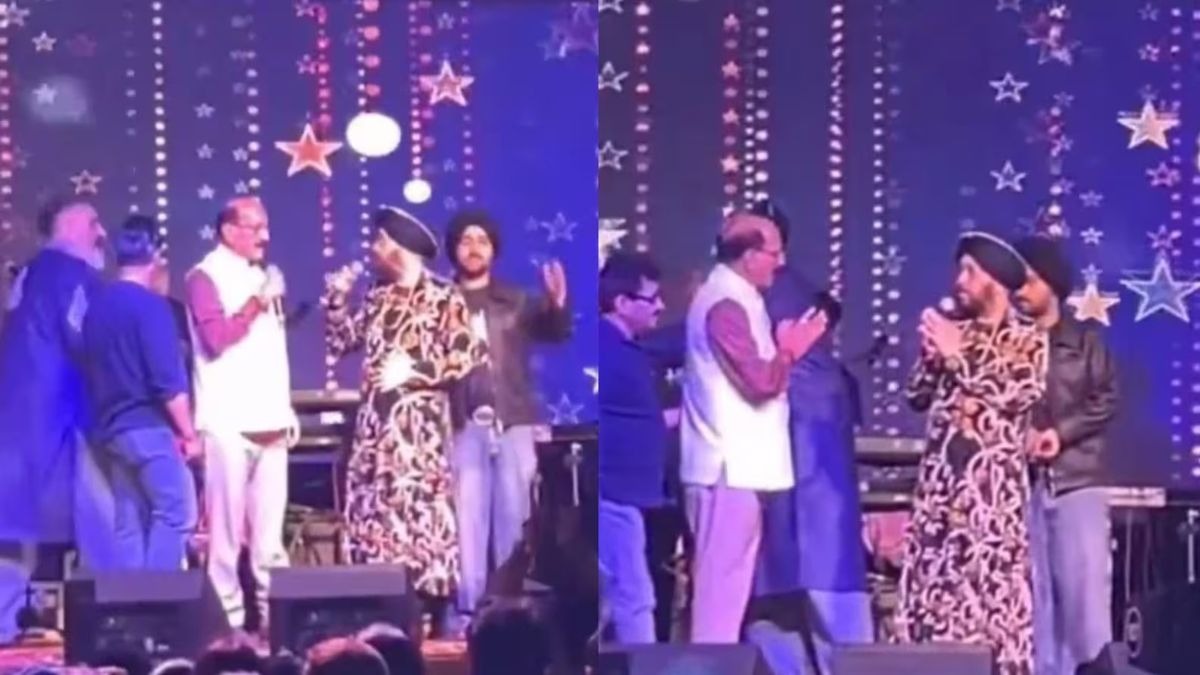
An Uttarakhand minister's onstage rebuke of the Punjabi pop artiste has reignited an uncomfortable debate on the line between artistic dignity and audience entitlement in who gets to judge a performance gone wrongThe moment lasted barely a few minutes. But in those few minutes, a routine concert became something else: a public reckoning.
On a stage during the Kunjapuri fair in Uttarakhand’s Narendra Nagar, with cameras rolling and a crowd watching, the state’s forest minister and local BJP legislator Subodh Uniyal interrupted Daler Mehndi’s performance and did something audiences rarely get to see. He expressed dissatisfaction in real time.
Not in a review. Not through an organiser.
Not after the event. He did it from the stage itself.Questioning Mehndi’s ability to sing or even speak clearly, he claimed the 59-year-old Punjabi pop artiste had been paid Rs 35 lakh for the show.
The minister accused him of making a fool of the audience after getting a substantial fee. Uniyal later told the media that Mehndi seemed disoriented and couldn’t even stand straight.
He suspected that the artiste could have been lip-synching instead of singing live. The minister also objected to what he described as inappropriate conduct at a programme organised as part of the Navratri celebrations dedicated to Goddess Durga.The video of the incident travelled quickly.
So did the arguments. Was this a public servant standing up for an audience that had paid for a show and felt short-changed?
Or was it an unnecessary humiliation of an ageing artist whose health may have affected his performance? Was it accountability or theatre?
Professional criticism or public shaming?The answer depends on which part of the episode one chooses to focus on. On one level, the minister’s complaint was straightforward.
Mehndi had reportedly been paid a substantial fee. Uniyal alleged the singer was not performing up to expectations and questioned whether he was even in a condition to be on stage.
The accusation resonated because audiences increasingly see live performances not as cultural encounters but as transactions. Tickets are purchased.
Contracts are signed. Expectations are set.
A performer promises an experience. The audience expects delivery.
In that framework, criticism is legitimate. If a singer is unable to sing, if a performance falls significantly below reasonable expectations, audiences and organisers have every right to be disappointed.
Celebrity cannot be a shield against professional scrutiny.Yet the controversy did not erupt because someone criticised a performance. It erupted because of how the criticism was delivered.
Public culture has become increasingly impatient with failure. Every mistake now arrives with an audience.
Every disappointment seeks a viral clip. Dissatisfaction no longer needs mediation; it demands spectacle.What might once have been an awkward conversation backstage became a national debate precisely because it unfolded under stage lights.
That distinction matters. A poor performance can be criticised.
A contract can be questioned. Organisers can seek explanations.
None of these necessarily require public humiliation.Once criticism becomes a spectacle, the discussion shifts. The focus moves from the quality of the performance to the treatment of the performer.
This is the point several members of the entertainment industry have made. Actor Anupam Kher’s defence of Mehndi was less about whether the concert was good and more about whether public reprimand was justified.
In a video message, Kher said he had learnt that the singer had not been keeping well for the past two to three years. Suggesting that Mehndi might have attempted to honour his commitment despite health issues, he argued that an artist’s dignity ought to survive even a disappointing performance. “I have known Daler Mehndi for the past 20–30 years, and I can say he does not drink...
This is not fair. Such public blaming is wrong,” Kher said, adding that Uniyal could have conveyed his dissatisfaction privately and with greater consideration.Singer Mika Singh also came out in support of his elder brother, saying Mehndi was recovering from a recent surgery.
Challenging those accusing his brother of being drunk at the show, Mika said he would give up singing if anyone could prove Mehndi consumed alcohol. Comic Kapil Sharma and rapper Badshah framed their support similarly.
Their interventions reflected loyalty, certainly, but also unease with a culture that increasingly treats public embarrassment as a form of accountability.And yet the opposite argument cannot be dismissed entirely. For years, audiences have been told to respect artists, trust organisers and accept explanations after the fact.
What is less frequently discussed is the audience’s own claim to accountability. If organisers spend public money, if sponsors spend private money, if audiences invest time and expectation, then are they required to remain politely silent when a performance appears visibly below standard?Singer Sona Mohapatra’s intervention is significant precisely because it complicates the celebrity solidarity that often follows such incidents.
Recalling another performance by Mehndi earlier this year in an Instagram post, she described it as one that left the audience disappointed and the organisers frustrated. After performing on February 28 at the Sufi Heritage Festival in Delhi, she said she had stayed back to watch Mehndi’s set on March 1. “From where we watched, Daler ji appeared disoriented, struggled to hold a note and kept repeating the same musical phrase.
The overall production was also deeply disappointing. We watched audience members gradually leave, people who had paid good money and come with great expectations,” she wrote in the post.Mohapatra’s account neither confirmed nor endorsed the allegations made in Uttarakhand.
Instead, it redirected attention to a question that often gets lost in discussions of artistic respect: what happens when audiences feel let down?The issue becomes particularly sensitive in the case of performers whose reputations were built decades earlier. Mehndi is not simply another singer.
He is one of the defining voices of Punjabi pop’s commercial rise in the 1990s, a performer whose songs became part of India’s cultural memory long before streaming platforms existed. Generations recognise him before they hear him.That legacy creates affection.
It can also create reluctance. Critics often hesitate to judge icons with the same severity they apply to younger performers.
Nostalgia softens standards. Familiarity becomes protection.
Sometimes deservedly so. Sometimes not.Nostalgia, however, cannot fully substitute for performance.
At the same time, performance cannot erase humanity. There remains a crucial distinction between evaluating what happened on stage and making claims about why it happened.
The available evidence allows audiences to form opinions about the quality of the show. It does not conclusively establish the minister’s suggestion that Mehndi was intoxicated.
Allegations of that nature require proof, not viral repetition.That distinction is easy to lose in an age of instant judgment. In the rush to choose sides, the debate has been flattened into a contest between artist and politician, celebrity and minister, dignity and accountability.
The reality is more complicated.A veteran singer may have delivered a disappointing performance. A minister may have had legitimate grievances.
An audience may have felt short-changed. And the manner of expressing that dissatisfaction may still have been excessive.All of those things can be true simultaneously.
This is perhaps why the episode has lingered beyond the news cycle. It speaks to a larger shift in public culture.
We no longer merely consume performances; we evaluate them publicly, collectively and often mercilessly. The distance between stage and audience has collapsed.
Every concert now carries the possibility of becoming a verdict.The real question raised by the controversy is not whether a singer had a bad night. It is whether criticism in the age of virality has forgotten the difference between accountability and humiliation.Subscribe to India Today Magazine- Ends