


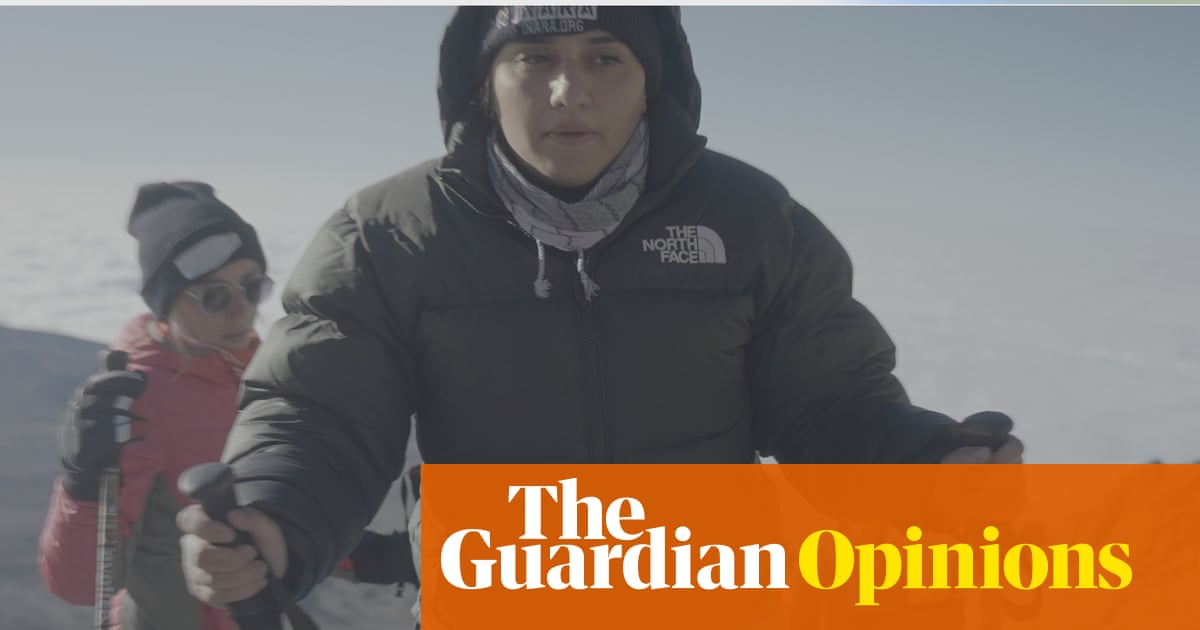
There was a screening last week of Seize the Summit, which follows four refugees as they try to reach the top of Kilimanjaro. It was organised by a recent MA graduate from Goldsmiths, with a panel afterwards, which I was set to chair.
So she and I were spitballing what the film-maker, Arwa Damon, would want to talk about, and Hanya, the graduate, said: “I think her purpose is to mainstream the idea of the refugee as a human being.” It was such a stark statement that we both started laughing.There are many categories of refugee in current affairs storytelling. There’s the desperate victim; the criminal, or criminal-waiting-to-happen; the hero, battling unimaginable odds, though this tends to be a retrospective narrative, ie second-generation members of a diaspora talking about their parents.
There are refugees en masse, shorn of any traits or qualities at all, discussed purely in terms of whether or not the host state can accommodate them, and how long they should be allowed to stay in any given place.But the refugee as a complex human, a mixture of strength and trauma, motivated variously by wanting to build a new life and return to what was theirs – this is a story I don’t feel I’ve heard much recently. Very few talk a lot about refugees as individuals, with personalities – and yet at the same time, the universalism of the experience, the fact of the status forced upon you and never chosen, is also etched away, or simply ignored.So the refugee in the mainstream imagination toggles between hero, villain or victim – except it’s not quite that simple.
People find it slightly harder to frame the child refugee as anything other than a victim – so instead, the status of “child” is endlessly contested, the tabloids popping up intermittently on a slow news day with rumours of 36-year-olds pretending to be teenagers.The male refugee, meanwhile, is being steadily erased altogether, as an idea. If you were to get your discussion points from GB News, you would think there was no such thing as a man displaced by war, or hunted down by an authoritarian regime – there are only “fighting age men”, who should be at home, fighting; or predatory men, who arrive here via Europe in order to commit crimes under the cover of their “different culture”.
A male refugee can be angry, but only as part of his antisocial, problematic persona, never legitimately. A female refugee can’t be angry at all, even if her home has been destroyed and her children have been killed.
She can only be sad.Seize the Summit follows Shaqayeq (from Afghanistan), Adnan and Safa (both from Syria) and Tania (from Ukraine). Damon said afterwards that the film wasn’t about war and displacement, it was about nature and recovery; but the thing that struck me most forcefully about it was how enragingly life-changing an injury can be.
Safa doesn’t make it to the top of Kilimanjaro: she was the victim of horrific burns injuries that have compromised her breathing. Adnan was shot by a sniper and lost the use of his body from his chest down.
He doesn’t make it to the top, either; his hero’s journey isn’t really about the mountain, it’s more about his struggle to accept help. He has spent the decade since his injury at age 14 trying to build a life in which he doesn’t need anything, and yet he won’t see any part of a mountain again unless others carry him up it, and his realisation of that is almost unbearably poignant to watch.Ronan Toal, a human rights barrister speaking on the panel afterwards, said in passing that the Somali word for claiming asylum was “surrender”.
That’s another notion that gets lost when the refugee isn’t described as fully human: how exquisitely painful it is to throw oneself on the mercy of anyone; how painful any of us would find it.If, as a refugee, you’re not allowed a personality, it must be quite hard to feel like a whole, legitimate person in the new society where you’re forced to build a life, right? Yeah, pretty hard, Hanya agreed, being from Gaza. “The one thing you’re definitely not allowed as a refugee,” she said, “is a sense of humour.”Seize the Summit doesn’t gild the experience of war – it is definitely not fun.
Yet the mountaineers spend a lot of time laughing, which is not a heroic, strength-in-the-face-of-adversity story. It’s a human being story.
Zoe Williams is a Guardian columnist The Guardian’s year in review 2026 On Tuesday 1 December, join Zoe Williams, Lucy Mangan, Jonathan Liew, Heather Stewart, Pippa Crerar, John Crace and host, multi-award-winning comedian Suzi Ruffell, for an evening of candid conversations, witty remarks and surprises as we look back on the year-defining stories of 2026. Book tickets here or at guardian.live Do you have an opinion on the issues raised in this article?
If you would like to submit a response of up to 300 words by email to be considered for publication in our letters section, please click here.