


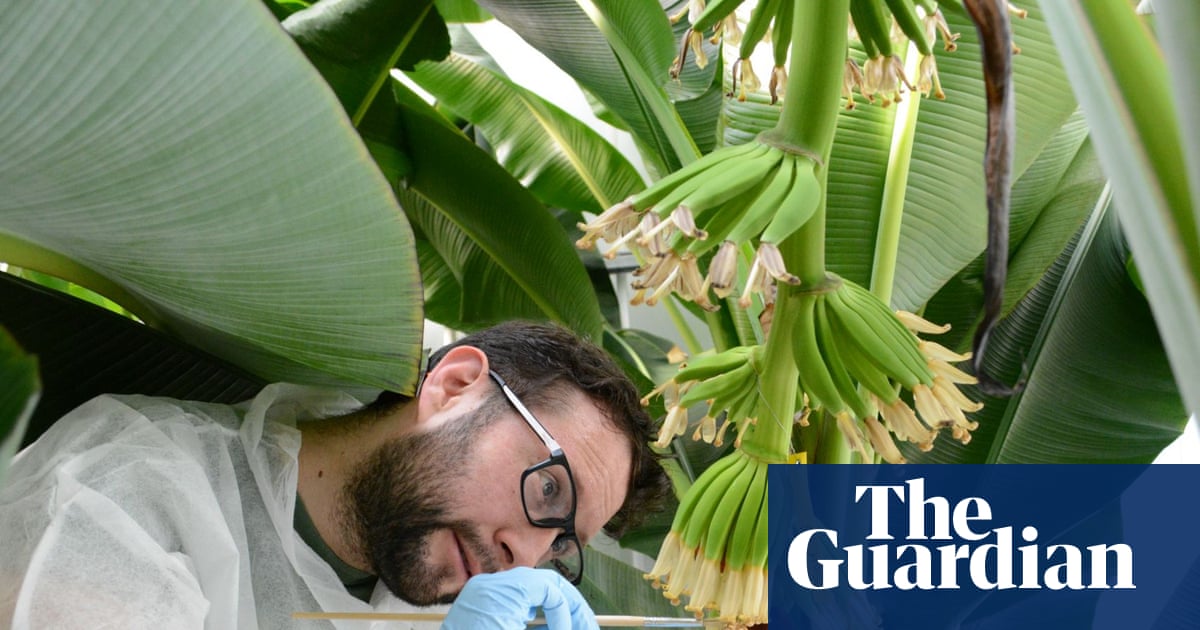
Love them or loathe them, bananas are one of the world’s most popular fruit. But a combination of the climate crisis and new killer diseases have had growers concerned over the banana’s threatened extinction, something that would impose a huge toll on farmers in countries from Guatemala to Malawi, alongside eradicating a staple food.Now researchers say they have made fresh advances in the race to save them from disaster.
This month, Yelloway – a research collaboration between Chiquita, the world’s largest banana company, and the crop-improvement company KeyGene – announced it had developed a fully fertile Cavendish banana, meaning it may be possible, through cross-breeding, to create new banana varieties that are commercially viable and resistant to disease.Second only to the tomato in terms of fruit consumption globally, the world grows about 139m tonnes of bananas a year. While there are more than 1,000 varieties, it is the Cavendish that is now found in most fruit bowls, taking over from the Gros Michel cultivar, which fell victim to Panama disease from the 1950s.A Cavendish banana plantation in the Canary Islands.
Photograph: Dominik Spalek/AlamyBut the Cavendish itself is under threat from diseases including a strain of Panama known as Tropical Race 4 (TR4). Dr Jose De Vega, an expert on crop genomics at the Earlham Institute in Norwich, said TR4 had spread from south-east Asia to Australia, Africa, the Middle East and Latin America.“The most worrying recent report came in December 2025 from Ecuador, the world’s largest banana exporter,” he said, noting that the disease threatened both global supply chains “and the food security of millions of people in the tropics for whom bananas and plantains are a staple food and a source of income”.Cavendish bananas have three sets of chromosomes, meaning they are typically sterile. “Combined with the ability to set fruit without pollination, this gives us the seedless banana,” said De Vega.Symptoms of yellowing and necrosis on a banana plant affected by Tropical Race 4, a strain of Panama disease.
Photograph: emarys/Getty ImagesThere are several different types of Cavendish, including dwarf versions, which have arisen as a result of random mutations in the Cavendish genome.But in each case new plants are grown from offshoots, so they are virtually genetically identical to the plant from which they came. While this results in uniform fruit, it also means they are vulnerable to the same diseases.Peter Stedman, Chiquita’s sustainability director, said: “We are not trying to preserve Cavendish.
We’re trying to replace Cavendish because we believe at the core of any sustainable farming system is biodiversity and genetic diversity.”Prof James Dale with young banana plants at a field trial site in Australia’s Northern Territory. Photograph: Anthony Weate/QUTOther researchers have taken different approaches.
In Australia, a team at Queensland University of Technology led by Prof James Dale has created a genetically modified Cavendish by using a bacterium to introduce a gene from a wild banana that produces resistance to TR4.The upshot, a type of Cavendish called QCAV-4, has been approved for human consumption in Australia and New Zealand, with researchers confirming that it tastes like the traditional banana.De Vega, by contrast, is collaborating with other researchers to explore gene-editing techniques. These involve using “molecular scissors” to cut parts of the Cavendish’s DNA and replace them with genes from other banana cultivars.His team have been sequencing the genomes of banana varieties that have different responses to TR4. “We are looking for the [immune genes] that resistant varieties have and that the Cavendish lacks, carries a broken version of, has too few copies of, or doesn’t switch on strongly enough,” said De Vega.“Once we identify a candidate gene, the idea is to edit the Cavendish’s own copy so it matches the copy in the resistant cousin.
That keeps everything that makes a Cavendish a Cavendish.”Yelloway is a partnership between Chiquita, the world’s largest banana company, and KeyGene, a crop improvement business. Photograph: Courtesy of ChiquitaIn Britain and elsewhere in Europe, De Vega added, gene-editing was seen as precision breeding rather than genetic modification.“That is because the change is one that could happen naturally or through conventional breeding,” he said. “The catch is that with a sterile Cavendish, conventional breeding has never really been an option, which is exactly why editing is so attractive for bananas.”But Stedman said there were drawbacks to such approaches. “Every time you are editing or improving Cavendish, you’re not creating a new variety, you’re not creating biodiversity – you’re just maintaining a monocrop,” he said, noting that brought susceptibility to disease.Yelloway’s production of a fully fertile Cavendish line – known as “Yellowdish” – using non-GM technologies potentially opens up a new route.Dale and De Vega noted that details on exactly how Yellowdish was produced, and with how many chromosomes, had not been revealed – meaning questions remained.Dale said the approach with Yelloway of crossing a fertile Cavendish with other types of fertile banana resistant to TR4 – and potentially other diseases – could have benefits, including in the regulatory environment and in public perceptions.A customs warning sign about the spread of the TR4 fungus that affects bananas and plantains at Bogotá airport in Colombia.
Photograph: Jeff Greenberg/Universal Images/GettyBut while it may result in disease-resistant progeny, he noted it could also yield a very different type of fruit.“Whatever they generate is going to be different to Cavendish,” Dale said, pointing out that crosses could produce a huge range of types but any new variety needed not only to be resistant to disease but also produce high yields and taste good.For Stedman, the challenge boils down to a numbers game. “If you have enough progeny, if you have enough children, the chances of one of them having … the traits that you want is much, much higher,” he said.