


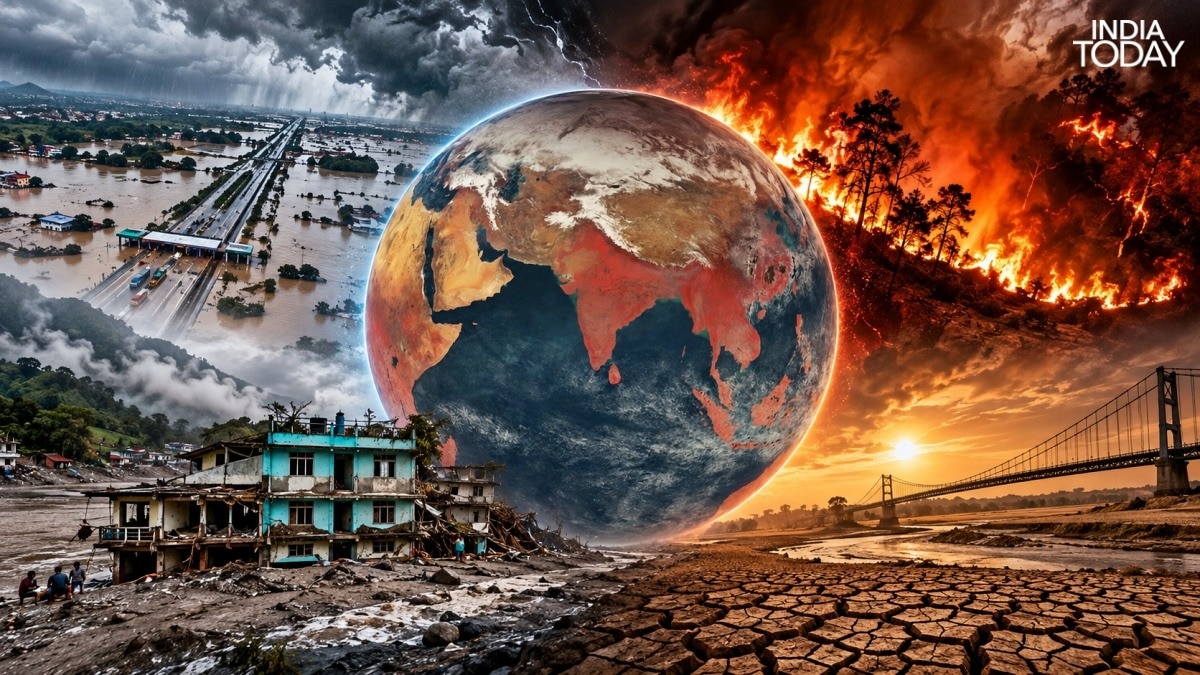
In 2015, the world gathered in Paris and sensibly agreed on a singular goal.The Paris Climate Agreement was signed with the aim of protecting humanity from the worst consequences of climate change by keeping global warming to well below 2°C, ideally 1.5°C, compared to pre-industrial emission levels. More than a decade later, that promise is slipping out of reach.The United Nations Environment Programme’s (UNEP) Emissions Gap Report 2026 has made that clear, warning that the breach of the 1.5°C threshold is now unavoidable.
The world’s best chance may be to limit how far temperatures overshoot that mark, and how long they remain above it, before bringing temperatures back down by the end of the century. Simon Stiell, UN climate chief, holds up a pamphlet that reads The Paris Agreement.
While the finding has sparked various conversations and debates and discussions, one must wonder whether the Paris Agreement has indeed failed, or is there still time to salvage the ambition it imbued in governments across the world. NOT THE END OF THE ROADUNEP’s lowest-overshoot pathway sees temperatures peaking at around 1.7-1.8°C above pre-industrial levels around mid-century, before returning to 1.5°C or below by 2100, with a 50% chance.
That's the best shot the planet has.Weaving it into a reality would require global greenhouse gas emissions to fall 18% by 2030, 45% by 2035 and 69% by 2040, compared with 2025 levels. It would also depend on substantial carbon dioxide removal later this century, whose feasibility remains uncertain.
An activist holds a sign demanding fossil fuel corporations be held accountable. Even full implementation of current national climate pledges would cut emissions by a mere 5-8% by 2030 and 11-15% by 2035.
UNEP projects warming of around 2.8°C by 2100 under current policies and 2.6°C if countries fulfil their pledges.For India, already exposed to extreme heat and floods, every fraction of a degree matters. Overshoot does not make the 1.5°C goal meaningless, but limiting the temperature peak and the time spent above the threshold can still lower the climate risks.Vaibhav Chaturvedi, senior fellow at the Council on Energy, Environment and Water (CEEW) and a contributing author of the UNEP report, said India’s climate commitments balance development needs with emissions reduction.“India is setting targets it can deliver, rather than hollow pledges,” he added.
Solar panels are seen installed on the terrace of houses. For India, the task at hand would carry a certain degree of urgency, considering the high stakes.INDIA'S CLIMATE CONUNDRUMThe world’s third-largest polluter faces the challenge of cutting emissions while meeting the energy and development needs of its population.Although India's per-capita emissions remain below the global average, the choices it makes now will help shape the world’s climate trajectory.
And considering what India has been up to since signing the Paris Agreement, it's safe to say it's well aware of the conundrum.UNEP estimates India spewed around 4.5 billion tonnes of greenhouse gases in 2025, excluding land-use emissions and removals. China emitted 16.1 billion tonnes and US 6 billion tonnes.
A woman worker carries a child on her back while working at a coal site, in Nadia, West Bengal. India’s per-capita emissions were about 3.1 tonnes of carbon dioxide equivalent, against a global average of 6.4 tonnes; China’s stood at 11.4 tonnes and the US at 17.6 tonnes.India can meet growing energy needs while avoiding some projected emissions growth through renewable energy, energy efficiency and electrification, said Ulka Kelkar, executive director for Climate, Economics & Finance at WRI India.India reduced its GDP emissions intensity by 36% between 2005 and 2020.
Non-fossil sources accounted for 52.57% of installed electricity capacity by February 2026, exceeding the earlier 50% target. Its forests and tree cover represented a carbon sink of 2.29 billion tonnes of carbon dioxide equivalent by 2021.
Union Minister for Environment, Forest and Climate Change Bhupender Yadav chairs a meeting. India’s updated commitments aim to reduce GDP emissions intensity by 47% from 2005 levels by 2035, raise non-fossil sources to around 60% of installed power capacity and create an additional carbon sink of 3.5-4 billion tonnes of carbon dioxide equivalent.The Climate Action Tracker’s September 2026 assessment projects that India could exceed some targets under current policies, with emissions intensity falling 54-60% and non-fossil sources reaching 69-70% of installed capacity by 2035.However, falling emissions intensity does not necessarily mean total emissions are declining.UNEP’s preliminary estimates show India’s emissions fell in 2025, but average annual emissions grew by 2.6% over 2016–2025, meaning one year’s decline does not establish a lasting trend.
An old Indian structure is seen with a wind turbine in the background, depicting green energy. CAN CLEAN ENERGY START REPLACING COAL?India’s renewable electricity generation rose by 98 terawatt-hours in 2025, while demand grew by 49 terawatt-hours, according to Ember’s Global Electricity Review 2026.Solar generation increased by 53 terawatt-hours and wind by 22 terawatt-hours, while coal-fired generation fell by around 44 terawatt-hours.Despite the rise in renewables, coal supplied almost 71% of India’s electricity."2025 was significant for the power sector, but not definitive proof of a sustained fall in overall emissions," Chaturvedi said. "India will need stronger transmission networks, battery and pumped-storage capacity, and a power system that can use renewable electricity when and where it is available." An aerial view of the Greenko's Pinnapuram Integrated Renewable Energy Project, in Andhra Pradesh.
Kelkar added that recycling steel and construction waste, blending fly ash into cement and designing longer-lasting products can reduce emissions from materials.These changes require investment in green steel and low-carbon cement, alongside standards and public procurement that create demand for cleaner products.Such measures can also support development through job creation, lower energy costs, improved air quality and reduced dependence on imported fossil fuels.That's where climate finance comes in, something India aims to bring into focus during the upcoming COP31 in Turkiye."Developed countries must meet climate-finance commitments and support technology transfer, skills development and collaboration with Indian businesses," said Kelkar. "Domestic investment in grids, storage, efficiency and clean technologies will also be essential."All of this brings us back to the question of what these changes would mean and whether they will make a difference to attaining a goal that seems obsolete. A sign says COP31 during the preparations of the upcoming UN climate talks in Antalya, Turkiye.
HAS PARIS AGREEMENT FAILED?The 1.5°C warning is a serious setback, but it does not automatically mean the Paris Agreement has failed.The agreement established a shared temperature goal and a framework for countries to set targets, report progress and strengthen their commitments over time. It never guaranteed that governments would automatically meet those goals.The gap between pledges and action remains substantial.
Yet limiting the peak of warming and returning to 1.5°C by 2100 remains possible in UNEP’s lowest-overshoot pathway, although this would require much deeper emissions cuts and significant carbon removal. People are seen in attendance at the UN Climate Summit 2026.
For India, a degree of fairness must also be considered.The country's relatively low per-capita emissions and development needs must be weighed alongside its growing total emissions. Developed countries must deliver emissions cuts and climate finance, while all major emitters strengthen their action.The Paris Agreement has not solved the climate crisis, no doubt, but the test now is whether countries can act at the scale and speed required.UNEP’s warning shows the world is falling short, but decisions made now will determine how far temperatures overshoot and whether the 1.5°C ambition can still be recovered.- Ends