


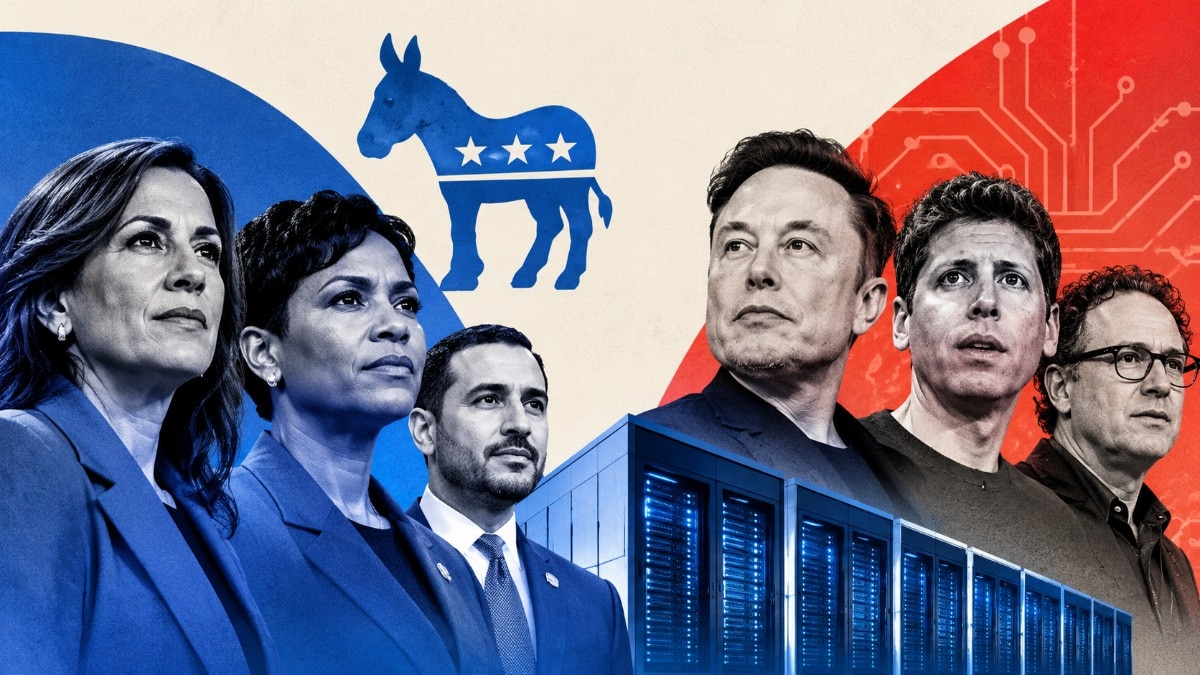
The American political scene is about to be upended in more ways than one after the Democrats recorded a thumping victory over the Republicans in the 2026 US midterm elections. One of the areas set to witness sweeping change is AI, more specifically the expansion of AI data centres across the US.
The Democrats have made their intentions clear in that, they strongly oppose big AI data centre construction on American soil arguing that they may be detrimental to local communities taking up land and other resources like water and electricity with virtually no incentive for the residents.According to the Associated Press, Democrats have won control of both chambers of Congress and flipped several Republican-held governor's offices, including in Texas, Georgia and Ohio. These are important states for the data centre industry, and their new Democratic leadership could bring fresh scrutiny to projects that have been expanding rapidly under the current leadership.
Texas alone is expected to account for around a quarter of US data centre capacity planned by 2030, while Atlanta has become the country's busiest data centre construction market, according to Reuters.Texas and Georgia could become tougher markets for data centresThe two big names to watch are Texas Governor-elect Gina Hinojosa and Georgia Governor-elect Keisha Lance Bottoms. Both Democrats made data centre expansion an important part of their campaigns, arguing that technology companies should not be allowed to put pressure on local resources without giving communities a say.Hinojosa, who defeated Republican Greg Abbott, has called for a pause on new data centre construction until lawmakers introduce stronger protections.
Speaking to CBS News' Face the Nation in October, she said there were "big water concerns" and "big electricity cost concerns" in Texas. She also argued that Texans should have a say in deciding whether these facilities come into their communities.
Bottoms, meanwhile, has called for a pause on new construction in Georgia while the state reviews the industry's impact. In an interview with WRBL, she said: "We need to take a pause on new construction and reassess where we are." She pointed to concerns around electricity bills, the environment and local water supplies.Their victories are significant because Texas and Georgia are among America's biggest data centre markets.
However, a change of governor does not automatically mean every project will be stopped. State legislatures, utility regulators and local authorities also have a say in how these facilities are approved.Elon Musk has a space solution for data centres One person who appeared less than amused by the results was Elon Musk.
The tech billionaire, who moved from California to Texas in 2020 as Tesla and SpaceX expanded their operations there, has reportedly spent an estimated $446 million backing Republican political groups during this election cycle. That made him the largest individual political donor in modern US history, according to Axios and The Washington Post.But Texas delivered a major setback for Republicans, with Hinojosa defeating Abbott.
Musk responded with a rather interesting post on X (formerly Twitter), writing: "Data centres in space looking pretty appealing right now."Given the timing and choice of words, the comment appears to be a jab at the election results and the prospect of tougher data centre rules. Though to be fair, Musk has been pitching for space data centres for a while going on to claim that he expects 100 per cent of computing to happen in space someday.
What’s known is that Musk is putting out big data centres on Earth, too, which would have to obey the local rules should they change.The data centre debate is not limited to Texas and Georgia. Michigan's Abdul El-Sayed, who defeated Republican Mike Rogers to win a US Senate seat, also made AI a major issue during his campaign.
He was also one of the major focus points of this election as he will become the first Muslim elected to the US Senate.In a 60 Minutes interview with Ross Douthat, El-Sayed said AI was increasingly the most important issue he heard about from voters. His position goes further than simply asking for stricter data centre rules.
When Douthat asked whether he would limit the frontier where AI companies are pushing forward, El-Sayed replied: "Full on pause."In the longer interview, he argued that some Chinese frontier research was "just spoofing our models", comparing the relationship to a water skier being pulled by a boat. However, he acknowledged that China could eventually "hop on a jet ski and catch up".
He also called for an international agreement to manage the risks of advanced AI.Will the AI data centre boom slow down?The US Department of Energy estimates that data centres could account for 11.8 per cent of America's total electricity consumption by 2030, up from around 4.4 per cent in 2023. That growing demand has turned electricity bills, water consumption and land use into major political issues.The power to regulate this expansion is also spread across several levels of government.
Congress can introduce nationwide rules covering electricity costs, environmental disclosures and incentives. However, state governments often have a more immediate influence on projects through utility regulators, electricity planning, water rules and state-level permits.
Local governments, meanwhile, can influence construction through zoning, land-use approvals and community restrictions.This is where the Democratic victories could matter. Texas, one of America's biggest data centre markets, elected Gina Hinojosa after she campaigned for a construction moratorium until lawmakers establish rules addressing electricity, water and property rights.
Georgia's Keisha Lance Bottoms has also called for a pause while the state reassesses the industry's impact. Texas alone accounts for roughly a quarter of US data centre capacity expected to come online by 2030.For technology companies, this creates a complicated situation.
Even if Washington does not introduce a nationwide ban, tighter state rules and local opposition could delay projects, increase costs and make access to electricity more difficult. The challenge may no longer be simply finding land and buying chips.
Companies also need to convince communities that the benefits of AI infrastructure justify the power, water and resources it consumes. While the final approval would still rest with US President Donald Trump for now, the Democrats’ relatively anti-stand on data centres—and even AI in general—means Musk and others would have to face tougher scrutiny in the days to come.- Ends