


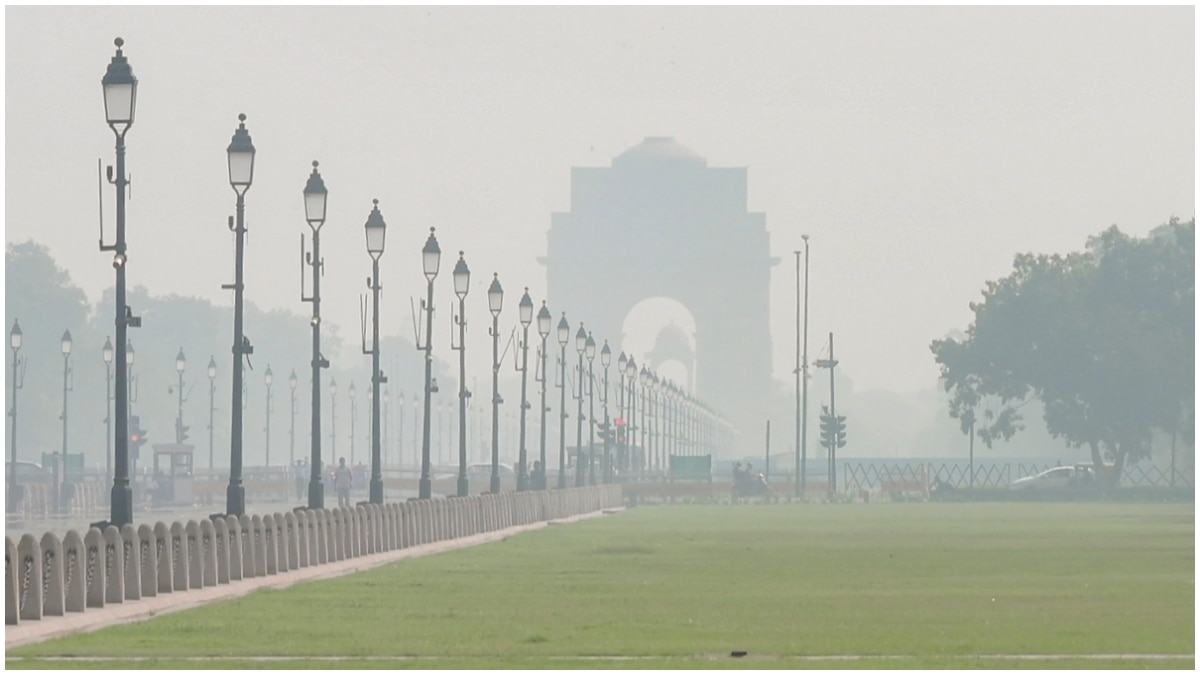
Delhi recorded an AQI of 191 on October 24, its lowest for the date in a decade outside Covid years. The moderate reading highlights gains from enforcement, cleaning, monitoring and public cooperation.A layer of smog engulfs the India Gate on a cold morning, in New Delhi, Wednesday, Oct.
21, 2026. Delhi recorded an Air Quality Index (AQI) of 191 on Saturday, its lowest reading for October 24 in a decade, excluding the Covid period, the city government said, according to news agency Press Trust of India.The government attributed the improvement to sustained pollution-control measures, including enforcement, monitoring, road cleaning, waste removal and public participation.
An AQI of 191 falls in the 'moderate' category.A statement issued by the Environment Department said the AQI was 306 on October 24, 2024, and 275 on the same date in 2025, before falling to 191 this year.Environment Minister Manjinder Singh Sirsa said the improvement reflected the government's efforts to tackle pollution through enforcement, monitoring and public participation. Nearly 9,883 vehicle challans were issued in the previous 24 hours as part of the anti-pollution drive, the government said.
During the same period, machines swept 2,810 km of roads, while water was sprinkled across 1,075 km to control dust.Authorities also removed 12,702 metric tonnes of waste and 2,223 metric tonnes of construction and demolition waste. They inspected 160 construction and demolition sites or plots and collected 168 metric tonnes of road dust, the statement said.
Sirsa said the government would continue its anti-pollution campaign in "war mode", with strict enforcement, continuous monitoring and public participation, PTI reported.He said government departments and district administrations had been directed to identify pollution hotspots and act against sources such as road dust, traffic congestion, unauthorised construction and waste burning.The government is also using its Integrated Command and Control Centre, which has artificial intelligence-based systems, CCTV surveillance and air-quality monitoring, to track pollution sources and review the implementation of control measures, the statement said.District magistrates and officials from the departments concerned are holding regular reviews to assess pollution-control measures and ensure timely action, it added.Sirsa appealed to residents not to burn waste, to manage it responsibly and to follow pollution-control rules. He said sustained public cooperation was essential to maintain the improvement in air quality.The government said it would continue field inspections, technology-based monitoring and enforcement to tackle pollution sources and further improve air quality in the national capital.- Ends