


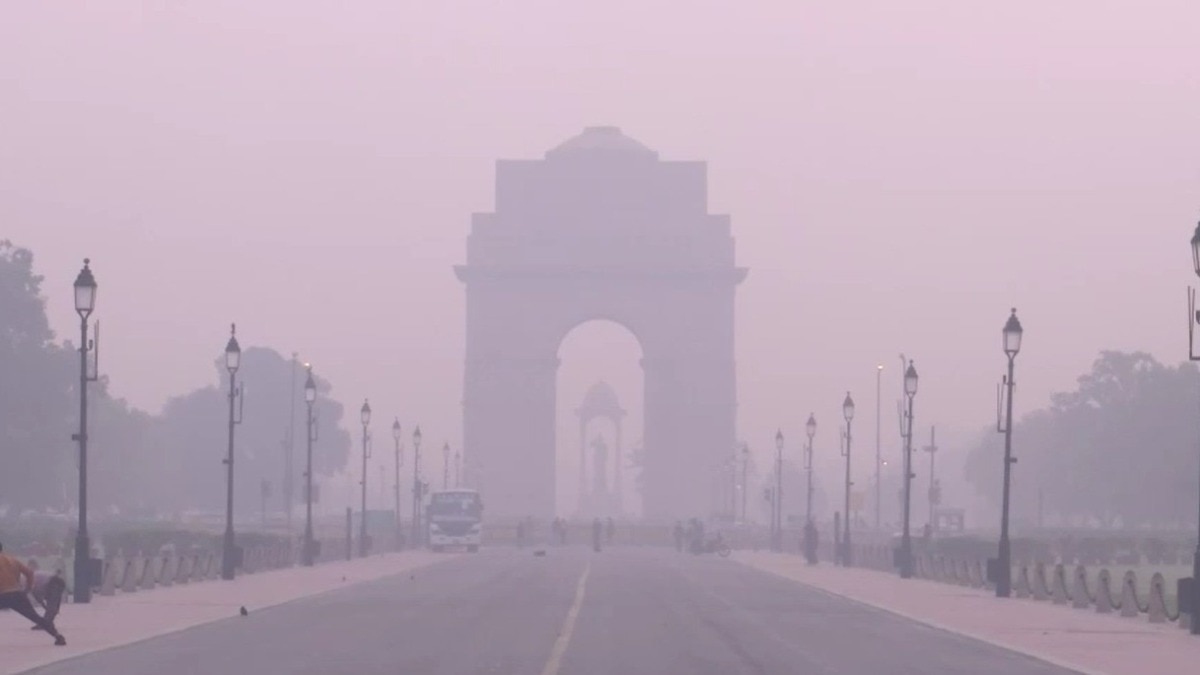
A thick layer of smog enveloped the national capital on Sunday morning as Delhi continued to grapple with high pollution levels, with the overall Air Quality Index (AQI) standing at 351 at 8 am. The reading was marginally higher than Saturday's AQI of 348, indicating a slight deterioration in air quality over the past 24 hours.
The air quality remained in the 'very poor' category. PM2.5 remained the prominent pollutant, raising concerns over the health risks associated with prolonged exposure to polluted air.The pollution situation remained particularly concerning in several parts of Delhi, where monitoring stations recorded AQI readings in the severe category.
IIT Delhi recorded the highest AQI at 425, followed by ITO at 415 and Narela at 414.NSIT Dwarka registered an AQI of 409, while Jaffarpur recorded 407. The Commonwealth Sports Complex reported 403, while Pusa and North Campus of Delhi University both recorded 402.
In all, eight monitoring stations reported AQI levels above 400, placing them in the severe category.Among other locations, Burari Crossing recorded an AQI of 400, followed by Mathura Road at 393, Punjabi Bagh at 386, Chandni Chowk at 385 and JNU at 383. Vasundhara Enclave registered 380, while Mundka recorded 379.
Chhawla and Sirifort reported readings of 369 and 368, respectively. Anand Vihar recorded an AQI of 364, followed by Aya Nagar at 362, Rohini at 360, Dilshad Garden at 357 and Burari at 354.
Tikri Kalan registered 344, while R K Puram recorded 339. Uttam Nagar reported an AQI of 330, followed by Dwarka Sector 8 at 328, Maidan Garhi at 325, Mandir Marg at 324 and Nangloi at 323.HOW IS AIR QUALITY IN DELHI-NCR?Air quality across neighbouring cities in the National Capital Region (NCR) also remained poor on Sunday morning.
Gurugram recorded the highest AQI among the neighbouring cities at 324, followed by Noida at 313 and Faridabad at 311. All three cities were in the 'very poor' category.
Ghaziabad recorded an AQI of 294, while Greater Noida reported 283, placing both cities in the 'poor' category.WHY IS PM2.5 A CONCERN?PM2.5 refers to fine particulate matter with a diameter of 2.5 micrometres or fewer. These tiny particles can travel deep into the lungs and even enter the bloodstream, making them particularly harmful to human health.They are emitted by several sources, including vehicle exhaust, industrial activities, construction dust and the burning of fuels.
Exposure to high concentrations of PM2.5 can aggravate asthma and other respiratory conditions, affect lung function and increase the risk of cardiovascular diseases.According to the Central Pollution Control Board's (CPCB) air quality classification, an AQI between 301 and 400 falls in the 'very poor' category, while readings between 401 and 500 are classified as 'severe'. Prolonged exposure to very poor air quality can cause respiratory illness, while severe pollution can affect even healthy people.- Ends