


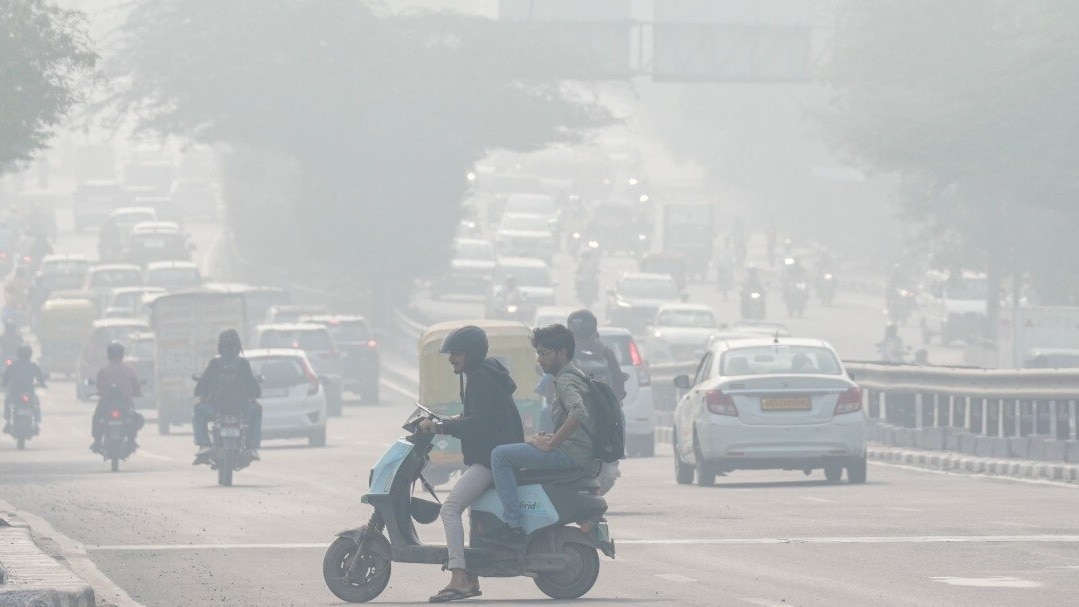
Delhi's air quality improved further on Sunday, with the Air Quality Index (AQI) falling by 26 points from the previous day to 239 in the 'poor' category, news agency PTI reported. Favourable weather conditions helped disperse pollutants across the national capital.
The city's AQI has improved gradually over four days, declining from 280 on November 19 to 270 on November 20, 265 on Saturday and 239 on Sunday.Of the 56 air quality monitoring stations that recorded data on Sunday, 36 reported 'poor' air quality, eight recorded 'very poor' air quality and 12 were in the 'moderate' category. Uttam Nagar recorded the worst air quality, with an AQI of 332, followed by IGNOU Maidan Garhi at 330.Vehicles were the biggest contributor to Delhi's PM2.5 concentration on Sunday, accounting for 38.6 per cent of the estimated pollution load, up from 33.1 per cent on Saturday, according to real-time estimates from the Air Quality Early Warning System cited by PTI.Biomass burning, including stubble burning and the use of wood and dung cakes as domestic fuel, contributed 24.2 per cent.
Waste burning, including municipal waste, plastic, rubber and electronic waste, accounted for 14.9 per cent. Secondary organic aerosols accounted for 8.9 per cent of the pollution load and secondary inorganic aerosols for 8 per cent.
Road dust, soil and mineral particles contributed 2.2 per cent, mixed combustion 1.6 per cent, industrial sources 1.5 per cent and coal combustion 0.2 per cent.According to the Central Pollution Control Board, an AQI between zero and 50 is considered 'good', 51 and 100 'satisfactory', 101 and 200 'moderate', 201 and 300 'poor', 301 and 400 'very poor', and 401 and 500 'severe'. Northwesterly winds reached speeds of up to 15 kmph on Sunday, helping pollutants disperse instead of accumulating near the surface.
The maximum mixing depth over Delhi was predicted to be around 1,500 metres. Mixing depth is the height up to which pollutants can mix in the atmosphere, and a greater depth generally helps their dispersal.The Air Quality Early Warning System has forecast that Delhi's air quality is likely to remain in the 'poor' category from Monday to Wednesday.
Over the following six days, it is expected to remain between the 'poor' and 'very poor' categories.The maximum mixing depth is predicted to decline from around 1,500 metres on Sunday to 1,200 metres on Monday and 1,000 metres on Tuesday, before rising to 1,100 metres on Wednesday.The ventilation index, which reflects the atmosphere's ability to disperse pollutants, was forecast at 6,000 square metres per second on Sunday. It is expected to rise to 6,500 square metres per second on Monday before falling to 3,500 on Tuesday and 3,200 on Wednesday.A ventilation index below 6,000 square metres per second, along with an average wind speed of less than 10 kmph, is considered unfavourable for the dispersal of pollutants, the Air Quality Early Warning System said.
Northwesterly winds could reach speeds of up to 20 kmph on Monday and help disperse pollutants, while lower ventilation levels on Tuesday and Wednesday could restrict their movement.At the Safdarjung weather station, the maximum temperature was 27.6 degrees Celsius, 0.9 degrees above the seasonal normal. Palam recorded 24.5 degrees Celsius, 2 degrees below normal, while Lodhi Road recorded 27.2 degrees Celsius, 1.2 degrees above normal.
The Ridge recorded 26.5 degrees Celsius, 0.2 degrees below normal, and Ayanagar recorded 26.2 degrees Celsius, 0.7 degrees below normal.The minimum temperature at Safdarjung was 11.8 degrees Celsius, 0.5 degrees above normal. Palam recorded 12.9 degrees Celsius, 1 degree above normal, while Lodhi Road recorded 12.8 degrees Celsius, 2.8 degrees above normal.
The Ridge recorded 13.5 degrees Celsius, equal to the seasonal normal, and Ayanagar registered 12.3 degrees Celsius, 0.7 degrees below normal.- Ends