


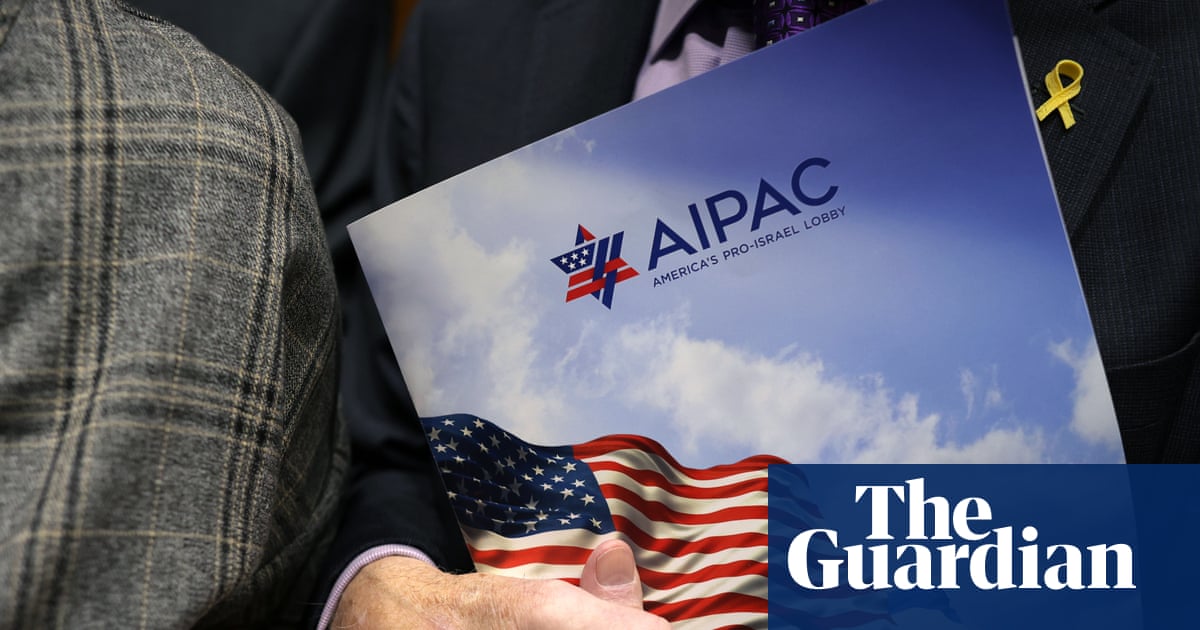
When the American Israel Public Affairs Committee, the most prominent pro-Israel lobby group in the US, announced on Wednesday that it would stop endorsing candidates or make direct contributions to them, its many critics were quick to hail the development as Aipac’s admission of how toxic its brand had become.The announcement marked a significant reversal that underscored just how profoundly US public opinion of Israel has shifted over the latest war in Gaza, and how political candidates’ once reflexive support for Israel has increasingly become a liability.But Aipac, which only launched its political action committee and started endorsing candidates three cycles ago, is hardly getting out of US elections. It pledged to maintain the work of its deep-pocketed super pac, United Democracy Project, and to continue to funnel millions of dollars to prop up pro-Israel candidates through individual donors and Aipac members.
The shift in strategy was a sign it was adapting to a changing political landscape, not that it was giving up its efforts to shape it.“Historically, AIPAC sustained an aura of invincibility that ensured it won most battles by walkover – if you are perceived as invincible, the other side doesn’t even bother to fight you,” the political analyst Trita Parsi wrote. “Rather than invincibility, AIPAC’s name now carries such toxicity that the group doesn’t want its own name on its political donations.”Aipac did not respond to a request for comment. On Wednesday, the New York Times reported that Aipac, which normally backs Democrats, was planning to give as much as $9m to a Pac supporting Republican Senate candidate Mike Rogers over Abdul El-Sayed in Michigan.
The group had already spent $32m seeking to defeat El-Sayed, an outspoken critic of Israel, in the primaries.But the announcement that it would stop directly backing candidates going forward was seen as tacit recognition that Aipac’s open support risked hurting pro-Israel candidates more than it helped them.“Through this shift, AIPAC openly admitted that their brand has become toxic in the political world,” Beth Miller, political director of Jewish Voice for Peace Action, one of Aipac’s most vocal critics, told the Guardian. “Fewer and fewer candidates are willing to be publicly affiliated with this extremist, warmongering group. This is a clear signal: being pro-genocide is bad politics and bad policy.”In a letter from Aipac to members first reported on by Jewish Insider, the group’s leadership seemed to acknowledge that its once formidable power in US elections had suffered as more candidates openly distanced themselves from Israel, and from the group itself.
In the letter, they noted that the 2026 election was “one of the most challenging environments in recent memory” for the group and predicted that the “challenges we are confronting will continue to grow in the years ahead.”“To win the fight for the future of the country and the U.S.-Israel alliance, we must build a more strategic, consequential, and nimble political operation,” they wrote. “The only tactic we’re married to is the most effective one.”While Aipac boasted that it helped 290 candidates this election cycle, leading to the defeat of 29 candidates it described as “anti-Israel”, the group has also suffered major blows – including in Michigan and New Jersey. More than a dozen candidates who took Aipac contributions in the past have since publicly distanced themselves from the group, and New York’s rep Pat Ryan announced last week that he would return nearly $250,000 from the group, the latest of several elected officials to return Aipac funds or say they would turn it down.Dion Nissenbaum, a journalist whose documentary on Aipac was published this week, featuring interviews with former Aipac insiders, told the Guardian that the announcement appeared to be the “first real admission from Aipac that their campaign strategy has backfired”.Still, he warned, “if Aipac’s super PAC – the main source of its campaign donations – is going to keep operating, it may be an attempt to reinvent itself without ceding the battlefield.”Tuesday’s announcement would change little in practice, those who have monitored Aipac’s political funding say.
An Aipac spokesperson told Jewish Insider that Aipac members had contributed over $90m to candidates this election cycle – far more than the $3m in donations the group contributed directly through its Pac.“This is not new,” Hady Amr, a former secretary for Israeli and Palestinian affairs with the US state department, noted. “This is Aipac going back to their tried and true approach.”Groups like TrackAipac and initiatives like the Reject Aipac campaign, that have in recent years played a growing role in calling out candidates over their ties to the group, are already attuned to the varied avenues through which the pro-Israel lobby funnelled contribution to candidates, some more visible than others.“[Aipac] has already been experimenting with ways to make their support more untraceable,” said Hamid Bendaas of the Institute for Middle East Understanding Policy Project, one of the groups behind the Reject Aipac campaign. By dropping endorsements and direct contributions, Aipac was giving up one tool available to lobby organizations to signal to politically-aligned donors who may not be active members which candidates to back.
Aipac had calculated that approach was more risky than worth it, he added, but it had plenty of other tools available.“It’s akin to an animal that chews its leg off to get out of a bear trap. It’s a last resort choice to survive and stay relevant, which they will on both counts,” Bendaas added. “Aipac is going to continue influencing elections.
If you’re someone who wants Aipac out of politics entirely, this is not that.“We know they’re going to continue driving tens of millions of dollars into our elections to support Israel’s atrocities,” echoed Miller, of JVP. “And we will continue to fight to fully get them, and their dirty money, out of our politics and out of Congress.”